
Listen to the summary
Key Data Snapshot
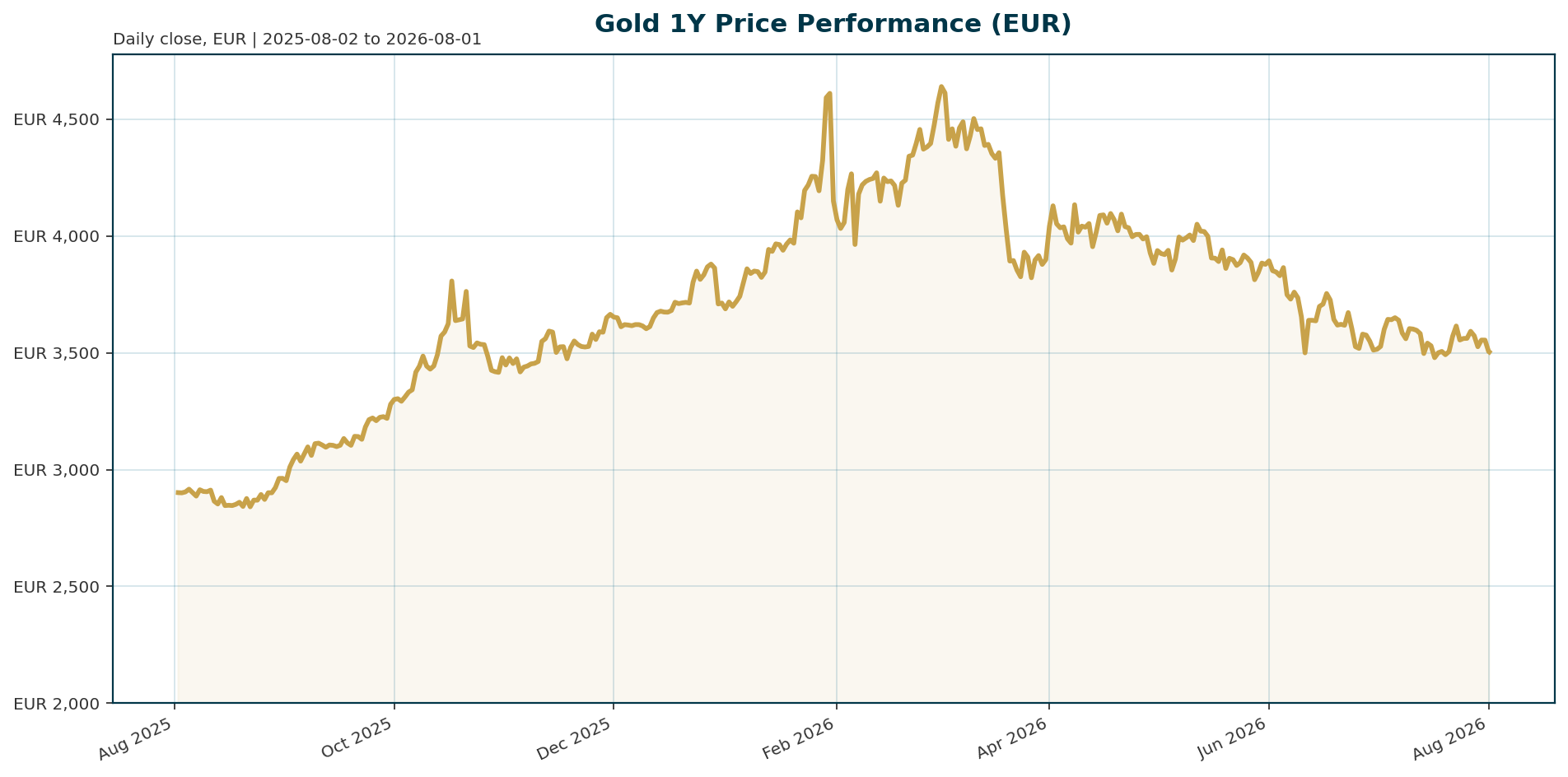
| Asset | XAU/EUR |
|---|---|
| Current Price | 3,503.26 EUR |
| Year to Date | +22.6% |
| 200-Day Change | -11.8% |
| ATH (Jan 2026) | 4,688.32 EUR (-25.3% drawdown) |
| 24h Volume | 79.58M EUR |
| BTC Dominance | 56.2% |
Macro Backdrop
Risk sentiment is neutral to positive, with equity momentum mixed across global benchmarks. The Euro area 10Y yield is 3.20%, while EUR/USD trades at 1.1497. Notably, the Hang Seng leads on a 5-day basis at 2.69%, whereas the Nikkei 225 lags at -0.88%. This mixed performance suggests investors are navigating a complex transition period where inflation dynamics and central bank policy remain the dominant variables.Investment Thesis
The investment thesis for gold centers on the decoupling of the precious metal from traditional risk assets, driven primarily by real interest rate dynamics rather than simple inflation fears. While the market recently experienced its worst quarter in 13 years due to interest rate fears, the fundamental argument remains intact: gold serves as a critical hedge against a potential stagflationary regime where central banks struggle to balance growth and price stability [T4]. The current price action reflects a bifurcated market, where cyclical pressure from real yields competes with defensive demand from sovereign entities seeking currency diversification.Bullish Drivers
- Structural Central Bank Demand: The World Gold Council survey reveals a robust consensus among reserve managers, with nearly 90% of respondents expecting to increase gold reserves over the next year [T3]. Central banks have accumulated an average of 1,000 tonnes of gold over the past four years, a pace significantly higher than the 500-tonne average of the preceding decade [T8]. This sustained institutional buying provides a structural floor for prices.
- Stagflationary Risks: A backdrop of slower growth alongside persistent inflation remains supportive for gold over the longer term [T2]. As central banks face a difficult balancing act between controlling inflation and supporting growth, interest rates often fail to keep pace with actual inflation, creating an environment where gold historically thrives [T5].
- Real Yield Compression: Markets are pricing in two 25bp rate cuts from the Federal Reserve in September and December [T2]. If inflation moderates as expected, real yields are likely to soften, reducing the opportunity cost of holding non-yielding bullion [T7].
Relative Positioning vs Bitcoin and Ethereum
Gold maintains a critical diversification role within the broader digital and traditional asset complex. With Bitcoin dominance at 56.2%, gold remains a vital store of value outside the crypto ecosystem [T3]. Despite a recent 25% drawdown from its January 2026 all-time high, gold is currently outperforming its own 200-day performance relative to the broader equity rally, which has been driven by the Hang Seng and Euro Stoxx 50. This suggests gold is acting as a counter-cyclical asset, potentially decoupling from crypto in risk-off environments where real yield sensitivity becomes the primary driver.Scenario Framework
- Base Case (Fed Easing): Inflation moderates sufficiently to allow the Federal Reserve to implement the expected two 25bp cuts in September and December. Real yields decline, supporting gold prices as the opportunity cost of holding bullion falls.
- Bear Case (Sticky Inflation): Inflation data, such as PCE, surprises to the upside, forcing the Fed to delay easing. Real yields spike, creating significant headwinds for gold and potentially triggering profit-taking given the metal is up roughly 6% year-to-date [T2].
- Bull Case (Debt Crisis): Global debt concerns mount, and geopolitical risks intensify. Investors flee to safety, leading to a surge in gold demand as a hedge against currency debasement and systemic financial instability.
Valuation Discussion
At 3,503.26 EUR, gold is approximately 25.3% below its January 2026 all-time high of 4,688.32 EUR. This drawdown offers a potential entry point if real yields continue their downward trajectory. However, valuation is currently driven by yield differentials; gold is priced as a high-beta asset to real yields rather than a static store of value. The market is currently pricing in a specific path for monetary policy, and any deviation from the expected easing cycle could lead to rapid repricing.Risks
- Real Yield Shock: The primary risk is a resurgence in inflation that pushes real yields higher. If inflation expectations rise faster than nominal yields, gold becomes comparatively less attractive [T1].
- Profit Taking: Despite a strong year-to-date performance, gold is vulnerable to bouts of profit-taking. The recent “worst quarter in 13 years” highlights the sensitivity of the market to interest rate expectations [T4].
- Geopolitical Limitations: Geopolitical tensions alone are insufficient to lift gold prices. Without a corresponding impact on inflation or monetary policy, heightened geopolitical risk may not translate into sustained price appreciation [T2].
Appendix
Sources
- T1: Gold approaches macro inflection as PCE data tests Fed outlook
- T2: Geopolitics alone isn’t enough to lift gold | ING THINK
- T3: Both Gold and Silver Lose Key Support Levels! Has Last Year’s Get-Rich-Quick Myth Finally Ended?
- T4: Gold losses ease after worst quarter in 13 years as interest rate fears hit bullion
- T5: 7 Reasons Gold and Silver Will Surge From Current Levels
- T6: Gold, Inflation and Interest Rates: How Do They Interact?
- T7: Fed Interest Rates & Gold Outlook: Key Drivers
- T8: Central banks to increase gold reserves over next 12 months: WGC survey – The Hindu
Disclaimer: This report is AI-generated for informational purposes only and does not constitute investment advice. The analysis is based on data available as of the current date and should not be relied upon as financial guidance. Users should conduct their own due diligence before making investment decisions.
Important Note / Wichtiger Hinweis:
EN: This report may have been generated using AI. It processes data from publicly available sources. The content is provided for informational purposes only.DE: Dieser Bericht kann mithilfe von KI erstellt worden sein. Dabei werden Daten aus öffentlich zugänglichen Quellen verarbeitet. Die Inhalte dienen ausschließlich Informationszwecken.
* DE: Die ergänzenden Inhalte können KI-generiert sein. EN: The additional content may be AI-generated.