
Watch the video
This player shows only the Gold chapter of the daily altii market briefing. Watch the full video on tube.altii.de.
Key Data Snapshot
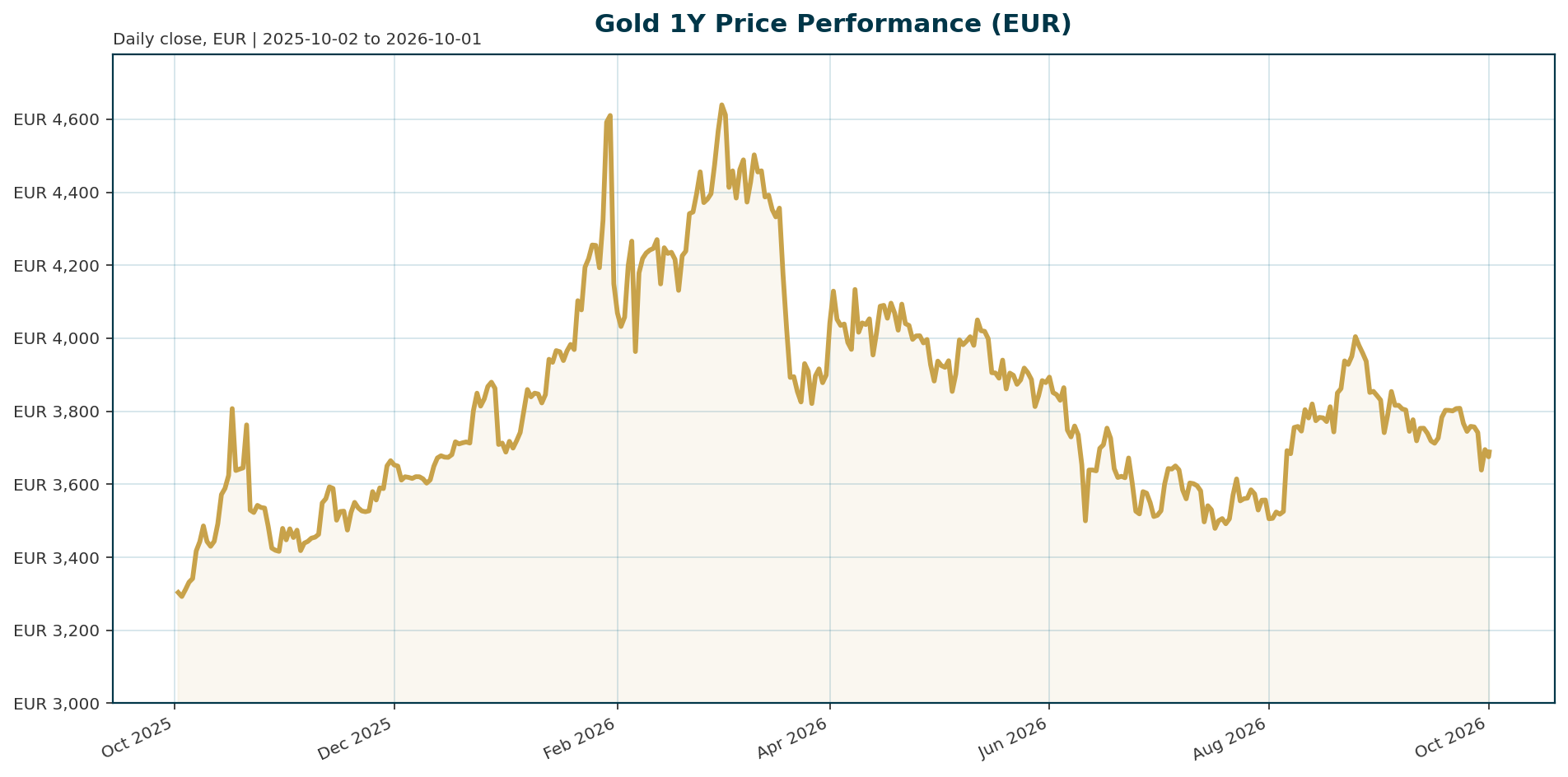
Gold (XAU, measured via the PAXG tokenized proxy) trades at EUR 3,689.81 per ounce as of 2026-10-01, down 0.10% over 24 hours and 5.90% over 30 days. The metal sits 21.30% below its all-time high of EUR 4,688.32 set on 2026-01-28, while still up 7.96% year-on-year. Calculated distance from ATH: (3,689.81 − 4,688.32) / 4,688.32 = −21.30%.
| Metric | Value | Note |
|---|---|---|
| Price (XAU/EUR) | EUR 3,689.81 | PAXG proxy, retrieved 04:23 UTC |
| 24h range | 3,664.57 to 3,727.51 | Change 24h: −0.10%, 1h: +0.35% |
| 7d / 14d / 30d | −2.51% / −2.29% / −5.90% | Multi-week correction, not a single shock |
| 200d / 1y | −16.77% / +7.96% | Mid-cycle correction within structural uptrend |
| ATH / ATL | 4,688.32 (2026-01-28) / 1,265.28 (2019-11-17) | −21.30% from ATH, +191.62% from ATL |
| Euro AAA 10Y yield | 3.61% | +32.9bp over 1m, as of 2026-09-29 |
| 10Y-2Y spread | 39.7bp | 3.6077% − 3.2106%; front-end-led steepening (2Y +40.5bp 1m vs 30Y +10.2bp) |
| EUR/USD | 1.1352 | −2.13% over 1m; firmer dollar is a gold headwind |
| Central bank purchases | >1,000t per year for three years | Structural pillar of demand [T3] |
Macro Backdrop
Cross-asset context: Risk sentiment is neutral with mixed equity momentum. The Nikkei 225 leads on five days at +3.27% while the Euro Stoxx 50 lags at −0.95%; DACH indicators average −0.32% over five days versus +0.43% globally, broadly in line. The rates backdrop shows euro yields mixed with curve steepening: the Euro Area AAA 10Y yield stands at 3.61%, up 8.4bp over five days and 32.9bp over one month, with a 39.7bp 10Y-2Y spread. FX is mixed, with EUR/USD at 1.1352 (−0.42% over five days, −2.13% over one month) and EUR/CHF the strongest mover at +0.24%. This context is relevant to gold but subordinate to the metal-specific analysis below.
The policy picture is the decisive variable. Energy prices have complicated the inflation outlook, raising the risk that inflation stays elevated and delaying monetary easing. A higher-for-longer rate environment keeps real yields elevated, which is a headwind for a non-yielding asset [T1][T8]. The Federal Reserve has held rates unchanged, with Chair Powell requiring clearer inflation progress before easing, though some economists still expect two 25bp cuts this year [T1]. Lombard Odier expects the Fed to stay on hold for much of 2026 with cuts more likely toward year-end, and views the current headwinds of higher yields and a stronger dollar as short-term rather than structural [T6].
Investment Thesis
The core thesis is that gold has migrated from a pure macro trade keyed to real yields toward a cornerstone reserve asset. The cyclical drivers, meaning rates, the dollar and positioning, currently pressure the price. The structural drivers, meaning elevated public debt, reserve diversification and monetary credibility concerns, remain intact.
Three facts anchor the structural leg. First, central banks have bought more than 1,000 tonnes annually for three years, and 95% of surveyed central banks expect to increase holdings; 44% now actively manage gold reserves, the highest share since the survey began in 2018 [T3]. A record 43% of 73 monetary authorities expect their own reserves to rise over the next year, with sanctions risk driving diversification away from dollars [T5]. Second, advanced-economy debt-to-GDP sits at or near post-war highs, and history suggests such burdens are often resolved through financial repression, inflation or currency depreciation, all of which favor gold [T4]. Third, the historical inverse link between gold and real yields has broken down at times: US 10Y real yields rose from roughly −1.2% to +2.5% between 2022 and 2023, yet gold posted a +13% return in 2023 [T2][T5]. Once sovereign reserves could be frozen, central banks began pricing jurisdiction, custody and political control alongside inflation and real yields [T7].
On this reading, the current 21.3% drawdown from the January peak is best characterized as a cyclical correction within a structural uptrend, attracting official-sector and long-term buyers on dips [T1]. The balance of evidence supports a constructive but not aggressive stance: the structural bid provides a floor, while elevated real yields cap near-term upside.
Bullish Drivers
- Central bank accumulation: Over 1,000 tonnes per year for three consecutive years, versus a materially lower baseline in the prior decade. 95% of central banks expect to increase holdings and 43% plan to strengthen domestic reserves [T3].
- Debt and financial repression: With public debt near post-war highs in advanced economies, the historical resolution paths of repression, inflation and currency depreciation all support gold over the medium term [T4].
- Stagflation risk: A mix of slower growth and persistent inflation, which elevated energy prices make more plausible, would remain supportive for gold over the longer term [T1].
- Monetary credibility: Gold has recently correlated with fears around Federal Reserve independence, and fiscal uncertainty plus eroding purchasing power reinforce private investor demand [T6].
- Jurisdiction hedging: Reserve freeze risk has pushed central banks to price custody and political control, a demand source with no real-yield equivalent [T7].
- Dip-buying support: Deeper pullbacks would likely attract buyers from central banks and longer-term investors, cushioning corrections [T1].
Relative Positioning vs Bitcoin and Ethereum
Bitcoin dominance stands at 58.29% of a total crypto market cap of USD 2,543.4bn, with 24h crypto volume of USD 89.17bn. The PAXG tokenized gold proxy ranks 58 by market cap at EUR 1,605.3m with EUR 116.7m in 24h volume. Over seven days gold fell 2.51% in euro terms while the Nikkei gained 3.27% over five days and the Nasdaq rose 1.86% over one month, reflecting gold’s defensive rather than high-beta profile.
The structural distinction is counterparty risk. Gold carries zero counterparty and zero custody-chain risk in physical form, whereas crypto exposure embeds exchange, custody and smart-contract risk. This is precisely the property central banks now price when hedging against reserve freezes and sanctions [T7]. No equivalent of the official-sector bid exists for Bitcoin or Ethereum [T3][T4]. In a neutral risk regime, gold competes with crypto for diversification flows and wins on institutional legitimacy; crypto wins on asymmetric upside. If sentiment turns risk-off, gold’s official-sector support should make it more resilient than crypto benchmarks. In a renewed risk-on regime, capital rotation toward higher-beta assets would add cyclical pressure to gold [T2].
Scenario Framework
Base case (scenario): Policy rates stay on hold with delayed cuts [T1][T6]. Real yields remain elevated but stop rising, central bank buying persists above 1,000t annually, and dollar strength fades. XAU/EUR ranges with a mild upward drift; the current correction proves cyclical, with support near the 3,664 EUR 24h low zone on dips. Triggers: Fed holding pattern, stable energy prices, continued official purchases.
Bull case (scenario): Energy-driven inflation persistence forces earlier or accelerated easing, or fiscal and monetary credibility concerns push real yields lower. Reserve-policy announcements from Asia and the Middle East reinforce the structural bid [T4]. A stagflationary mix would make gold the primary macro hedge [T1]. XAU/EUR challenges the EUR 4,688 ATH. Triggers: rate cut acceleration, sustained negative real rates, disclosed reserve accumulation.
Bear case (scenario): Growth stabilizes, energy prices recede, real yields rise further and the dollar strengthens [T2][T6]. ETF outflows persist, jewellery demand weakens, and rising reserve values moderate official buying [T2][T6]. A broad risk-on environment reduces hedging demand, and US-China de-escalation unwinds part of the embedded risk premium [T2]. XAU/EUR extends the drawdown well beyond the current 21.3%. Triggers: renewed real-yield surge, ETF outflow streak, weaker physical demand.
Valuation Discussion
Gold has no cash-flow anchor, so valuation rests on opportunity cost, FX decomposition and flow dynamics. The opportunity cost for a EUR-based holder is approximated by the Euro Area AAA 10Y yield of 3.61%; illustratively, the annual carry forgone is 3,689.81 × 3.61% ≈ EUR 133 per ounce per year. The bundle contains no explicit euro-area inflation expectation series, so real yields cannot be computed precisely; the +32.9bp one-month rise in nominal 10Y yields nonetheless signals a rising hurdle [T5][T8].
FX decomposition matters for the EUR quote: XAU/EUR moves combine the USD gold price with EUR/USD. With EUR/USD down 2.13% over one month, part of the 5.90% XAU/EUR decline over 30 days is FX-cushioned; by inference, USD-denominated gold likely fell more than the euro figure implies over that window. ING notes gold up roughly 6% year-to-date in USD terms, leaving the market vulnerable to profit-taking, with deeper pullbacks attracting central bank and long-term buyers [T1]. This USD YTD figure should not be read as the EUR-denominated YTD return, which is not available in the bundle.
The asymmetry frames the valuation call: a 21.3% drawdown from ATH against a +7.96% one-year return and an intact structural bid favors accumulation over chasing, contingent on real yields not making new highs [T6]. If euro real yields keep climbing, the fair-value hurdle rises and further de-rating is plausible. Notably, gold has already demonstrated the ability to rally through sharply rising real yields, as in 2023’s +13% return [T2][T5], so the real-yield signal alone should not dominate the positioning decision.
Risks
- Higher-for-longer real yields: The primary identified risk. Elevated energy prices complicate the easing path and keep the opportunity cost of holding gold high [T1][T6].
- Stronger dollar: A firmer USD is a documented headwind and partially explains the recent softness [T1][T6].
- ETF and physical demand: A prolonged decline in ETF demand or weaker jewellery demand would remove private-sector support, even if partly offset by central bank buying [T6].
- Moderation of official buying: As prices rise, the value of existing reserves increases, which could eventually slow the pace of purchases, raising a demand-sustainability question [T2].
- De-escalation and risk-on: Meaningful geopolitical de-escalation, particularly between the US and China, or a broad risk-on environment would reduce the embedded risk premium and hedging demand [T2].
- Data caveats: The price source is the PAXG token rather than LBMA spot; market cap and volume reflect the token, a small fraction of the physical gold market. USD gold performance is inferred rather than directly observed. Some cited commentary predates the current correction and should be dated accordingly.
On balance, even in the bear path, central bank dip-buying historically limits drawdown depth relative to pure risk assets [T1].
Appendix
Methodology notes: XAU/EUR pricing uses the PAXG tokenized gold proxy (coingecko_id pax-gold), so market cap (EUR 1,605.3m, rank 58), 24h volume (EUR 116.7m) and circulating supply (435,070.59 tokens) describe the token, not the global gold market. Sanity check: 435,070.59 × 3,689.81 ≈ EUR 1,605.3m, matching the reported market cap. Euro-rate data uses the ECB AAA yield curve; FX data uses Frankfurter. Market data retrieved 2026-10-01T04:23:14Z; yields as of 2026-09-29; equities as of 2026-09-30 or 2026-10-01 depending on source. Bundle generated 2026-10-01T04:23:26Z.
Additional reference data: Euro AAA yields: 2Y 3.21% (+40.5bp 1m), 5Y 3.35% (+40.7bp 1m), 10Y 3.61% (+32.9bp 1m), 30Y 3.83% (+10.2bp 1m). FX: EUR/USD 1.1352 (YTD −3.39%), EUR/CHF 0.94632, EUR/JPY 178.56 (1m −3.77%), EUR/GBP 0.85602. Equities: DAX 25,199.19 (1m −4.03%), ATX 6,856.00 (YTD +28.97%), Euro Stoxx 50 6,243.80, S&P 500 7,651.54 (YTD +11.77%), Nasdaq 26,861.06 (YTD +15.57%), Nikkei 225 68,536.89 (YTD +36.15%), Hang Seng 24,613.30 (YTD −3.97%).
Sources
- [T1] Geopolitics alone isn’t enough to lift gold | ING THINK
- [T2] Gold in review: from pure macro trade to cornerstone asset | Saxo
- [T3] Geopolitical Determinants of the Global Gold Market | FutureUAE
- [T4] Central Banks Now Hold More Gold Than Treasuries | CEOWORLD magazine
- [T5] Is it a golden era for gold? | J.P. Morgan Private Bank
- [T6] Gold’s slowdown doesn’t signal a reversal | Lombard Odier
- [T7] Gold Trades Independently of Real Yields | LinkedIn
- [T8] Global monetary tightening: Energy shocks put inflation back in focus | LSEG
Disclaimer: This report is AI-generated and for informational purposes only. It does not constitute investment advice, a recommendation, or an offer to buy or sell any financial instrument. Data may be incomplete, delayed or inaccurate, and readers should conduct their own research and consult a licensed advisor before making investment decisions.
Important Note / Wichtiger Hinweis:
EN: This report may have been generated using AI. It processes data from publicly available sources. The content is provided for informational purposes only.DE: Dieser Bericht kann mithilfe von KI erstellt worden sein. Dabei werden Daten aus öffentlich zugänglichen Quellen verarbeitet. Die Inhalte dienen ausschließlich Informationszwecken.
* DE: Die ergänzenden Inhalte können KI-generiert sein. EN: The additional content may be AI-generated.