
Listen to the summary
Key Data Snapshot
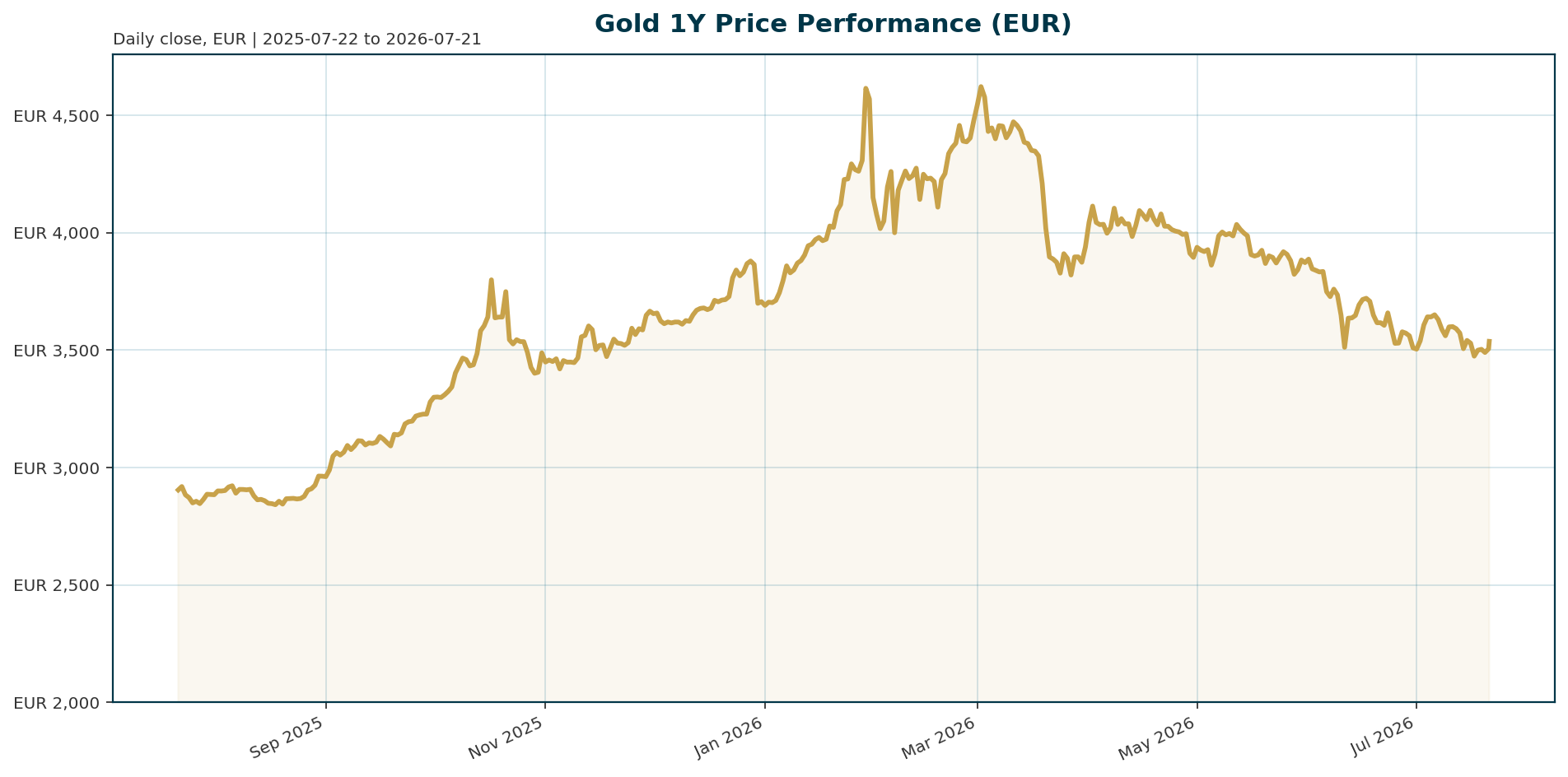
| Asset | Price (EUR) | 1Y Return | 200D Return | ATH (EUR) | ATH Date |
|---|---|---|---|---|---|
| Gold (XAU) | 3,537.60 | +22.35% | -4.62% | 4,688.32 | 2026-01-29 |
Key Structural Metrics
- Central Bank Demand: ~1,000 tonnes/year (double previous decade) [T1].
- FX Rate: EUR/USD 1.1443 (weak) [T7].
- US Real Yield Headwind: 10Y Treasury at 4.6% [T4][T5].
- EUR Yield Advantage: Euro Area AAA 10Y at 3.15% [T7].
Macro Backdrop
Risk sentiment remains neutral to negative with equity momentum moderately negative. The DAX and Euro Stoxx 50 are down approximately 1.2% and 0.8% over five days, respectively, while the Hang Seng leads with a 1.80% gain. The FX backdrop is mixed, with EUR/USD trading at 1.1443 and showing a five-day decline of 0.15%. Euro area yields are mixed, with the 10-year yield at 3.15% and the 2-year yield at 2.70%, suggesting a complex monetary environment for gold.
Investment Thesis
The core thesis for gold remains a structural shift toward a multipolar monetary order. Gold is increasingly viewed as “outside money” [T2], offering no political allegiance, no counterparty risk, and immunity from sanctions compared to sovereign currencies or bank deposits [T2]. This evolution transforms gold from a simple inflation hedge into a strategic monetary hedge and potential collateral asset [T2]. The primary driver is the erratic nature of US policy, which has pushed reserve managers to diversify away from the dollar [T3]. Despite the current price action, the fundamental demand profile is supported by central banks, which have doubled their buying pace to an average of 1,000 tonnes per year [T1].
Bullish Drivers
- Structural Reserve Diversification: The World Gold Council reports central banks have increased buying to 1,000 tonnes/year. A June survey of 76 central banks found 89% expect global holdings to rise over the next 12 months [T1].
- US Debt Sustainability: With US debt approaching $40 trillion and interest costs near $2 trillion annually, the fiscal trajectory limits the Fed’s room to sustain higher-for-longer rates, eventually pressuring yields [T4].
- Geopolitical Inflation Premium: Escalating tensions in the Middle East are sustaining inflationary fears and supporting oil prices, which adds to the inflation hedge narrative for gold [T6].
- Undervalued Sentiment: Managed money longs in gold are 23% below the 12-month moving average, indicating room for technical buying [T5].
Relative Positioning vs Bitcoin and Ethereum
Gold maintains a distinct advantage over cryptocurrencies in terms of institutional adoption and monetary utility. While Bitcoin dominance stands at 56.56%, gold benefits from the explicit accumulation by central banks, which have increased official holdings to approximately 25% of FX reserves [T4]. Unlike crypto assets, gold functions as a recognized monetary collateral and a hedge against sovereign credit risk, whereas cryptocurrencies remain largely speculative in the eyes of reserve managers.
Scenario Framework
- Base Case (Hawkish Hold): The Fed holds rates steady at the July meeting, acknowledging sticky inflation but avoiding a hike. Real yields stabilize, and central banks continue accumulation. Gold trades within a range around current levels.
- Bull Case (Fed Pivot): Inflation spikes or geopolitical risk forces the Fed to pivot to easing. Real yields collapse as bond markets price in rate cuts. Gold rallies aggressively, potentially reclaiming ATH levels.
- Bear Case (Overtightening): The Fed overtightens to combat inflation, pushing the 10-year yield above 5%. Real yields surge, making the zero-coupon nature of gold prohibitively expensive relative to cash. Gold corrects significantly.
Valuation Discussion
Gold is priced as a zero-coupon asset, making it highly sensitive to real yield differentials. The US 10-year yield at 4.6% and the 30-year pushing through 5% provide a headwind, making gold expensive relative to cash [T4][T5]. However, the Euro area 10-year yield at 3.15% offers a relative yield advantage for EUR-denominated investors. Furthermore, EUR weakness against the USD (1.1443) provides a tailwind for XAU/EUR, partially offsetting the headwind from US monetary policy.
Risks
- Real Yield Rebound: The primary risk is a resurgence in bond market nervousness, driving US real yields higher and pressuring gold prices [T4].
- Geopolitical De-escalation: A resolution to Middle East tensions could remove the inflation premium and reduce safe-haven flows into gold [T6].
- Fed Policy Error: Chair Warsh’s hawkish stance could lead to an overtightening cycle, triggering a recession that forces a sharp repricing of risk assets.
Appendix
Sources
- Rule Symposium Video: Central banks double gold-buying pace – Mining.com [T1]
- Gold is becoming the reserve asset of the new multipolar world – Sprott’s Paul Wong – Shanghai Metals Market [T2]
- Fed won’t hike but hold, Warsh may have started too hawkish, and U.S. policy is driving sovereign gold demand – Natixis’ Christopher Hodge – KITCO [T3]
- Mining Alpha EP4 | Gold Hasn’t Moved. Sentiment Has Collapsed. The Gap Is the Opportunity – Crux Investor [T4]
- Despite Middle East escalation, interest rates remain the key price driver for gold and silver – StoneX – KITCO [T5]
- Gold eases as Middle East tensions revive inflation concerns – Reuters [T6]
This report is AI-generated for informational purposes only and does not constitute investment advice. Always conduct your own research or consult with a qualified financial advisor before making investment decisions.
Important Note / Wichtiger Hinweis:
EN: This report may have been generated using AI. It processes data from publicly available sources. The content is provided for informational purposes only.DE: Dieser Bericht kann mithilfe von KI erstellt worden sein. Dabei werden Daten aus öffentlich zugänglichen Quellen verarbeitet. Die Inhalte dienen ausschließlich Informationszwecken.
* DE: Die ergänzenden Inhalte können KI-generiert sein. EN: The additional content may be AI-generated.