
Listen to the summary
Key Data Snapshot
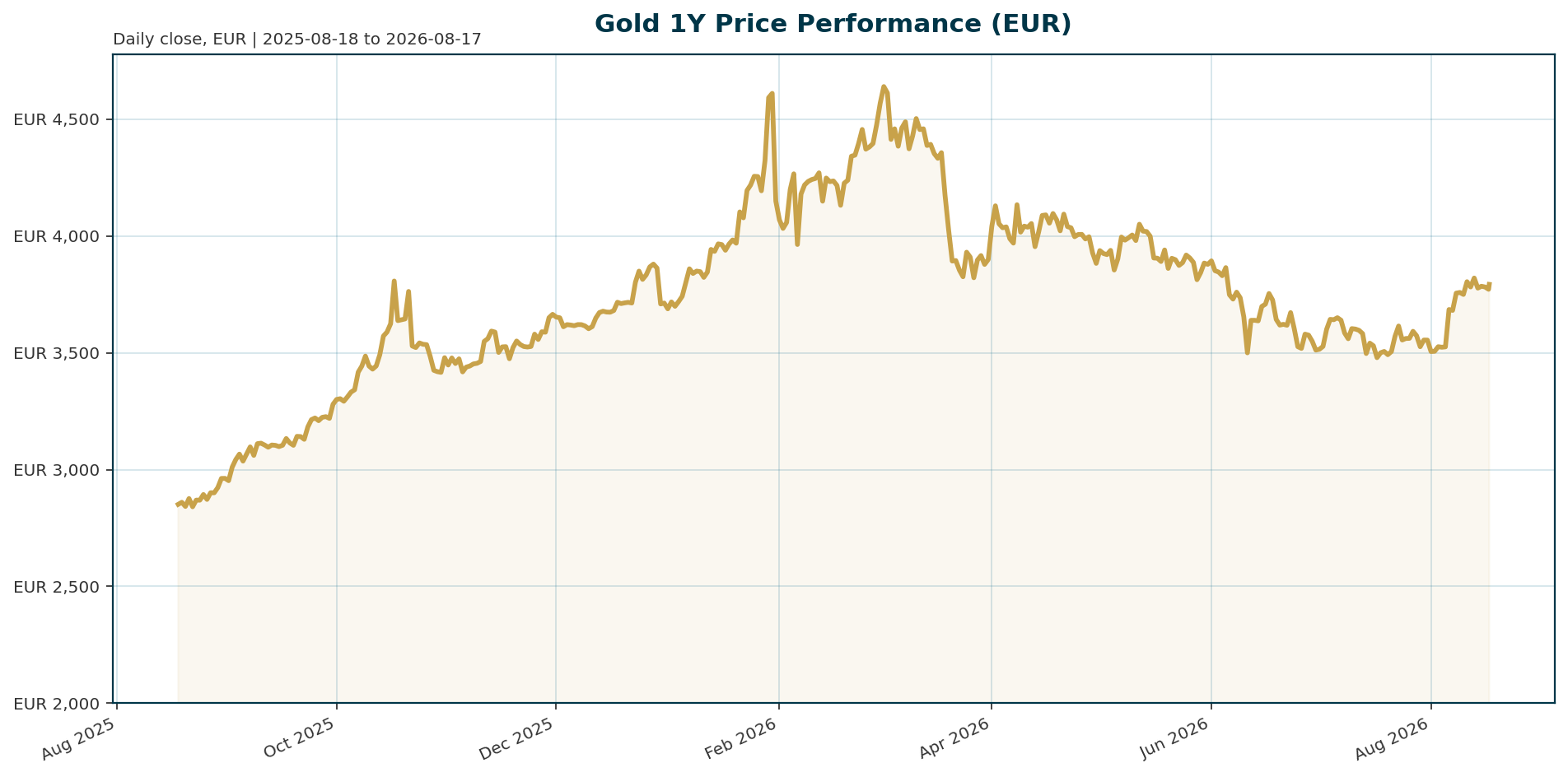
| Metric | Value | Context |
|---|---|---|
| Current Price (XAU/EUR) | 3,791.02 | Latest quote |
| All-Time High (ATH) | 4,688.32 | Jan 28, 2026 |
| Drawdown from ATH | -19.1% | Calculated: (3791.02 – 4688.32) / 4688.32 |
| Year-to-Date (YTD) | +31.8% | Performance since Jan 1 |
| 200-Day Return | -21.0% | Recent volatility correction |
| Central Bank Survey (Own Reserves) | 45% | Expect increase over next 12 months [T7] |
| Central Bank Survey (Global Reserves) | 89% | Expect increase over next 12 months [T7] |
| Euro Area AAA 10Y Yield | 3.16% | Nominal rate backdrop |
Macro Backdrop
Risk sentiment is positive, driven by broad equity momentum where the Nikkei 225 leads regional indices with a 7.34% one-month gain and the DAX rises 5.76% over the same period [T5]. The rates backdrop is mixed, with the Euro area AAA 10Y yield holding steady at 3.16%, while the FX backdrop shows EUR/USD trading at 1.1558. Key observations highlight divergent regional performance, with the Hang Seng lagging at -0.54% over five days despite the positive global tone. This environment suggests a risk-on appetite that typically pressures non-yielding assets like gold, though structural diversification flows provide support.Investment Thesis
Gold’s current valuation is defined by a tug-of-war between geopolitical hedging and the opportunity cost of holding non-yielding assets. The investment thesis rests on the structural shift in global reserve management, where central banks are aggressively diversifying away from the US dollar [T3]. Societe Generale identifies central bank buying and real yields as the two primary drivers of price action [T3]. While gold remains a hedge against inflation and geopolitical risk, its performance is increasingly tethered to the path of real yields. The market is currently pricing a “higher-for-longer” interest rate environment, which suppresses gold’s appeal relative to yield-bearing assets. However, the persistent accumulation by official sector buyers provides a structural floor, suggesting that while short-term volatility is likely, the long-term thesis for gold as a portfolio diversifier remains intact.Bullish Drivers
- Structural Central Bank Demand: Global central banks have accumulated an average of 1,000 tonnes of gold over the past four years, a significant acceleration from the previous decade [T7]. A record 45% of respondents to the World Gold Council survey expect their own reserves to increase, providing a consistent support level [T7].
- Stagflationary Risks: A backdrop of slower growth alongside persistent inflation remains supportive for gold over the longer term [T2]. If energy prices remain elevated due to geopolitical tensions, the risk of stagflation increases, reinforcing gold’s role as a store of value.
- Dovish Pivot Potential: The bull case relies on a scenario where major central banks pivot to a dovish stance before inflation is fully controlled. If economic weakness forces a policy shift, real yields could decline, making gold more attractive relative to interest-bearing assets [T8].
- Currency Diversification: Nations not aligned with the US are reducing reserve mix exposure to dollars to mitigate sanctions risk, driving sustained demand for gold as a foreign exchange hedge [T6].
Relative Positioning vs Bitcoin and Ethereum
Gold maintains its status as the primary reserve asset and benchmark for “hard money” despite the rise of cryptocurrencies. While Bitcoin dominance stands at 56.21%, gold offers a critical stabilizing force in portfolios during periods of high volatility [T4]. Unlike Bitcoin and Ethereum, which are highly correlated with risk sentiment and crypto-specific liquidity, gold provides a non-correlated store of value. In a risk-on environment, crypto assets typically outperform gold, but in a risk-off scenario, gold usually acts as the safe haven of last resort. The current macro backdrop, characterized by positive equity momentum, suggests a risk-on tilt where gold may face headwinds, but its structural role as a reserve asset remains distinct from the speculative nature of digital assets.Scenario Framework
- Base Case: The Federal Reserve maintains a hawkish stance, keeping real yields elevated. Gold consolidates around current levels, facing a 6-8% correction as market participants re-rate the asset for a higher-for-longer rate environment [T1]. Central bank buying absorbs selling pressure, preventing a sharp breakdown.
- Bull Case: Inflation moderates without requiring aggressive rate hikes, or real yields decline due to economic weakness. A dovish pivot by the Fed would trigger a rotation into gold, potentially pushing prices towards USD 4,800 per ounce (approx EUR 4,150) and beyond [T1].
- Bear Case: Oil prices spike due to renewed geopolitical conflict, driving persistent inflation. This forces central banks to maintain or extend tightening cycles, crushing gold as the opportunity cost of holding non-yielding assets rises significantly [T8].
Valuation Discussion
Gold is currently trading at a discount to its January 2026 ATH of 4,688.32 EUR, sitting at a 19.1% drawdown. Despite this correction, the asset is up 31.8% year-to-date, indicating strong momentum despite recent volatility. Analysts at MOFSL anticipate a 6-8% correction from current levels before a potential move towards USD 4,800 per ounce, which implies significant upside potential if the macro environment shifts [T1]. The current valuation is sensitive to real yield movements; a sustained decline in real yields would likely re-rate gold towards its ATH, while persistent high yields will likely keep the asset range-bound or in a consolidation phase.Risks
- Elevated Real Yields: The primary headwind remains the rise in real yields, which increases the opportunity cost of holding gold. If US economic data remains stronger than expected, real yields could continue to climb, pressuring prices [T5].
- Sovereign Reserve Liquidation: A tail risk exists regarding the sale of official gold reserves by major sovereigns such as the US, Germany, and Italy to stabilize public finances. Such a supply shock could weaken the structural price floor supported by central bank accumulation [T8].
- Successful Disinflation: If inflation moderates rapidly and central banks successfully engineer a soft landing without aggressive rate hikes, the demand for gold as an inflation hedge could diminish.
- Geopolitical Resolution: While geopolitical risks currently support gold, a rapid de-escalation of conflicts could reduce safe-haven demand, particularly if it leads to a dovish pivot in monetary policy.
Appendix
Sources
- Gold looks beyond war as inflation, monetary policy steer prices: Report | Business Standard [T1]
- Geopolitics alone isn’t enough to lift gold | ING THINK [T2]
- Gold’s Dual Drivers: Central Bank Flows and Real Yields, According to Societe Generale | CryptoRank.io [T3]
- Both Gold and Silver Lose Key Support Levels! Has Last Year’s Get-Rich-Quick Myth Finally Ended? | Bitget News [T4]
- Gold suffers worst quarter in 13 years amid interest rate hike fears | CNBC [T5]
- Is it a golden era for gold? | J.P. Morgan Private Bank U.S. [T6]
- Central Bank Gold Reserves Survey 2026 | World Gold Council [T7]
- Gold Declined 10% Over Two Weeks on Rising Oil Prices and Interest Rate Pressure | Crux Investor [T8]
Disclaimer: This report is AI-generated for informational purposes only and does not constitute investment advice. The analysis reflects the state of the market as of 2026-08-17 and should be independently verified before making investment decisions.
Important Note / Wichtiger Hinweis:
EN: This report may have been generated using AI. It processes data from publicly available sources. The content is provided for informational purposes only.DE: Dieser Bericht kann mithilfe von KI erstellt worden sein. Dabei werden Daten aus öffentlich zugänglichen Quellen verarbeitet. Die Inhalte dienen ausschließlich Informationszwecken.
* DE: Die ergänzenden Inhalte können KI-generiert sein. EN: The additional content may be AI-generated.