
The altii-Gold-Report, XAU in EUR
Generated: 2026-09-16 04:58 UTC. Quote currency: EUR.
Listen to the summary
Key Data Snapshot
| Metric | Latest | Read-through |
|---|---|---|
| XAU/EUR price | 3,744.51 | Stable over 24h, softer over 7d and 30d. |
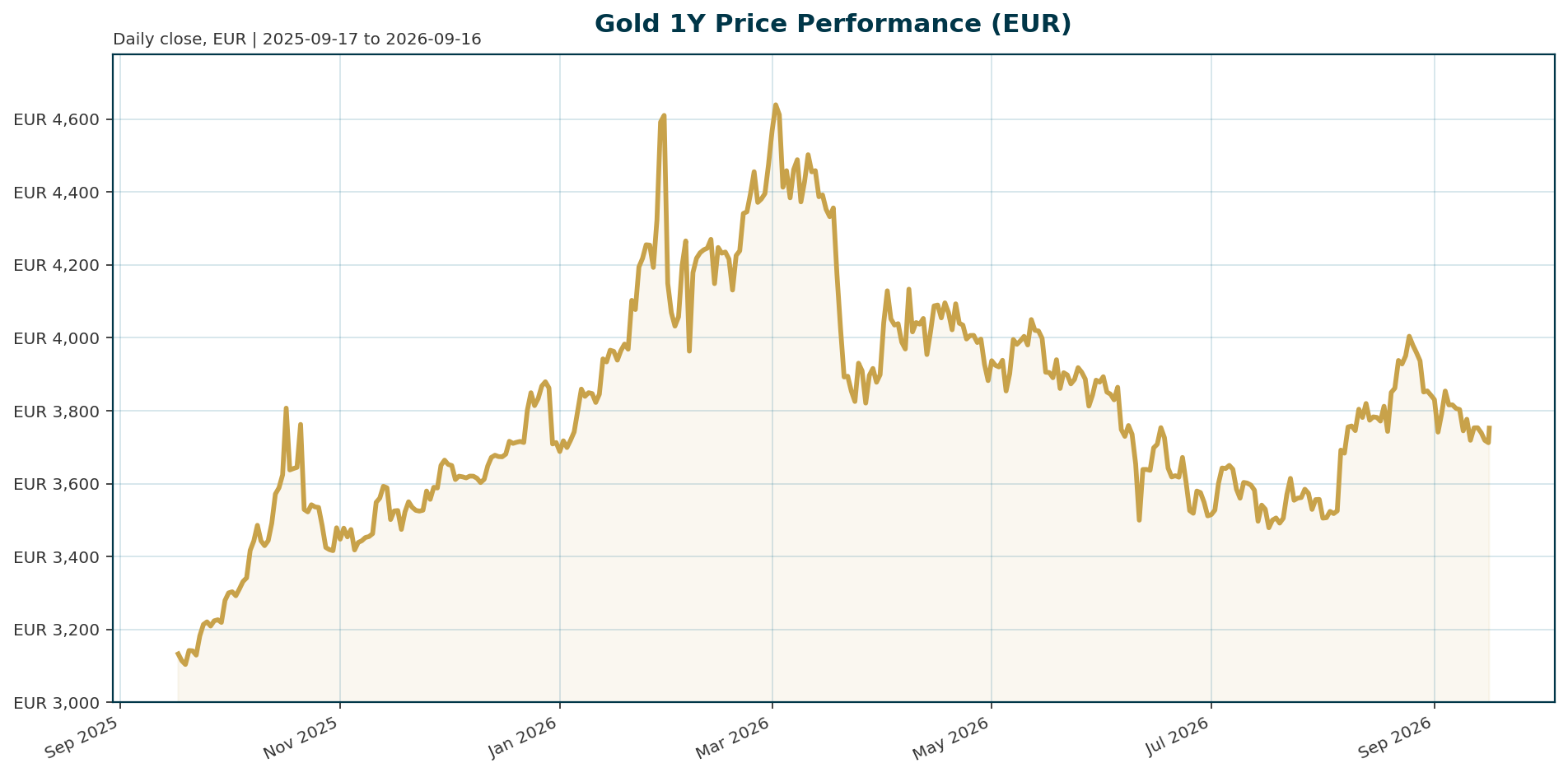
| 1h / 24h / 7d / 30d | +0.10% / +0.28% / -1.30% / -1.30% | Short-term consolidation rather than fresh upside momentum. |
| 200d / 1y | -18.40% / +17.30% | Medium-term drawdown within a still-positive annual trend. |
| 24h high / low | 3,759.75 / 3,695.38 | Range = 3,759.75 – 3,695.38 = 64.37, or 64.37 / 3,744.51 = 1.72% of spot. |
| All-time high | 4,688.32 on 2026-01-28 | Drawdown = 3,744.51 / 4,688.32 – 1 = -20.13%. |
| All-time low | 1,265.28 on 2019-11-17 | Gain from low = 3,744.51 / 1,265.28 – 1 = +195.94%. |
| Instrument-level market cap | 1.627bn | Feed-level metric linked to the supplied gold identifier, not global physical gold market capitalization. |
| 24h volume | 152.7mn | Volume / market cap = 152.7mn / 1.627bn = 9.38%. |
| Circulating supply | 434,499.37 | Total supply equals circulating supply; max supply unavailable. |
| EUR/USD | 1.1551, -0.53% over 5d | EUR weakness mechanically lifts XAU/EUR if USD gold is unchanged. |
| Euro area AAA 10Y yield | 3.5409%, +16.25 bp over 5d | Higher euro yields raise the opportunity cost of holding gold. |
| Euro area 10Y-2Y spread | 31.3 bp | Calculation: 3.5409% – 3.2278% = 0.3132 percentage points. |
Macro Backdrop
The broad cross-asset backdrop is mildly adverse but not decisive for gold. Risk sentiment is negative, equity momentum is moderately negative, and DACH indicators are broadly in line with global equities, averaging -1.17% over 5 days versus -1.29% globally. The rates backdrop is euro yields rising with curve flattening: the euro area AAA 10Y yield is 3.54%, up 16.2 bp over 5 days. FX is mixed, with EUR/USD at 1.1551, down 0.53% over 5 days. This matters for EUR investors because weaker EUR/USD can support XAU/EUR even if USD gold is flat.
Gold-specific macro signals remain balanced. The constructive case rests on policy uncertainty, reserve diversification and the possibility that real yields stop rising. Saxo notes that softer US employment, inflation and consumer data reduced pressure on the Federal Reserve to tighten further, while the Bloomberg Dollar Index began to roll over after earlier strength [T2]. That is bullish for gold if it translates into lower real yields and weaker USD.
The bearish macro case is equally clear. ING argues that gold depends less on geopolitics alone and more on how events affect inflation, monetary-policy expectations and real interest rates [T3]. Higher-for-longer real rates would be a headwind, while a stagflationary mix of slower growth and persistent inflation would remain supportive over the longer term [T3]. Forex.com also frames 2026 as more finely balanced after a powerful 2025, with much of the easing cycle potentially priced in and the ECB more neutral [T5].
Investment Thesis
For EUR-based institutional portfolios, gold remains a strategic hedge rather than a simple momentum trade. XAU/EUR is 20.13% below its January 2026 high, but it is still 17.30% higher over one year and 195.94% above the 2019 low. This combination suggests a market that has repriced structurally but no longer carries the same near-term momentum premium.
The core thesis is that gold has shifted from a primarily real-yield-sensitive asset to a reserve-quality asset supported by structural demand. Societe Generale describes a post-2022 regime shift in which gold has traded near record highs despite positive real yields, supported by central bank purchases, dedollarisation, geopolitical uncertainty and sovereign-debt concerns [T1]. A separate summary of Societe Generale’s view identifies the two key drivers as central bank buying and real yields [T4].
Official-sector buying is the strongest institutional pillar. EBC reports that central banks purchased more than 3,200 tonnes between 2022 and 2024, including about 1,136 tonnes in 2022, 1,037 tonnes in 2023 and around 1,045 tonnes in 2024 [T8]. The same source notes that reserve managers increasingly view gold as a long-term store of value, inflation hedge, crisis performer and portfolio diversifier [T8]. Lombard Odier adds that the macro context still favours real assets amid fiscal uncertainty and erosion of purchasing power [T7].
The thesis is not one-sided. If real yields rise sharply, the US dollar strengthens, ETF demand weakens and central-bank demand slows at elevated prices, the strategic case would remain valid but the entry point would likely deteriorate.
Bullish Drivers
- Central-bank reserve demand: Official-sector buying has become a structural source of demand. The reported 2022 to 2024 purchases of more than 3,200 tonnes provide a higher floor than historical models based only on real yields would imply [T8].
- Reserve diversification: Dedollarisation and sovereign balance-sheet diversification support gold as a neutral reserve asset [T1]. This driver is slow moving, which makes it more relevant for strategic allocation than for short-term trading.
- Survey support: EBC reports that 29% of respondents in the 2024 Central Bank Gold Reserves survey planned to increase gold holdings over the following 12 months, the highest share since the survey began in 2018 [T8]. It also reports that about 44% of reserve managers in 2025 actively managed gold books, with risk management as a key motive [T8].
- ETF flows remain positive: Societe Generale notes that gold-backed ETF inflows have moderated sharply this year but remain positive [T1]. Positive ETF flows can amplify price moves if technical levels improve.
- Lower volatility and reserve-manager appeal: Societe Generale argues that lower volatility is improving gold’s appeal to longer-term reserve managers rather than short-term momentum traders [T1].
- Potential real-yield relief: Saxo argues the interest-rate backdrop has shifted in gold’s favour as Fed tightening pressure has eased and the dollar has started to roll over [T2].
- Compressed real yields: GoldSilver.com states that gold’s relationship with real yields remains one of the most reliable predictors of price movements and that compressed real yields support gold because they reduce the opportunity cost of holding a non-yielding asset [T6].
- Buyers on weakness: ING argues that deeper pullbacks would likely attract buyers, particularly central banks and longer-term investors [T3].
Relative Positioning vs Bitcoin and Ethereum
Gold, Bitcoin and Ethereum all compete for portfolio roles linked to scarcity, alternative stores of value and monetary uncertainty. The supplied data, however, are much stronger for gold than for crypto. Bitcoin dominance is 58.47%, total crypto market capitalization is 2.248tn, and total crypto 24h volume is 91.19bn. Current Bitcoin price, Bitcoin return, Ethereum price, Ethereum return, Ethereum valuation metrics and Ethereum network data are unavailable in the bundle.
Gold has clearer evidence of institutional reserve use. Societe Generale frames gold as a hedge against monetary and policy uncertainty [T1]. EBC identifies gold as a long-term store of value, inflation hedge, crisis performer and portfolio diversifier [T8]. Those use cases align directly with sovereign reserve management and institutional defensive allocation.
Relative positioning should therefore be objective-led:
- Defensive macro sleeve: Gold should rank ahead of Bitcoin and Ethereum when the goal is reserve-quality liquidity, policy uncertainty hedging and central-bank-aligned diversification.
- Risk-on alternatives sleeve: Bitcoin and Ethereum may provide higher beta to crypto liquidity and risk appetite, but this cannot be quantified from the supplied data.
- Barbell allocation: Gold can anchor the defensive side, while Bitcoin and Ethereum can represent higher-volatility alternatives. Sizing requires crypto-specific data not provided here.
Scenario Framework
| Scenario | Macro conditions | XAU/EUR implication | Key triggers |
|---|---|---|---|
| Base case | Policy uncertainty persists, reserve demand remains firm, but euro yields stay elevated. | Consolidation around current levels near 3,744.51. | Central-bank demand offsets, but does not overwhelm, the opportunity cost of higher yields. |
| Bull case | Real yields soften, USD weakens, ETF flows improve, and risk sentiment remains fragile. | Upside toward translated USD technical thresholds. | Saxo identifies USD 4,500 as a key 200-day moving-average test, with a break likely to attract momentum and ETF demand [T2]. At EUR/USD 1.1551, USD 4,500 equals 4,500 / 1.1551 = 3,895.77 EUR, or 4.04% above spot. |
| Bear case | Inflation or employment data revive both real yields and the dollar. | Downside pressure, especially if ETF demand weakens and central-bank buying slows. | Saxo calls a simultaneous rise in real yields and USD the most challenging macro backdrop for gold [T2]. Lombard Odier also flags higher-for-longer real yields, ETF-demand decline and weaker physical demand as risks [T7]. |
| Stagflation case | Growth slows while inflation remains persistent. | Strategic demand improves despite delayed easing. | ING argues stagflation would support gold over the longer term [T3]. |
Additional reference levels matter for EUR investors. Saxo identifies USD 4,200 as a level below which gold would look more like consolidation than a fresh bull leg [T2]. At EUR/USD 1.1551, USD 4,200 equals 3,636.05 EUR, which is 2.90% below current XAU/EUR. Forex.com discusses a possible USD 5,000 hurdle but warns against expecting groundbreaking gains after the strong 2025 rally [T5]. USD 5,000 equals 4,328.63 EUR, or 15.60% above current XAU/EUR.
Valuation Discussion
Gold has no cash-flow anchor. Valuation therefore rests on opportunity cost, real yields, reserve demand, historical extremes, technical levels and EUR/USD translation.
On historical reference points, XAU/EUR at 3,744.51 is neither distressed nor euphoric. It is 20.13% below the all-time high of 4,688.32, calculated as 3,744.51 / 4,688.32 – 1. It is also 195.94% above the all-time low of 1,265.28, calculated as 3,744.51 / 1,265.28 – 1. That supports a balanced valuation view: the strategic floor has likely risen, but the asset is not cheap versus its own history.
On macro valuation, Societe Generale argues that structural factors have created a higher floor and reduced gold’s sensitivity to elevated real rates [T1]. CryptoRank’s summary of Societe Generale makes the same point through a supply-absorption lens: central-bank demand can reduce sensitivity to short-term interest-rate expectations [T4]. This supports a higher-floor valuation scenario.
The counterargument is opportunity cost. If real yields rise and reserve buying slows, gold could reprice closer to traditional real-yield models. That matters today because euro yields are rising: the euro area AAA 2Y yield is 3.2278%, the 10Y is 3.5409%, and the 30Y is 3.7888%. The 30Y-10Y slope is 3.7888% – 3.5409% = 0.2479 percentage points, or 24.8 bp.
EUR translation is material. Implied XAU/USD from the supplied EUR price and FX rate is 3,744.51 x 1.1551 = 4,325.28 USD. A 0.53% fall in EUR/USD mechanically raises EUR gold by roughly 1 / (1 – 0.0053388) – 1 = 0.54% if USD gold is unchanged. Therefore, EUR investors should avoid reading USD technical levels as native EUR signals without conversion.
Risks
- Real-yield shock: Saxo identifies renewed inflation or employment strength that revives both real yields and the dollar as the clearest risk to gold [T2]. ING also notes that higher-for-longer rates would keep real yields elevated and weigh on gold [T3].
- Central-bank demand slows: ING says central banks remain supportive but buying may slow [T3]. Forex.com similarly warns that central-bank demand may not be as relentless at elevated prices [T5].
- Easing already priced: Forex.com argues that much of the global easing cycle may already be priced in after the strong 2025 rally [T5].
- ETF and physical demand disappointment: Lombard Odier lists a prolonged decline in ETF demand and lower physical demand, including jewellery, as risks [T7]. Societe Generale also notes ETF inflows have moderated sharply, even though they remain positive [T1].
- Euro yield headwind: The market overview shows euro yields rising and the curve flattening. That raises the opportunity cost of holding a non-yielding asset for EUR investors.
- FX ambiguity: USD strength can pressure USD gold, while EUR weakness can cushion XAU/EUR. The net effect depends on whether FX translation offsets the underlying gold move.
- Momentum risk: XAU/EUR is down 18.40% over 200 days despite a 17.30% one-year gain. This confirms that strategic strength does not eliminate tactical drawdown risk.
- Data risk: Market cap, supply, rank and volume appear to be instrument/feed-level metrics linked to the supplied Coingecko identifier, pax-gold. They should not be interpreted as global physical bullion metrics.
Appendix
Methodology and calculations
- Report generated at 2026-09-16T04:58:30.628413Z. Market data retrieved at 2026-09-16T04:58:18.990590Z.
- Asset: Gold, symbol XAU, quote currency EUR. Supplied Coingecko identifier: pax-gold.
- Market overview errors: none reported.
- 24h range: 3,759.75 – 3,695.38 = 64.37. Range as % of spot: 64.37 / 3,744.51 = 1.72%.
- ATH drawdown: 3,744.51 / 4,688.32 – 1 = -20.13%.
- ATL gain: 3,744.51 / 1,265.28 – 1 = +195.94%.
- Implied XAU/USD: 3,744.51 x 1.1551 = 4,325.28 USD.
- USD to EUR technical conversion: EUR level = USD level / EUR/USD.
- USD 4,200 = 4,200 / 1.1551 = 3,636.05 EUR, which is 2.90% below spot.
- USD 4,500 = 4,500 / 1.1551 = 3,895.77 EUR, which is 4.04% above spot.
- USD 5,000 = 5,000 / 1.1551 = 4,328.63 EUR, which is 15.60% above spot.
- Volume / market cap: 152,661,050 / 1,626,958,276 = 9.38%, interpreted as an instrument/feed-level liquidity metric.
- Euro area 10Y-2Y spread: 3.5409400409% – 3.2277796081% = 0.3131604328 percentage points, or 31.3 bp.
- Euro area 30Y-10Y spread: 3.7888180586% – 3.5409400409% = 0.2478780177 percentage points, or 24.8 bp.
Data limitations
- Real-yield series, inflation expectations, US Treasury yields and current ETF tonnage are unavailable in the bundle.
- Bitcoin spot price, Bitcoin returns, Ethereum spot price, Ethereum returns, Ethereum valuation metrics and Ethereum network data are unavailable.
- Most Tavily source publication dates are unavailable, so timing and stale-data risk should be considered.
- Central-bank buying figures cited from secondary summaries refer mainly to 2022 to 2024 historical flow data, not current monthly purchases.
Sources
- [T1] It’s time to get bullish on gold again, says SocGen | Kitco News
- [T2] ICYMI: ETF flows return to gold as Saxo flags 289-tonne central bank demand
- [T3] Geopolitics alone isn’t enough to lift gold | articles | ING THINK
- [T4] Gold’s Dual Drivers: Central Bank Flows and Real Yields, According to Societe Generale | Forex News | CryptoRank.io
- [T5] Gold 2026 Outlook: Fundamental XAU/USD analysis
- [T6] 7 Reasons Gold and Silver Will Surge From Current Levels
- [T7] Gold’s slowdown doesn’t signal a reversal | Lombard Odier
- [T8] How Geopolitics and Central Banks Are Driving Gold Higher | EBC Financial Group
This report is AI-generated, for informational purposes only, and does not constitute investment advice, investment research, an offer, or a solicitation to buy or sell any financial instrument.
Important Note / Wichtiger Hinweis:
EN: This report may have been generated using AI. It processes data from publicly available sources. The content is provided for informational purposes only.DE: Dieser Bericht kann mithilfe von KI erstellt worden sein. Dabei werden Daten aus öffentlich zugänglichen Quellen verarbeitet. Die Inhalte dienen ausschließlich Informationszwecken.
* DE: Die ergänzenden Inhalte können KI-generiert sein. EN: The additional content may be AI-generated.