
Watch the video
This player shows only the Gold chapter of the daily altii market briefing. Watch the full video on tube.altii.de.
Key Data Snapshot
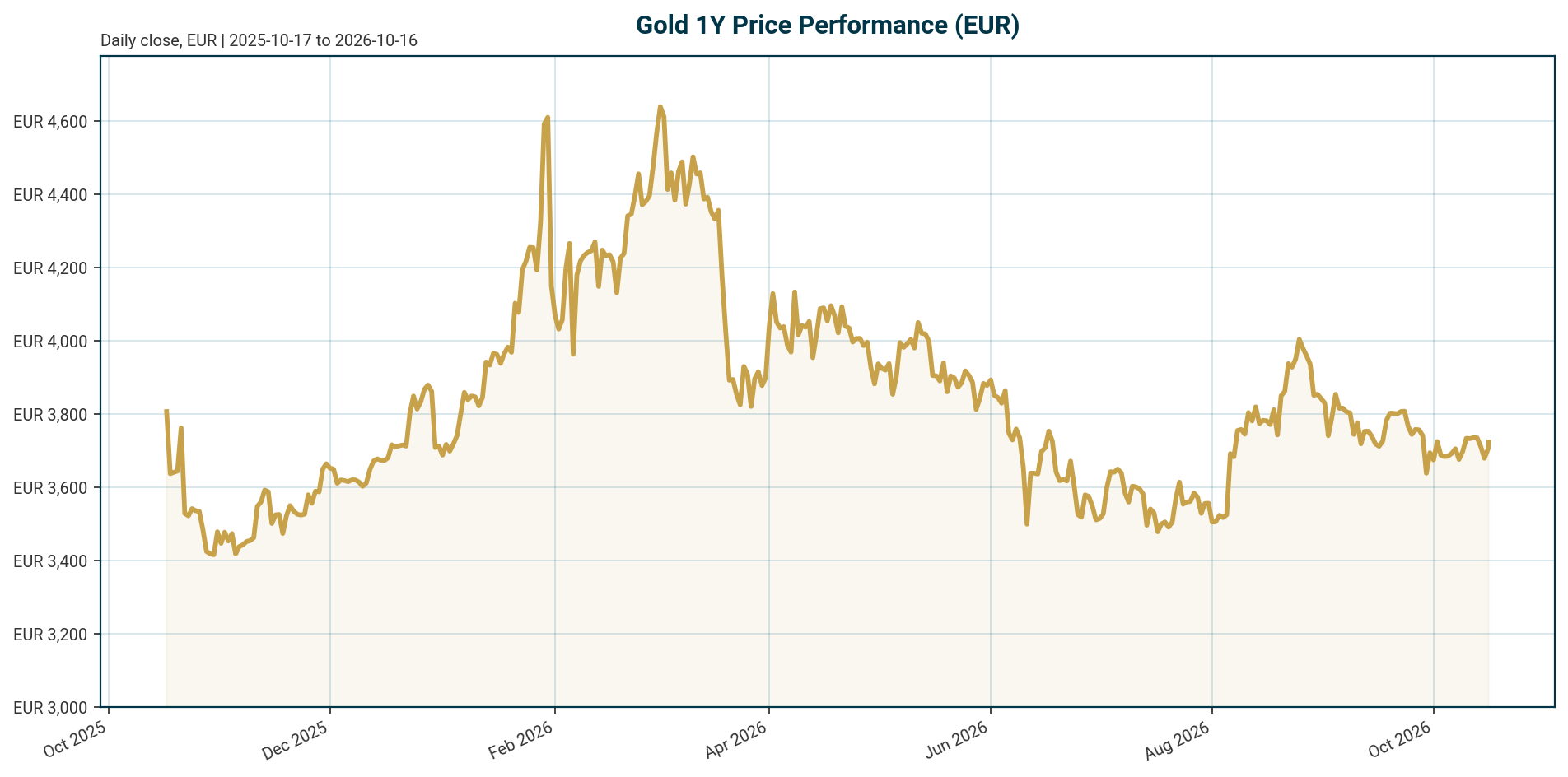
XAU is trading at 3,717.91 EUR, implying a USD price of approximately 3,320.00 USD (calculated as 3717.91 / 1.1201). The asset remains 20.7% below its January 2026 ATH of 4,688.32 EUR [T1]. Over the last 30 days, XAU has declined -3.34%, while the 200-day trend shows a -7.03% drawdown, indicating a consolidation phase following peak speculative pricing.
| Metric | Value | Context |
|---|---|---|
| XAU Price (EUR) | 3,717.91 | Current spot price; trading below ATH |
| 30-Day Change | -3.34% | Negative momentum over the last month |
| 200-Day Change | -7.03% | Structural drawdown from recent highs |
| ATH (Jan 2026) | 4,688.32 EUR | |
| BTC Dominance | 59.28% | |
| Euro Area 10Y Yield | 3.51% |
Macro Backdrop
The global macro environment presents a complex mix of risk sentiment and monetary policy. Risk sentiment is neutral with DACH equities outperforming global peers, specifically the DAX which leads with a 1.18% 5-day gain, while the Nikkei 225 lags with a -4.98% drop. The euro area yield curve is flattening, with the Euro Area AAA 10Y yield at 3.51% and the spread to the 2Y yield at 42.2 bp. The FX backdrop is mixed, with EUR/USD at 1.1201.
Within this backdrop, gold is displaying resilience. Despite US Treasury yields topping 5%, gold has held firmly above the $4,000 level, with institutions noting that the traditional negative correlation with bond yields is systematically weakening due to concerns over fiat currency purchasing power [T1]. The ECB has defended recent rate hikes, citing persistent inflation risks, including oil prices rising above $100 following the US-Iran conflict [T1].
Investment Thesis
The investment thesis for gold is anchored in the persistence of inflation and the structural shift in reserve management. While real yields have risen, the opportunity cost of holding gold has not deterred investors, as the true return on cash and bonds is diminished after accounting for inflation [T6]. The thesis posits that gold remains a critical component of long-term reserve strategies, serving as a hedge against fiscal uncertainty and the gradual erosion of purchasing power [T4].
Key to this thesis is the acceleration in official sector accumulation. Central banks have accumulated an average of 1,000t of gold over the past four years, up significantly from the 500t average of the preceding decade [T2][T5]. This structural demand provides a floor for prices, mitigating the impact of short-term rate volatility and supporting the view that gold is re-anchoring to a higher valuation regime driven by a “debasement trade” [T1][T3].
Bullish Drivers
- Structural Central Bank Demand: A record 45% of survey respondents expect their own gold reserves to increase over the next year, with 89% expecting global reserves to rise [T5]. The World Gold Council confirms an acceleration in official accumulation driven by geopolitical and economic uncertainty [T2].
- Monetary Policy Divergence: The Federal Reserve is likely to keep policy rates on hold for much of 2026, with cuts more probable towards the end of the year [T4]. This limits the upside pressure on real yields that typically weighs on gold.
- Geopolitical Risk Premium: Elevated geopolitical instability, highlighted by the US-Iran conflict and broader regional tensions, drives demand for gold as a crisis hedge [T2]. Nations on the borders of active conflicts are increasing reserves to reduce vulnerability to sanctions [T3].
- Inflation Persistence: ECB President Joachim Nagel cautioned that low energy inventories and supply chain disruptions could keep inflation elevated, supporting gold’s role as a real asset [T1].
Relative Positioning vs Bitcoin and Ethereum
Gold maintains its position as the primary safe haven asset relative to the cryptocurrency market. With Bitcoin dominance sitting at 59.28%, gold acts as the primary hedge against crypto volatility and systemic risk [T3].
Crucially, the official sector is prioritizing gold over digital assets. The World Gold Council survey indicates that geopolitical instability is a key allocation driver for EMDE institutions (95%), whereas advanced economies prioritize it at 67% [T2]. This divergence suggests that while Bitcoin captures speculative momentum, gold remains the preferred vehicle for sovereign reserve diversification and wealth preservation.
Scenario Framework
- Base Case: Real yields remain elevated but stable. Central bank buying (averaging 1,000t) supports prices around current levels. The Fed holds rates steady, preventing a significant spike in real yields that would trigger a sharp correction.
- Bull Case: The Fed signals rate cuts in late 2026 combined with renewed geopolitical escalation (e.g., Middle East). This triggers a flight to safety, decoupling gold from yields and driving prices back toward the January 2026 ATH of 4,688.32 EUR.
- Bear Case: Real yields spike due to a hawkish Fed or persistent inflation, causing a reversion to sub-3,500 EUR. This would occur if ETF demand collapses or physical demand (jewellery) weakens significantly, overwhelming central bank buying.
Valuation Discussion
Gold is currently priced with a discount to its ATH, reflecting the “real yield premium” risk. However, valuation is supported by the scarcity of gold and its role as a non-correlated asset in a high-debt environment [T6][T7].
Despite the recent drawdown, the fundamental value proposition remains intact. The current price action suggests the market is digesting the higher-for-longer real yield environment rather than a fundamental breakdown in gold’s utility as a store of value. Analysts at UBS note that while prices are under pressure due to real yields, they expect a higher price in the medium term [T8].
Risks
- Higher-for-Longer Real Yields: A sustained spike in real yields due to aggressive Fed tightening or persistent inflation could trigger a sharp price correction [T4].
- Declining ETF Flows: A prolonged decline in investment demand, specifically via ETFs, could overwhelm the structural support provided by central bank buying [T4].
- Physical Demand Weakness: Lower physical demand, such as for jewellery, could exert additional downward pressure on prices [T4].
- USD Strength: A stronger US dollar, often correlated with higher US yields, could make gold more expensive for non-USD holders, dampening demand [T1].
Appendix
Sources
- Gold Holds Above $4,000 Even as US Treasury Yields Top 5% — Institutions Say Gold’s Pricing Logic Is “Re-Anchoring” — BigGo Finance [T1]
- Central Bank Gold Purchases Hit 1,000t Average: WGC Survey [T2]
- Is it a golden era for gold? | J.P. Morgan Private Bank U.S. [T3]
- Gold’s slowdown doesn’t signal a reversal | Lombard Odier [T4]
- Central Bank Gold Reserves Survey 2026 | World Gold Council [T5]
- How Inflation and Interest Rates Affect Gold Prices in 2026 [T6]
- What Affects Gold Prices? 6 Key Factors Explained | XTB [T7]
- Gold: Between inflation fears and diversification of reserves [T8]
This report is AI-generated for informational purposes only and does not constitute investment advice. The analysis is based on data available as of 2026-10-16.
Important Note / Wichtiger Hinweis:
EN: This report may have been generated using AI. It processes data from publicly available sources. The content is provided for informational purposes only.DE: Dieser Bericht kann mithilfe von KI erstellt worden sein. Dabei werden Daten aus öffentlich zugänglichen Quellen verarbeitet. Die Inhalte dienen ausschließlich Informationszwecken.
* DE: Die ergänzenden Inhalte können KI-generiert sein. EN: The additional content may be AI-generated.