
Listen to the summary
Key Data Snapshot
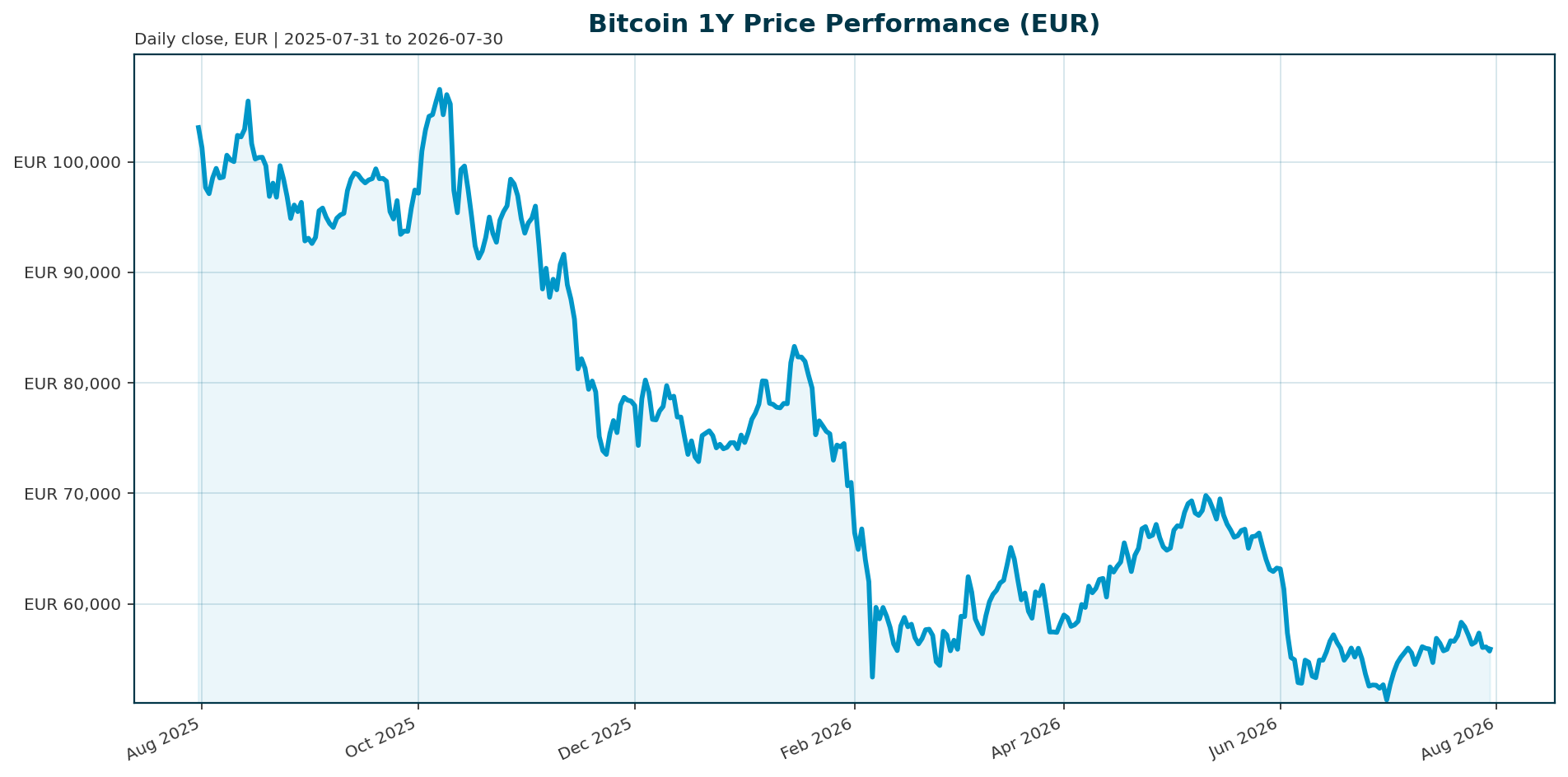
Bitcoin is trading at 55,923 EUR, marking a 48.1% drawdown from the October 2025 all-time high of 107,662 EUR. Despite recent 30-day momentum of +7.1%, the 200-day trend remains bearish at -29.3%. The market is characterized by high liquidity, with 24-hour volume reaching 24.4 billion EUR, and Bitcoin dominance stands at 56.5%.
| Metric | Value |
|---|---|
| Current Price (EUR) | 55,923.00 |
| Market Cap (EUR) | 1.12 Trillion |
| 24h Volume (EUR) | 24.45 Billion |
| Change (30d) | +7.1% |
| Change (200d) | -29.3% |
| All-Time High (ATH) | 107,662.00 (Oct 2025) |
| Dominance | 56.5% |
Market Setup
The macro backdrop remains restrictive, with the Federal Reserve under Chair Kevin Warsh expected to hold rates through Q3, limiting room for policy easing that historically supports risk assets [T1]. Euro area yields are mixed, with the 10-year yield at 3.16% and the 2-year yield at 2.71%, while the EUR/USD pair sits at 1.1395 [market_overview]. Equity markets show regional divergence, with the DAX outperforming global peers at +2.8% over five days, while the Nikkei 225 lags at -4.1% [market_overview]. This environment suggests a risk-off bias, making Bitcoin’s performance heavily dependent on liquidity conditions and institutional flows.
Investment Thesis
Bitcoin has evolved from a narrative-driven speculative asset into a flow-driven macro instrument. The dominant thesis for 2026 centers on the tension between ETF gravity and the macro ceiling. ETFs have become the primary institutional access point, transforming Bitcoin into an integrated Wall Street liquidity vehicle [T4]. Fair value is increasingly determined by the dynamic between expanding distribution into wealth management platforms and the macro forces governing real rates and risk appetite [T5].
Bullish Drivers
- Regulatory Catalysts: The Digital Asset Market Clarity Act scheduled for Senate review represents a pivotal opportunity to establish a federal market-structure framework, potentially unlocking broader institutional participation [T1][T6].
- Structural Demand: The $22 trillion US 401(k) and Defined Contribution system offers massive upside potential. Even a 1% allocation would generate $90 to $130 billion in steady, rules-based inflows, dwarfing current ETF flows [T5].
- Flow Resilience: Recent ETF inflows have revived bullish sentiment, suggesting institutional buyers are accumulating ahead of expected policy easing [T2][T3]. Whale wallets have also begun accumulating, signaling a structural floor [T5].
Relative Positioning vs Gold and Ethereum
Bitcoin is currently positioned as a high-beta macro hedge rather than a traditional safe haven like gold. While DACH equities are outperforming, the correlation between Bitcoin and traditional markets has increased due to ETF integration [market_overview][T4]. Relative to Ethereum, Bitcoin serves as the primary macro layer, while Ethereum functions as the tech layer. Both assets are now deeply integrated into the machinery of global capital, but Bitcoin retains the structural supply scarcity advantage [T4][T5].
Scenario Framework
- Base Case: The Fed maintains current rates, and ETF flows stabilize. Bitcoin consolidates in a 50,000 to 60,000 EUR range, reacting to incremental institutional inflows.
- Bull Case: The CLARITY Act passes and the Fed signals a pivot to easing. ETF inflows resume aggressively, allowing Bitcoin to reclaim the 80,000 EUR psychological level.
- Bear Case: Macro deterioration, such as rising yields or geopolitical stress, triggers margin calls. ETF outflows accelerate, forcing selling pressure that could test the 40,000 EUR support zone.
Valuation Discussion
Bitcoin is currently trading at a significant discount to its October 2025 peak, reflecting the macro ceiling and regulatory uncertainty. However, the long-term valuation thesis is anchored in the expansion of ETF distribution channels. With ETF holdings exceeding 1 million BTC equivalent and net mining supply growing slowly, the reallocation of existing capital is the primary price driver [T5]. The potential integration into the US retirement system provides a structural bid that could support higher valuations as adoption matures [T6].
Risks
- Macro Volatility: Bitcoin is now tightly coupled with global liquidity. Rising interest rates, dollar strength, or equity market weakness can trigger forced selling via ETF redemptions [T7][T8].
- Regulatory Hurdles: Delays in passing the CLARITY Act or unfavorable regulatory rulings could dampen institutional enthusiasm and cap upside [T1].
- Competition for Capital: As AI and other high-growth themes capture investor attention, Bitcoin must compete for a finite pool of institutional capital [T8].
Appendix
Sources
- Q2 2026 Digital Asset Review [T1]
- Bitcoin Holds Near $80K–$81K as ETF Inflows Revive Bullish Sentiment [T2]
- Bitcoin (BTC) price touches $70,000 as ETF inflows signal institutional interest [T3]
- Bitcoin ETF Flows Remain a Key Market Driver [T4]
- Bitcoin 2026 outlook: ETF gravity vs. Macro ceiling [T5]
- Bitcoin Price Prediction 2026 [T6]
- Why U.S. Macroeconomic Data Drives Bitcoin Price in 2026 [T7]
- Bitcoin Opens June Under Pressure as ETF Outflows Cross $2B [T8]
This report is AI-generated for informational purposes only and does not constitute investment advice. Please consult a qualified financial advisor before making investment decisions.
Important Note / Wichtiger Hinweis:
EN: This report may have been generated using AI. It processes data from publicly available sources. The content is provided for informational purposes only.DE: Dieser Bericht kann mithilfe von KI erstellt worden sein. Dabei werden Daten aus öffentlich zugänglichen Quellen verarbeitet. Die Inhalte dienen ausschließlich Informationszwecken.
* DE: Die ergänzenden Inhalte können KI-generiert sein. EN: The additional content may be AI-generated.