
Listen to the summary
Key Data Snapshot
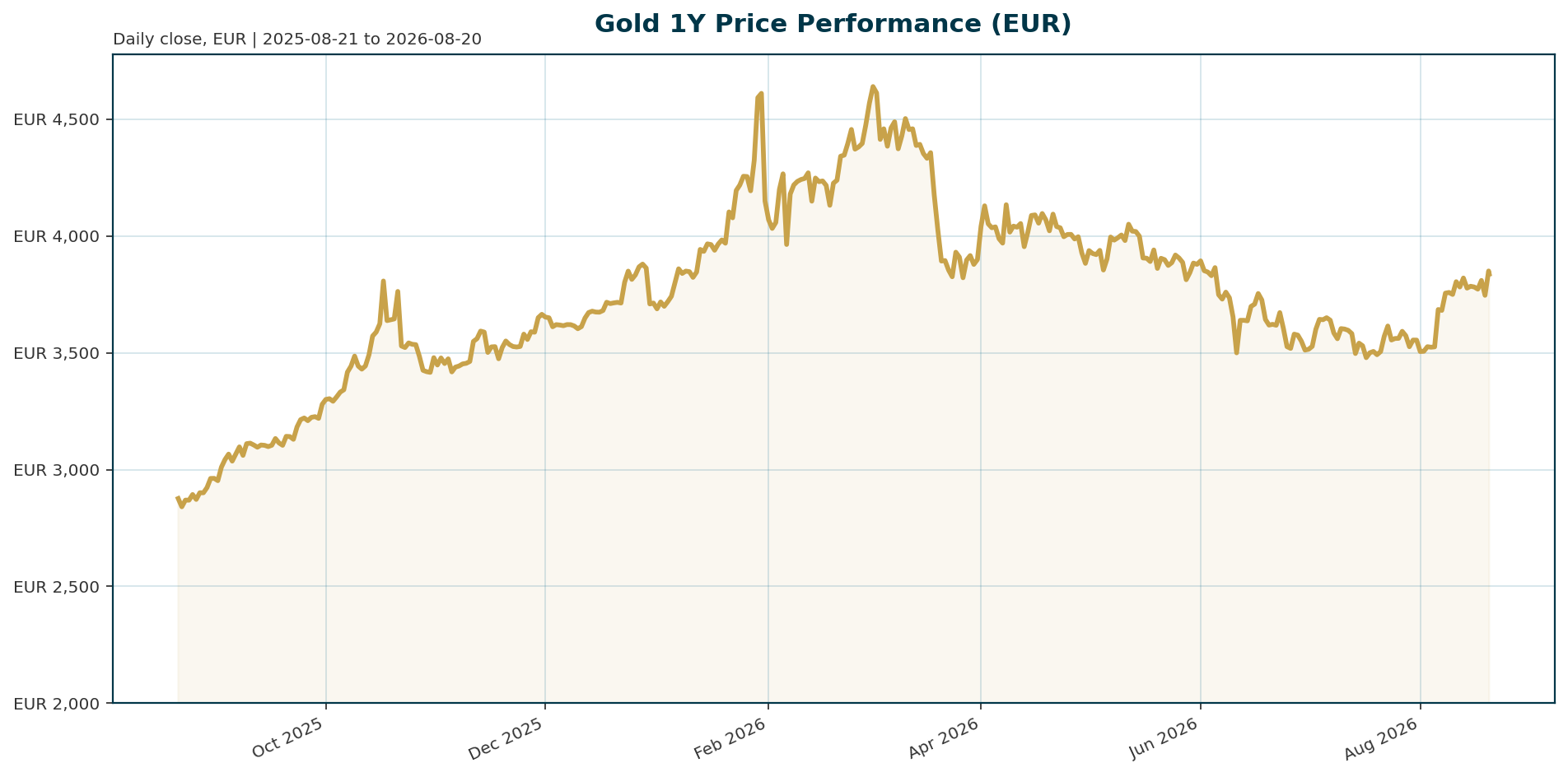
| Metric | Value | Context |
|---|---|---|
| Current Price (XAU/EUR) | 3,835.06 | Recovery from Q2 lows |
| Year-to-Date Change | +35.5% | Strong momentum despite volatility |
| All-Time High (ATH) | 4,688.32 | -18.2% below peak (Jan 2026) |
| 200-Day Return | -7.6% | Recovery phase post-correction |
| Market Cap | 1.68B | Significantly smaller than total crypto market cap |
| BTC Dominance | 56.64% | Primary driver of speculative flows |
Macro Backdrop
Risk sentiment remains neutral. The rates backdrop features euro yields rising, while the FX backdrop is mixed. Key observations include the DAX leading on a 1-month basis at 5.01% and the Hang Seng showing the strongest 5-day move at 2.64%. However, the Nikkei 225 is the weakest 5-day performer at -4.14%. The Euro area AAA 10Y yield stands at 3.29% and has moved 12.3 bp over the last 5 days. EUR/USD is at 1.1604, moving 0.40% over 5 days. These tightening financial conditions and a strengthening dollar environment create a headwind for non-yielding assets like gold.Investment Thesis
Gold is currently priced by a dual structure. Structural support comes from central bank diversification away from the US dollar, while the primary near-term driver remains real yield dynamics [T4][T7]. The thesis relies on the belief that despite hawkish Fed expectations, the structural shift in reserve management provides a durable floor, even as real yields remain elevated. The market is in a consolidation phase following a worst quarter in 13 years (Q2 2026), with positioning appearing moderate rather than stretched.Bullish Drivers
Continued central bank accumulation is the primary structural bull case. J.P. Morgan notes that 43% of global monetary authorities expect their own gold reserves to increase over the next year [T7]. Additionally, the World Gold Council survey indicates nearly 90% of central banks view gold as a tool for hedging inflation and geopolitical risk, with expectations of reserve increases [T5]. A stagflationary backdrop where inflation remains sticky while growth slows would also reinforce the inflation hedge narrative, keeping gold attractive as a defensive asset [T3].Relative Positioning vs Bitcoin and Ethereum
Gold retains a significantly larger market cap (1.68B) compared to the total crypto market cap (2.1T), though crypto is a larger aggregate pool. BTC dominance of 56.64% suggests Bitcoin remains the primary driver of speculative flows within the alternative asset class. Gold serves as the traditional anchor, while crypto offers higher beta exposure to macro shifts. The correlation between gold and real yields has increased recently, making gold more sensitive to macro drivers than in previous cycles [T5].Scenario Framework
- Base Case: Hawkish Fed and Euro rates persist. Gold consolidates or corrects 6-8% before resuming its longer-term trend. The market largely prices in a sustained tightening cycle [T2][T6].
- Bull Case: Inflation moderates faster than rates, real yields decline, and the EUR weakens. This environment provides support for bullion, potentially pushing prices toward the ATH of 4,688.32 [T1][T2].
- Bear Case: A stagflationary shock with oil price spikes forces central banks to tighten further. This crushes real yields and the opportunity cost of holding gold, triggering a sharp correction. The bull case requires a pivot to dovish policy before inflation is fully controlled [T8].
Valuation Discussion
Current levels are 18.2% below the ATH, suggesting the market has not fully priced in the peak bullishness of early 2026. Year-to-date gains of 35.5% are significant but must be weighed against the backdrop of rising real yields and a strengthening dollar. UBS analysts note that gold entered the recent volatility period with elevated valuations and dovish Fed expectations as tailwinds, making it more sensitive now to macro drivers [T6]. Valuation is supported by structural demand rather than speculative mania, though recent corrections have reset expectations.Risks
Sovereign reserve liquidation poses a material risk. If major sovereigns like the US, Germany, or Italy sell assets to stabilize public finances, the resulting supply shock could weaken the structural price floor that central bank accumulation has supported over the past three years [T8]. Persistently high energy prices could trap central banks in a ‘higher-for-longer’ rate environment, increasing the opportunity cost of holding gold and suppressing its safe-haven appeal [T3]. A rapid reversal in monetary policy leading to a spike in real yields could trigger a sharp correction.Appendix
Sources
- Gold approaches macro inflection as PCE data tests Fed outlook [T1]
- Gold looks beyond war as inflation, monetary policy steer prices: Report [T2]
- Geopolitics alone isn’t enough to lift gold [T3]
- Gold’s Dual Drivers: Central Bank Flows and Real Yields, According to Societe Generale [T4]
- Both Gold and Silver Lose Key Support Levels! Has Last Year’s Get-Rich-Quick Myth Finally Ended? [T5]
- Gold suffers worst quarter in 13 years amid interest rate hike fears [T6]
- Is it a golden era for gold? [T7]
- Gold Declined 10% Over Two Weeks on Rising Oil Prices and Interest Rate Pressure [T8]
This report is AI-generated for informational purposes only and does not constitute investment advice. Please consult a qualified financial advisor before making investment decisions.
Important Note / Wichtiger Hinweis:
EN: This report may have been generated using AI. It processes data from publicly available sources. The content is provided for informational purposes only.DE: Dieser Bericht kann mithilfe von KI erstellt worden sein. Dabei werden Daten aus öffentlich zugänglichen Quellen verarbeitet. Die Inhalte dienen ausschließlich Informationszwecken.
* DE: Die ergänzenden Inhalte können KI-generiert sein. EN: The additional content may be AI-generated.