
Listen to the summary
Key Data Snapshot
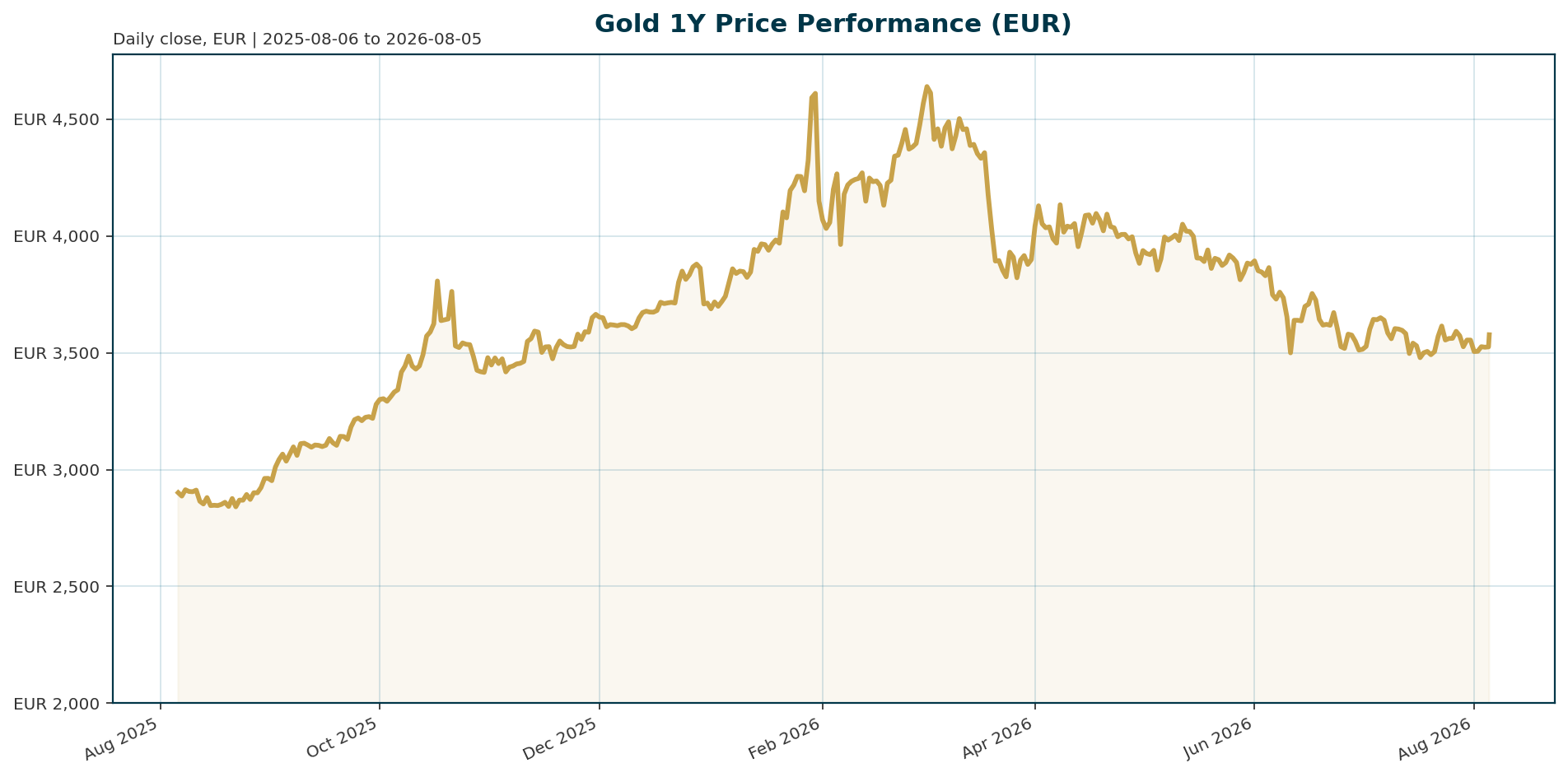
| Metric | Value | Context |
|---|---|---|
| Price (XAU/EUR) | 3,575.24 | Current market price |
| Year-to-Date Change | +21.9% | Significant outperformance year-to-date |
| 24h Change | +1.6% | Positive intraday momentum |
| All-Time High (ATH) | 4,688.32 | Jan 2026; current price is -23.7% from ATH |
| Market Cap | 1.58 B EUR | Rank 43 globally |
| Volume (24h) | 95.9 M EUR | Liquidity metrics |
| BTC Dominance | 56.58% | Crypto market share |
Macro Backdrop
The global macro environment presents a dichotomy for gold. Risk sentiment remains positive, evidenced by the Nasdaq Composite’s strong 5-day performance of 8.76% [T6]. This risk-on appetite creates a headwind for non-yielding assets like gold, as investors favor equities over safe havens. However, the backdrop is not uniformly bullish for risk assets. Euro area yields are mixed, with the AAA 10Y yield at 3.19% and a 10Y-2Y spread of 48.3 bp, suggesting potential fragility in the sovereign debt complex [T6]. The EUR/USD pair is trading at 1.1520, moving sideways over the past week.
The primary macro driver for gold remains the Federal Reserve’s policy path. Recent data indicates inflation remains sticky, running at the 91st percentile of its 12-month range [T2]. This has led to a complex environment where markets oscillate between narratives of eventual easing and a “higher-for-longer” rate environment. Real yields, currently estimated around 2% on the 10-year TIPS, are a critical determinant of gold’s price action [T2].
Investment Thesis
The investment thesis for gold rests on two pillars: structural central bank diversification and the inverse relationship between bullion and real interest rates. Despite recent consolidation, gold is viewed as a critical hedge against currency debasement and rising public debt levels [T6]. The World Gold Council’s 2026 survey highlights that 92% of central banks consider interest rate levels a primary factor in reserve management, with 90% citing gold’s historical crisis performance as highly relevant [T8].
Societe Generale emphasizes that central bank gold purchases have become a dominant structural factor, providing a consistent floor under prices by absorbing supply and reducing sensitivity to short-term rate expectations [T7]. This structural demand is expected to persist as institutions continue to diversify away from the US dollar, particularly in emerging markets [T7].
Bullish Drivers
- Real Yield Compression: A potential pivot in Federal Reserve policy could lead to a decline in real yields. If inflation moderates without triggering broad second-round effects, the Fed is likely to adopt a more moderate tone later in the year, potentially resuming an easing cycle [T3]. Falling real yields remove the opportunity cost of holding gold, historically providing strong support for bullion.
- Accelerated Central Bank Accumulation: Global central banks are accelerating their gold buying pace, averaging 1,000t over the past four years compared to 500t in the preceding decade [T8]. This structural demand, driven by geopolitical instability and inflation concerns, offers a robust support floor that is less sensitive to short-term speculative flows.
- Stagflationary Environment: A backdrop of slower growth alongside persistent inflation remains structurally supportive for gold. ING notes that while energy prices complicate the inflation outlook, a stagflationary regime supports gold over the longer term [T4]. This contrasts with the 2022 environment, where labor markets were far tighter, making second-round inflation effects less likely today.
Relative Positioning vs Bitcoin and Ethereum
Gold’s current correlation profile differs significantly from the crypto sector. While Bitcoin dominance remains high at 56.58%, gold’s price action is increasingly correlated with real yields rather than tech equities [T5]. This decoupling suggests that gold offers a distinct utility in a portfolio, particularly when real yields are elevated.
Unlike cryptocurrencies, which are often driven by speculative flows and risk-on sentiment, gold remains the primary reserve asset for central banks [T7]. The recent divergence between the Nasdaq Composite (strong risk appetite) and gold (consolidation) highlights gold’s role as a defensive asset within a portfolio, providing a hedge against the very equity risk sentiment that drives crypto valuations.
Scenario Framework
- Bullish Scenario: If inflation readings show clearer signs of moderation, investors could begin to anticipate a gradual easing cycle. A decline in real yields below 1.5% would likely trigger a re-rating of gold, potentially targeting the January 2026 ATH of 4,688.32 [T1][T3].
- Base Case: Inflation remains sticky, and the Fed maintains its current restrictive stance. Real yields stabilize around the 2% level, where gold has historically compounded. In this scenario, gold trades in a consolidation range, supported by central bank buying but capped by the opportunity cost of holding non-yielding assets.
- Bearish Scenario: If inflation surprises to the upside, markets may delay expectations for policy easing, leading to a rapid rise in real yields. This would place significant pressure on gold, potentially triggering profit-taking after its 21.9% YTD gains and the worst quarter in 13 years [T5][T6].
Valuation Discussion
Gold is currently trading at 3,575.24 EUR, representing a -23.7% pullback from its January 2026 ATH of 4,688.32 [T2]. This discount suggests room for upside if real yields normalize. However, valuation is not solely determined by price levels. Real yields on the 10-year TIPS are estimated at 2%, a level high by recent standards but still within the historical band where gold has compounded [T2].
Given the structural support from central bank demand and the elevated inflation environment, the current valuation appears fair. The market is currently pricing in a “higher-for-longer” rate environment, but the potential for a policy pivot remains a key catalyst for re-valuation toward ATH levels.
Risks
- Real Yield Reversal: The primary risk to the thesis is a sharp reversal in monetary policy. If the Fed maintains a hawkish stance or raises rates further, real yields could spike, creating a significant headwind for gold prices [T7].
- Profit Taking: After a strong run of 21.9% YTD and a worst quarter in 13 years, the market remains vulnerable to bouts of profit-taking. Any negative macro data could trigger a sell-off as investors rotate back into risk assets [T6].
- Geopolitical Decoupling: While geopolitical risks remain elevated, ING notes that gold’s direction depends less on headlines alone and more on how events shape inflation and policy expectations [T4]. If tensions de-escalate without translating into sustained inflation, the safe-haven premium may dissipate.
Appendix
Sources
- [T1] Gold approaches macro inflection as PCE data tests Fed outlook – FXStreet
- [T2] Central Banks Are Snapping Up Gold, ETF Investors Are Just Waking Up – 24/7 Wall St.
- [T3] Gold: Between inflation fears and diversification of reserves – UBS
- [T4] Geopolitics alone isn’t enough to lift gold – ING THINK
- [T5] Both Gold and Silver Lose Key Support Levels! – Bitget News
- [T6] Gold suffers worst quarter in 13 years amid interest rate hike fears – CNBC
- [T7] Gold’s Dual Drivers: Central Bank Flows and Real Yields – Societe Generale
- [T8] Central Bank Gold Purchases Hit 1,000t Average: WGC Survey – Mexico Business News
This report is AI-generated by GLM 4.7 Flash for informational purposes only. It does not constitute investment advice. The author and altii assume no liability for any decisions made based on the content provided herein.
Important Note / Wichtiger Hinweis:
EN: This report may have been generated using AI. It processes data from publicly available sources. The content is provided for informational purposes only.DE: Dieser Bericht kann mithilfe von KI erstellt worden sein. Dabei werden Daten aus öffentlich zugänglichen Quellen verarbeitet. Die Inhalte dienen ausschließlich Informationszwecken.
* DE: Die ergänzenden Inhalte können KI-generiert sein. EN: The additional content may be AI-generated.