
Listen to the summary
Key Data Snapshot
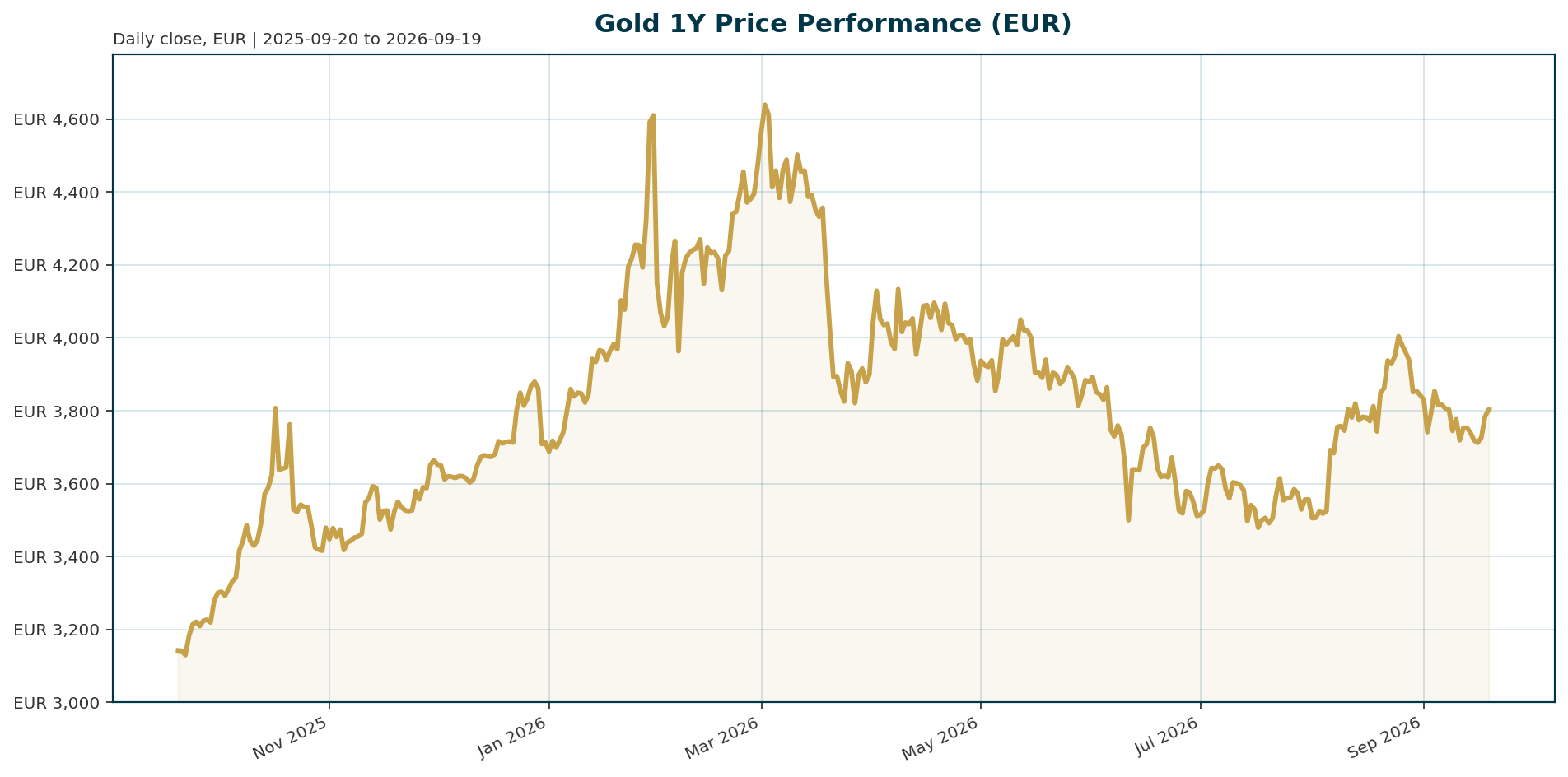
| Metric | Latest | Interpretation |
|---|---|---|
| XAU/EUR spot | €3,802.70 | Current anchor price, retrieved 2026-09-19 04:30:57 UTC. |
| Performance | 24h: +0.38%; 7d: +0.30%; 14d: -1.50%; 30d: -2.40%; 200d: -18.80%; 1y: +19.60% | Short-term stable, medium-term corrective, still positive on a 1-year horizon. |
| 24h range | Low: €3,779.26; high: €3,822.04 | Range width: €42.78, equal to 1.13% of spot. Spot is €19.34 below the high and €23.44 above the low. |
| All-time high | €4,688.32 on 2026-01-28 | Current drawdown: (3,802.70 / 4,688.32 – 1) = -18.89%. Required return to regain ATH: (4,688.32 / 3,802.70 – 1) = +23.29%. |
| All-time low | €1,265.28 on 2019-11-17 | Current price is +200.54% above the recorded low. |
| Instrument liquidity proxy | Market cap: €1.652bn; 24h volume: €147.441mn; rank: 52 | Turnover proxy: 147.441 / 1,652.249 = 8.92%. These are tracked instrument metrics, not total physical gold market metrics. |
| Supply proxy | Circulating supply: 434,499.37; total supply: 434,499.37; max supply: unavailable | Fully diluted valuation equals market cap at €1.652bn. |
| Euro rates | AAA 2Y: 3.148%; 10Y: 3.488%; 30Y: 3.750% | 10Y-2Y spread: (3.4875 – 3.1482) x 100 = 33.93 bp. 30Y-2Y spread: 60.20 bp. |
| FX | EUR/USD: 1.1497, -0.45% over 5d | EUR weakness mechanically supports XAU/EUR when USD gold is stable. Holding USD gold constant, a 1% fall in EUR/USD implies roughly a 1% rise in XAU/EUR. |
Macro Backdrop
The cross-asset backdrop is neutral rather than strongly risk-off. The market overview shows neutral risk sentiment, mixed equity momentum, a euro rates backdrop described as mixed with curve flattening, and mixed FX. DACH indicators averaged -0.01% over 5 days versus +0.85% for global equity indicators. Euro area AAA 10Y yields stand at 3.49%, down 3.5 bp over 5 days, while EUR/USD is 1.1497, down 0.45% over 5 days. This context matters for gold, but it remains subordinate to the core drivers: real yields, the dollar, official-sector demand and policy uncertainty.
For XAU/EUR, the macro signal is mixed. Lower euro long-end yields over the last 5 days marginally reduce the opportunity cost of holding a non-yielding asset. At the same time, the level of euro AAA yields remains elevated, with the 2Y at 3.148%, 10Y at 3.488% and 30Y at 3.750%. That rate structure does not argue for an unconditional gold breakout.
The global gold debate remains focused on the interaction between inflation, policy expectations and real interest rates. ING argues that geopolitics alone is not enough to lift gold, because geopolitical events need to transmit through inflation, monetary policy and real rates to become durable price drivers [T4]. This is important for a EUR investor: headline risk can support safe-haven demand, but persistent inflation can also keep real yields high and delay monetary easing.
The bullish macro case is that softer activity and inflation data reduce the pressure on central banks to tighten further, weaken the dollar and ease real yields. Saxo-related commentary points to a more favorable interest-rate backdrop for gold after softer US data and a rolling-over dollar [T3]. The bearish macro case is the opposite: resilient US growth, higher Treasury yields and a firmer dollar create a direct headwind for bullion [T1]. The most adverse combination would be a simultaneous rise in real yields and the dollar, particularly if inflation or employment data force renewed policy repricing [T3].
Investment Thesis
Our base case is constructive but not complacent. XAU/EUR is consolidating after a large drawdown from its January 2026 peak. The price is still +19.60% over 1 year, but -2.40% over 30 days and -18.80% over 200 days. That profile argues for strategic ownership, not aggressive momentum chasing.
The core institutional thesis is that gold has moved into a higher-floor regime. Société Générale has described a post-2022 regime shift in which gold traded near record highs despite persistently positive real yields, supported by central-bank purchases, dedollarisation, geopolitical uncertainty and sovereign-debt concerns [T2]. This matters because the traditional valuation model, based mainly on real-yield opportunity cost, has become less complete.
Gold’s demand base is also more institutional and less purely tactical than in past cycles. Central-bank demand, reserve diversification and geopolitical uncertainty continue to provide structural support even during corrections [T1]. ETF inflows have moderated but remain positive, while lower volatility can increase gold’s appeal to longer-term reserve managers rather than short-term momentum traders [T2].
The balanced conclusion: gold remains a strategic hedge against monetary, fiscal and geopolitical uncertainty, but near-term returns depend on whether real yields and the dollar ease or rise together. At €3,802.70, XAU/EUR is neither capitulating nor breaking out. It is pricing a structural bid with cyclical caution.
Bullish Drivers
- Official-sector demand: WGC-related reporting indicates central banks accumulated an average of roughly 1,000 tonnes of gold per year over the past four years, compared with about 500 tonnes over the preceding decade [T7]. This is the strongest structural anchor for gold.
- Reserve-manager intent: A WGC survey cited by The Hindu reports that a record 45% of respondents expect their own gold reserves to increase over the next 12 months, while only 1% expect a decrease [T8].
- Macro reserve rationale: Interest-rate levels were cited as relevant by 92% of survey participants, and 90% cited gold’s historical performance during crises as highly relevant [T7]. This confirms that gold is not only a commodity allocation, but a reserve-management tool.
- Emerging-market demand bias: EMDE institutions place especially high value on geopolitical instability as an allocation driver, with 95% citing it versus 67% for advanced economies [T7].
- Dedollarisation and sanctions hedging: Some reserve managers seek to diversify away from the US dollar to reduce sanctions vulnerability and hedge higher, more volatile inflation [T6].
- Persistent named buyers: China has reportedly extended its buying streak to 18 consecutive months, while Poland remains a major buyer and Eastern European and Asian central banks continue to dominate purchases [T1].
- EUR translation effect: EUR/USD is down 0.45% over 5 days. If USD gold is unchanged, EUR-based gold rises mechanically when the euro weakens.
- Recovery optionality: The price is 18.89% below the ATH, so a move back to prior highs would require a +23.29% return. That is meaningful upside, but it does not require a new secular high.
The bull case needs confirmation from both flows and macro. A durable move higher would be more credible if central-bank demand remains visible, ETF flows stay positive, real yields ease and EUR/USD weakness does not reverse abruptly.
Relative Positioning vs Bitcoin and Ethereum
Gold’s role differs materially from Bitcoin and Ethereum. In this report, gold is assessed as a reserve-quality macro hedge linked to central-bank demand, real yields, reserve diversification, geopolitical risk and sovereign-debt concerns [T2][T5][T6]. Crypto assets sit in a separate risk and liquidity complex.
The bundle provides broad crypto context but not enough data for a precise relative-return table. BTC dominance is 58.31%, total crypto market cap is €2.426tn equivalent as reported in the bundle, and total crypto 24h volume is 112.221bn in the bundle’s reporting terms. However, BTC spot price, BTC performance, ETH spot price and ETH performance are unavailable. Therefore, exact relative performance versus Bitcoin and Ethereum is unavailable.
| Asset | Available data | Institutional interpretation |
|---|---|---|
| Gold / XAU | XAU/EUR spot, performance, range, proxy volume and market cap available. | Macro hedge with reserve-manager and central-bank demand support. |
| Bitcoin | BTC dominance available at 58.31%; BTC spot and returns unavailable. | Relative-return conclusion unavailable from provided data. |
| Ethereum | Benchmark list includes Ethereum; ETH spot and returns unavailable. | Relative-return conclusion unavailable from provided data. |
Base positioning: treat gold as a policy and reserve hedge, not as a substitute for crypto beta. A bullish gold-versus-crypto view would require evidence that institutional reserve demand and lower real yields are pulling capital toward gold independent of digital-asset risk appetite. A crypto-outperformance view cannot be substantiated from the supplied dataset.
Scenario Framework
| Scenario | Assumptions | XAU/EUR implication |
|---|---|---|
| Base case: consolidation with structural floor | Neutral risk sentiment, mixed FX, euro yields stable to slightly lower, central-bank demand persistent, ETF flows not strongly negative. | XAU/EUR remains range-bound to modestly constructive. The current price near €3,802.70 is consistent with consolidation inside a positive 1-year trend. |
| Bull case: real-yield relief and weaker dollar | Real yields decline, the dollar weakens, ETF flows remain positive and central-bank demand stays visible. | XAU/EUR challenges converted resistance levels and begins to close the gap to the €4,688.32 ATH. Required return to ATH is +23.29%. |
| Bear case: real yields and USD rise together | US inflation or employment re-accelerates, policy expectations tighten, real yields rise and the dollar strengthens. | This is the highest-risk macro mix for gold. XAU/EUR likely retests lower consolidation levels as opportunity cost and FX pressure rise [T3][T5]. |
| Stagflation case | Energy prices lift inflation, growth slows, policy easing is constrained, but demand for inflation and policy hedges rises. | Near-term volatility increases. Higher real yields may cap rallies, but longer-term hedge demand remains supportive [T4]. |
USD technical references require EUR conversion. Saxo-related commentary cites USD 4,500 as a key technical test and USD 4,200 as a consolidation threshold [T3]. Using EUR/USD 1.1497:
- USD 4,500 / 1.1497 = €3,914.06, which is 2.93% above current XAU/EUR.
- USD 4,200 / 1.1497 = €3,654.00, which is 3.91% below current XAU/EUR.
These converted levels are indicative only. They depend on both USD gold and EUR/USD.
Valuation Discussion
Gold has no coupon, dividend or cash flow. Its valuation therefore depends on opportunity cost, scarcity, reserve demand, portfolio insurance value and currency translation. Real yields remain the cleanest traditional valuation input because they measure the inflation-adjusted return available on interest-bearing alternatives. J.P. Morgan notes that gold has historically had an inverse relationship with real yields because higher real yields raise the opportunity cost of holding a non-yielding asset [T6].
The complication is that the historical model has weakened. J.P. Morgan also notes that after the Fed began raising rates in 2022, real yields rose sharply, yet gold remained resilient and delivered a +13% return in 2023, ending that year at a record high of USD 2,068 per ounce [T6]. Société Générale similarly argues that gold has traded near record highs despite positive real yields, implying that structural forces have raised the floor [T2].
At €3,802.70, valuation is mixed:
- Bearish lens: Gold is not obviously cheap if judged by positive nominal yields and still-elevated real-rate risk. The 200-day performance of -18.80% shows that the market can reprice sharply when macro conditions tighten.
- Bullish lens: Gold trades 18.89% below its ATH, while official-sector demand and reserve diversification remain structural supports. If the equilibrium floor has risen, the current drawdown may represent consolidation rather than a regime break.
- EUR lens: EUR/USD at 1.1497 creates a currency channel. A weaker euro lifts XAU/EUR for any given USD gold price, while a stronger euro dilutes EUR returns.
Our valuation conclusion is balanced: XAU/EUR is not deeply discounted on a traditional real-yield model, but it is not stretched versus its own 2026 high if one accepts that central-bank demand, dedollarisation and sovereign-risk hedging have structurally repriced gold’s floor.
Risks
- Real-yield shock: A rapid rise in real yields would increase the opportunity cost of holding gold and pressure valuation [T5].
- Stronger US dollar: Rising Treasury yields, a firmer dollar and resilient US growth are cited as headwinds for bullion [T1].
- Policy repricing: A renewed acceleration in inflation or employment data that revives both real yields and the dollar is described as the clearest risk to gold’s outlook [T3].
- Higher-for-longer rates: Persistent inflation could delay easing, keep real yields elevated and cap gold rallies [T4].
- Official-sector slowdown: Central banks remain supportive, but buying may slow, reducing a key demand cushion [T4].
- ETF-flow reversal: ETF inflows have moderated, even if still positive in the cited commentary [T2]. A reversal would weaken tactical demand.
- Profit-taking: Gold remains vulnerable to bouts of profit-taking after strong multi-year performance [T4].
- Geopolitical transmission risk: Geopolitical events do not automatically lift gold unless they affect inflation, policy expectations, real yields or safe-haven allocation [T4].
- Data limitation: The supplied market cap, supply and volume metrics appear to describe a tracked gold proxy or instrument, not the full above-ground gold market.
- Relative-asset limitation: BTC and ETH spot and performance data are unavailable, so precise relative positioning versus Bitcoin and Ethereum is unavailable.
Appendix
Data and calculation notes
- Report generated at 2026-09-19 04:31:12 UTC.
- Market data retrieved at 2026-09-19 04:30:57 UTC.
- Asset: Gold, symbol XAU, quote currency EUR, CoinGecko id pax-gold.
- Market overview errors: none reported.
- EUR/USD source in bundle: frankfurter_fx, as of 2026-09-19.
- Euro area yield data source in bundle: ECB yield curve, as of 2026-09-17.
- ATH drawdown calculation: (3,802.70 / 4,688.32 – 1) x 100 = -18.89%.
- Required return to ATH: (4,688.32 / 3,802.70 – 1) x 100 = +23.29%.
- 24h range width: 3,822.04 – 3,779.26 = €42.78, or 42.78 / 3,802.70 = 1.13%.
- Euro AAA 10Y-2Y spread: (3.4875063501 – 3.1481938332) x 100 = 33.93 bp.
- Euro AAA 30Y-2Y spread: (3.7501901540 – 3.1481938332) x 100 = 60.20 bp.
- Euro AAA 10Y-5Y spread: (3.4875063501 – 3.2386915110) x 100 = 24.88 bp.
- Turnover proxy: 147,441,467 / 1,652,249,412 = 8.92%.
- USD level conversion assumption: EUR value = USD value / EUR/USD 1.1497.
- Market cap, supply and volume are treated as instrument or proxy metrics, not as measures of the total physical gold market.
- BTC and ETH relative-return calculations are not performed because spot prices and performance series are unavailable.
Sources
- [T1] Central banks keep gold bullish long term | The Star
- [T2] It’s time to get bullish on gold again, says SocGen | Kitco News
- [T3] ICYMI: ETF flows return to gold as Saxo flags 289-tonne central bank demand
- [T4] Geopolitics alone isn’t enough to lift gold | ING THINK
- [T5] Gold’s Dual Drivers: Central Bank Flows and Real Yields, According to Societe Generale | CryptoRank.io
- [T6] Is it a golden era for gold?
- [T7] Central Bank Gold Purchases Hit 1,000t Average: WGC Survey
- [T8] Central banks to increase gold reserves over next 12 months: WGC survey | The Hindu
This report is AI-generated, for informational purposes only, and does not constitute investment advice, a recommendation, an offer or a solicitation to buy or sell any asset.
Important Note / Wichtiger Hinweis:
EN: This report may have been generated using AI. It processes data from publicly available sources. The content is provided for informational purposes only.DE: Dieser Bericht kann mithilfe von KI erstellt worden sein. Dabei werden Daten aus öffentlich zugänglichen Quellen verarbeitet. Die Inhalte dienen ausschließlich Informationszwecken.
* DE: Die ergänzenden Inhalte können KI-generiert sein. EN: The additional content may be AI-generated.