
Watch the video
This player shows only the Gold chapter of the daily altii market briefing. Watch the full video on tube.altii.de.
Key Data Snapshot
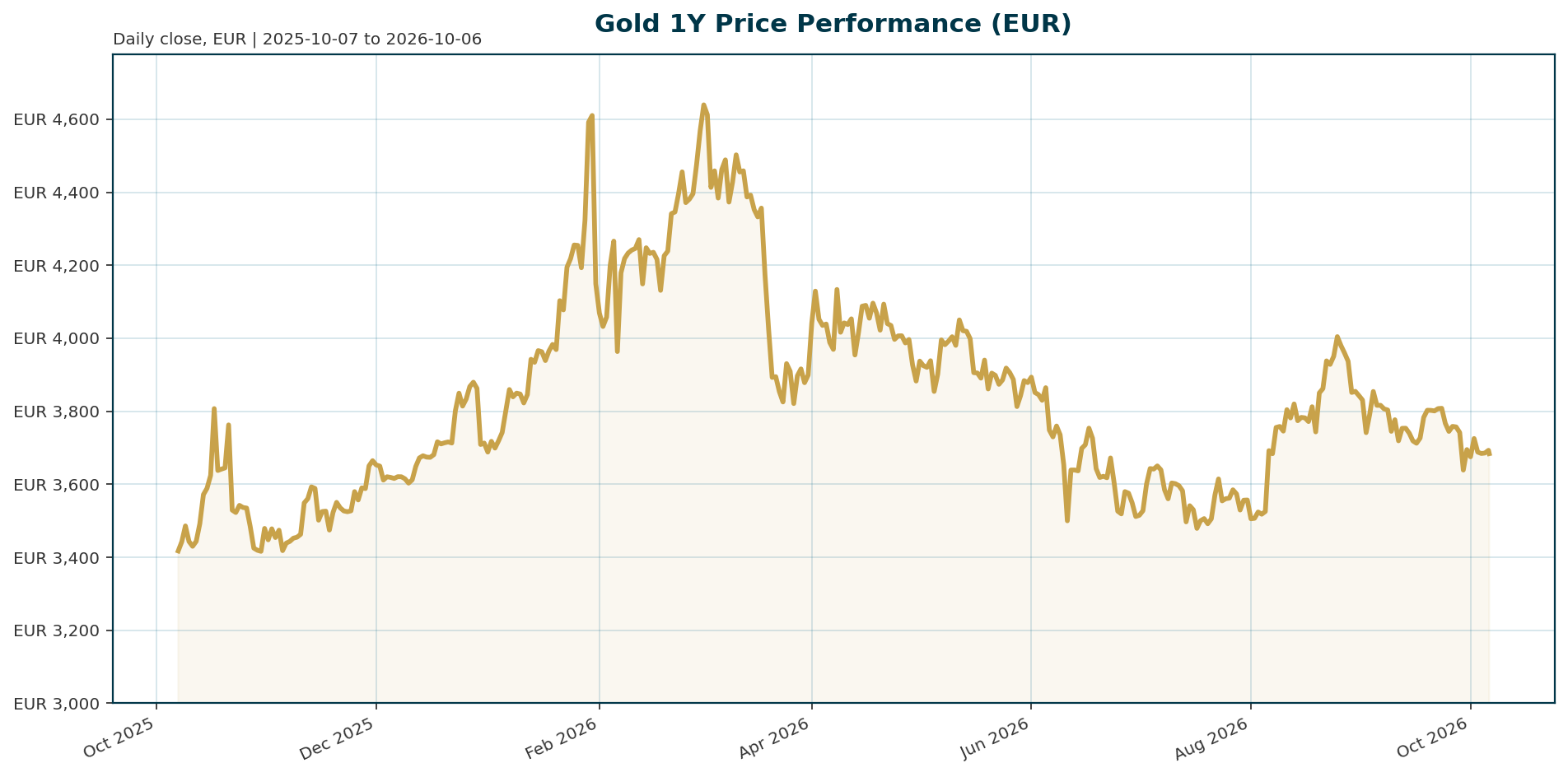
| Metric | Value | Comment |
|---|---|---|
| XAU/EUR price | 3681.63 | Pricing anchor for all analysis |
| 24h change | -0.65% | Mild, orderly |
| 7d change | -0.23% | Flat |
| 14d change | -4.70% | Consolidation phase |
| 30d change | -6.64% | Macro-driven pullback |
| 200d change | -12.08% | Largest horizon decline |
| 1y change | +5.33% | Still positive for EUR holders |
| 24h range | 3677.54 to 3719.38 | Range of 41.84, or 1.14% of price (41.84 / 3681.63) |
| All-time high | 4688.32 (2026-01-28) | Current price is -21.47% below ATH (3681.63 / 4688.32 – 1) |
| Upside to ATH | +27.34% | 4688.32 / 3681.63 – 1 |
| All-time low | 1265.28 (2019-11-17) | Current price is +191.0% above ATL (3681.63 / 1265.28 – 1) |
| Euro AAA 2Y yield | 2.99% | -24.1 bp over 5d |
| Euro AAA 10Y yield | 3.46% | -16.7 bp over 5d; 10Y-2Y spread 47.2 bp (3.464 – 2.992), curve steepening |
| EUR/USD | 1.1233 | -0.50% over 5d, -3.37% over 1m, euro weaker |
| Quoted instrument market cap / 24h volume | 1.60bn / 101.1m | Proxy instrument data, not global gold market totals (see Appendix); volume/market cap ratio 6.30% |
The performance gap between the 30d change (-6.64%) and the 1y change (+5.33%) is 11.97 percentage points. This confirms a cyclical correction inside a longer-term positive return profile rather than a full trend reversal.
Macro Backdrop
Market overview: Risk sentiment is neutral and equity momentum is mixed, with the Nikkei 225 the strongest 5-day performer at +5.31% and the ATX the weakest at -2.72%. DACH indicators average -1.64% over 5 days against +1.97% for global equity indicators, so the region is lagging. The rates backdrop features falling euro yields and a steepening curve: the euro area AAA 10Y yield sits at 3.46%, down 16.7 bp over 5 days, with a 10Y-2Y spread of 47.2 bp. In FX, the euro is broadly weaker, with EUR/USD at 1.1233, down 0.50% over 5 days. This backdrop is broadly constructive for euro-denominated gold at the margin, but it is context, not the core of the thesis.
Gold-specific drivers: Gold’s macro sensitivity is dominated by two variables. First, real yields: real yields are nominal government bond yields minus inflation, and they represent the true purchasing-power return on bonds. When real yields fall, the opportunity cost of holding a non-yielding asset declines and gold is typically supported [T8]. Academic evidence suggests long-term real rates explain inflation-adjusted gold prices better than short-term policy expectations, though both matter [T7]. Second, official-sector flows: Societe Generale identifies persistent central-bank buying and real-yield direction as the two primary forces currently shaping gold, with emerging-market reserve diversification away from the US dollar providing a structural floor [T1]. Lombard Odier frames the current slowdown as short term rather than structural, with higher yields and a stronger dollar the main headwinds, and expects the Fed to hold for much of 2026 with cuts only late in the year [T2]. The current mix of falling euro nominal yields and a weaker euro is conditionally supportive for XAU/EUR, but the bundle contains no direct real-yield or inflation-expectation series, so real-rate compression cannot be measured here and remains a scenario.
Investment Thesis
The core thesis for euro-based investors: gold remains a strategic diversifier and hedge against inflation surprises, fiscal credibility risk and institutional confidence erosion, but near-term XAU/EUR returns are capped until real-yield pressure eases decisively [T2]. The structural bid from central-bank reserve diversification is intact and increasingly decouples gold from short-term rate expectations [T1]. Meanwhile, if nominal rates rise but inflation stays elevated, real rates can remain low or negative, which historically still supports gold demand [T4]. The EUR translation layer matters in both directions: a weaker euro (EUR/USD down 3.37% over 1m) mechanically cushions EUR-denominated gold if USD gold stagnates, but a euro rebound would amplify any USD-gold drawdown in EUR terms. Weighing both sides, we treat the current -21.47% drawdown from the January 2026 ATH as a consolidation within a constructive medium-term structure, with the balance of risk determined by the real-yield path rather than by speculative flows.
Bullish Drivers
- Structural central-bank demand: Persistent official-sector buying, driven by reserve diversification away from the dollar, absorbs supply and reduces gold’s sensitivity to short-term rate repricing [T1].
- Real-yield relief scenarios: The bull case requires one of three triggers: a dovish pivot before inflation is fully controlled, inflation moderating without aggressive rate increases, or real yields declining because economic weakness outpaces the policy response [T3]. A sharp US slowdown leading to easing is described as the most favorable scenario for gold [T5].
- Fiscal and inflation-credibility hedging: Persistent fiscal uncertainty and still-high inflation reinforce private demand for diversified assets, and gold has recently correlated with fears around Fed independence [T2].
- Real-rate downside potential: Persistently high real rates suggest room for easing that could fuel a continuation of the bull market [T5].
- EUR translation tailwind: With the euro weaker across 5d and 1m horizons, EUR-denominated gold outperforms its USD equivalent on a relative basis, all else equal.
- Scarcity anchor: Gold’s slow, predictable supply growth supports its long-term purchasing-power role as inflation persists [T4].
Relative Positioning vs Bitcoin and Ethereum
The bundle provides only aggregate crypto context, not direct BTC or ETH price series, so this comparison must remain qualitative. Bitcoin dominance stands at 58.70%, total crypto market capitalisation is approximately 2.61 trillion USD, and 24h crypto volume is roughly 74.4 billion USD. No BTC/EUR, ETH/EUR or ETH/USD performance data is available in this bundle, and therefore no quantified relative-return comparison can be made here.
Framework-wise, the assets compete for overlapping but distinct mandates. Gold’s demand rests on real yields, official-sector reserve flows and inflation hedging [T1][T7]; Bitcoin and Ethereum trade more on liquidity conditions, risk appetite and crypto-native adoption cycles. With risk sentiment neutral and equity momentum mixed, there is currently no strong signal for a rotation either way. In a policy-easing, weak-growth scenario, gold’s defensive appeal would likely hold while crypto performance depends more heavily on a liquidity-driven risk-on bid. In a broad risk-on environment with falling yields, Bitcoin and Ethereum could compete for the same alternative-asset allocation dollars. In an institutional de-risking regime, gold’s reserve-asset status may be favored over crypto beta. These are scenario framings, not data-proven conclusions for this cycle.
Scenario Framework
- Bull (real-yield compression): Policy expectations turn dovish, real yields fall, central-bank buying persists, and the euro stays weak or stable. XAU/EUR retests and potentially exceeds the 4688.32 ATH, requiring +27.34% from current levels. Goldman Sachs is cited with a target near 4900 USD/oz, equivalent to roughly 4361 EUR/oz at EUR/USD 1.1233, about +18.5% above the current EUR price [T5].
- Base (range-bound consolidation): Central-bank demand supports the downside while higher-for-longer real-yield uncertainty caps upside. Lombard Odier’s expectation of Fed on-hold through most of 2026 fits this path [T2]. XAU/EUR oscillates below the ATH, with the 1y positive return (+5.33%) gradually rebuilt.
- Bear (tightening dominance): Oil-driven inflation persists through mid-2026, major central banks maintain or extend tightening, real yields rise, and ETF or physical demand weakens. The tightening signal currently dominates the geopolitical tug-of-war in one analysis [T3]. XAU/EUR extends the drawdown beyond -12.08% over 200d.
- Tail risk (reserve liquidation): The US, Germany and Italy hold approximately 8,133, 3,350 and 2,451 tonnes of official gold reserves respectively as of December 2025. Any major sovereign sale to stabilize public finances would weaken the structural price floor [T3].
- FX-overlay note: If USD gold is unchanged and EUR/USD moves 1%, EUR-denominated gold moves approximately inversely by around 1%. A euro rebound of 3% would roughly offset a 3% USD-gold gain for EUR holders.
Valuation Discussion
Gold produces no cash flow, so conventional DCF valuation does not apply. The relevant anchors are opportunity cost, real-yield regime and relative-level comparisons. Three anchors stand out:
- ATH anchor: At 3681.63, XAU/EUR trades 21.47% below the 4688.32 January 2026 ATH. A full recovery requires +27.34%. This is a demanding move that, historically, has required either real-yield compression or an acceleration of official-sector demand.
- Sell-side target reference: Goldman Sachs is cited with a target close to 4900 USD/oz [T5]. Converted at EUR/USD 1.1233, this equals roughly 4361 EUR/oz, implying about +18.46% upside from the current EUR price (4361 / 3681.63 – 1). This sits below the ATH in EUR terms because the cited target is USD-denominated and the euro would need to stay weak for the levels to reconcile. It is a reference point from a cited source, not an altii forecast. Major banks overall are described as cautious but expecting gold to return to or exceed prior highs in the medium term [T5].
- Regime anchor: With no direct real-yield series in this bundle, the valuation case rests on nominal euro yields (10Y at 3.46%, falling) and the direction of inflation. Long-term real rates are the strongest theoretical explanator for inflation-adjusted gold prices [T7]. If real yields stay elevated, valuation should be treated as constrained despite structural reserve-flow support; if real yields compress, the same price level becomes cheap on an opportunity-cost basis.
Net assessment: on level-based anchors, gold is neither cheap nor expensive in EUR terms; the valuation verdict depends almost entirely on the real-yield trajectory, which is currently unmeasurable from this dataset.
Risks
- Real-yield repricing: A sharp monetary-policy reversal driving real yields rapidly higher is the primary headwind [T1]. Higher-for-longer real yields are explicitly flagged as a negative factor [T2].
- Strong growth plus accelerating inflation: This is described as the most significant bearish risk: buoyant US growth and employment with accelerating inflation would solidify a Fed hiking cycle [T5].
- Oil-driven tightening transmission: The four-stage channel (conflict raises oil, oil drives inflation persistence, inflation forces tightening, tightening raises the opportunity cost of holding gold) currently sees the tightening signal dominant [T3].
- Demand fatigue: Investment demand reached historically high levels in 2025 and may have plateaued, so real-yield relief would not automatically restore demand growth [T5]. Prolonged ETF outflows and weaker physical demand such as jewellery are additional negatives [T2].
- Sovereign supply shock: Reserve liquidation by a major holder would undermine the structural price floor [T3].
- FX reversal: If the euro strengthens materially, XAU/EUR underperforms USD gold through translation, independent of gold’s USD-level dynamics.
- Data limitations: No direct real-yield, inflation-expectation, ETF-flow, central-bank purchase volume or physical demand series is available in this bundle, which lowers the precision of every scenario above.
Appendix
Definitions. Real yield: the nominal government bond yield minus the inflation rate, representing the purchasing-power return on bonds [T8]. Opportunity cost: the yield forgone by holding a non-interest-bearing asset like gold; falling real yields reduce it and support gold prices [T8]. Curve steepening: long-end yields rising relative to or falling less than short-end yields; the euro AAA 10Y fell 16.7 bp over 5 days versus 24.1 bp for the 2Y, producing the observed steepening.
Calculations. 24h range: 3719.38 – 3677.54 = 41.84, or 1.14% of price. ATH drawdown: 3681.63 / 4688.32 – 1 = -21.47%, consistent with the supplied -21.4722%. Upside to ATH: 4688.32 / 3681.63 – 1 = +27.34%. Distance above ATL: 3681.63 / 1265.28 – 1 = +191.0%, consistent with the supplied 190.97%. Volume/market-cap: 101,066,684 / 1,603,168,895 = 6.30%. 10Y-2Y spread: 3.4639685465 – 2.9918960503 = 0.4721, i.e. 47.2 bp, matching the supplied figure. Goldman target conversion: 4900 / 1.1233 = 4361.4 EUR/oz; upside: 4361.4 / 3681.63 – 1 = +18.46%. Performance gap: -6.6406% – 5.3307% = -11.97 pp.
Data caveats. The quoted market data is linked to the pax-gold identifier in the bundle and should be read as a quoted XAU/EUR instrument or tokenized-gold proxy, not as totals for the global physical gold market. Market cap, rank, supply and volume figures therefore have limited interpretation value. The market-overview block is contextual and does not replace gold-specific macro analysis. No direct real-yield, breakeven-inflation, ETF-flow, central-bank purchase, jewellery-demand, BTC-price or ETH-price series is included in this bundle. All scenario statements above are explicitly labeled assumptions, not measured conditions. Several cited sources lack publication dates in the provided source list, so recency is handled cautiously.
Sources.
- [T1] Gold’s Dual Drivers: Central Bank Flows and Real Yields, According to Societe Generale (CryptoRank.io)
- [T2] Gold’s slowdown doesn’t signal a reversal (Lombard Odier)
- [T3] Gold Declined 10% Over Two Weeks on Rising Oil Prices and Interest Rate Pressure (Crux Investor)
- [T4] How Inflation and Interest Rates Affect Gold Prices in 2026 (US Gold Bureau)
- [T5] Real Interest Rates at Record Highs: What If Gold Benefits Again? (GoldBroker)
- [T6] Gold: Between inflation fears and diversification of reserves (UBS)
- [T7] Gold and Silver: The Hidden Forces Driving Their Price Movements (The People’s Economist)
- [T8] Why Gold Goes Up When Jobs Numbers Come In Bad (GoldSilver)
Disclaimer. This report is AI-generated, for informational purposes only, and does not constitute investment advice or a recommendation to buy or sell any asset. Data reflects the bundle retrieved on 2026-10-06 and may not represent the latest market conditions. Investors should conduct their own due diligence and consult a licensed advisor before making allocation decisions.
Important Note / Wichtiger Hinweis:
EN: This report may have been generated using AI. It processes data from publicly available sources. The content is provided for informational purposes only.DE: Dieser Bericht kann mithilfe von KI erstellt worden sein. Dabei werden Daten aus öffentlich zugänglichen Quellen verarbeitet. Die Inhalte dienen ausschließlich Informationszwecken.
* DE: Die ergänzenden Inhalte können KI-generiert sein. EN: The additional content may be AI-generated.