
Watch the video
This player shows only the Gold chapter of the daily altii market briefing. Watch the full video on tube.altii.de.
Key Data Snapshot
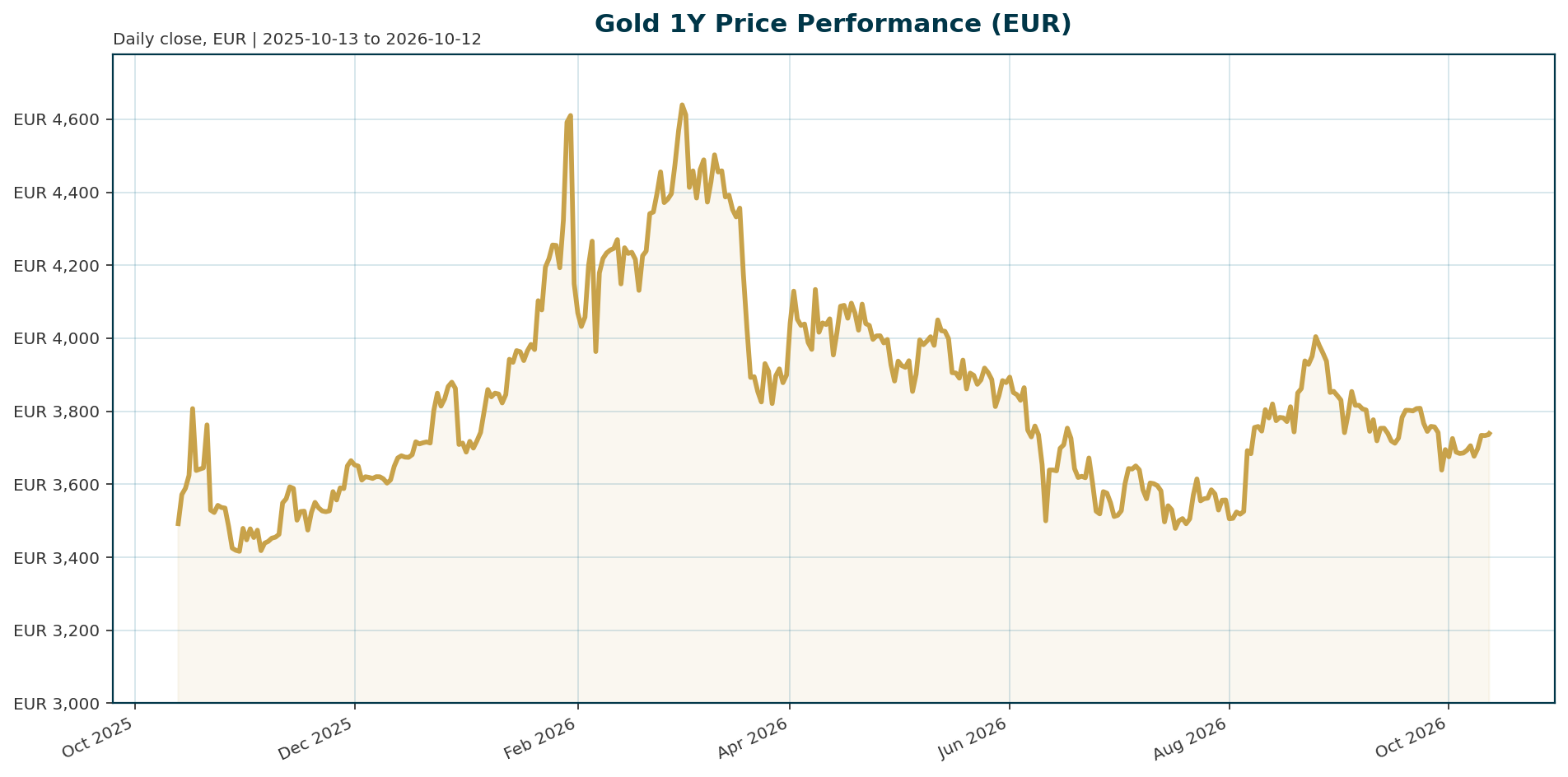
| Metric | Latest | Interpretation |
|---|---|---|
| XAU/EUR price | €3,741.39 | Modestly positive short term, still in drawdown from January 2026 high. |
| Performance | 1h +0.0092%, 24h +0.1928%, 7d +1.1450%, 30d -3.6129%, 200d -6.8886%, 1y +4.6507% | Near-term stabilization, but medium-term consolidation remains intact. |
| 24h range | High €3,751.85, low €3,728.61 | Range = €23.24, or 0.62% of the 24h low. |
| Distance from ATH | ATH €4,688.32 on 2026-01-28 | €4,688.32 – €3,741.39 = €946.93, equal to -20.1976%. |
| Distance from ATL | ATL €1,265.28 on 2019-11-17 | €3,741.39 – €1,265.28 = €2,476.11, equal to +195.6955%. |
| Euro area AAA yields | 2Y 3.0331%, 5Y 3.1965%, 10Y 3.5192%, 30Y 3.7782% | 10Y-2Y spread = 3.5192% – 3.0331% = 48.6 bp. |
| EUR/USD | 1.1218 | +0.1160% over 5d, -3.3764% over 1m, -4.5277% YTD. |
| Implied XAU/USD translation | $4,197.09 | €3,741.39 × 1.1218. This is a mechanical FX translation, not an independently sourced spot quote. |
| Token-proxy market data | Market cap €1.6441bn, 24h volume €104.6864mn, circulating supply 439,434.571174 | Volume to market cap = €104.6864mn / €1.6441bn = 6.37%. These fields reflect the Pax Gold proxy, not total physical gold. |
| Crypto context | Bitcoin dominance 59.6584%, total crypto market cap €2.5191tn, total crypto 24h volume €50.8616bn | Total crypto volume to market cap = €50.8616bn / €2.5191tn = 2.02%. |
Bottom line: XAU/EUR has stabilized over one week but remains 20.20% below its January 2026 peak. The tactical setup is mixed: euro yields remain elevated, EUR/USD translation matters for EUR investors, and the medium-term drawdown argues against chasing momentum. The strategic setup remains more constructive if official-sector demand, debt concerns and policy uncertainty continue to offset the opportunity cost of holding a non-yielding asset.
Macro Backdrop
The broader market backdrop is neutral rather than overtly defensive. Risk sentiment is classified as neutral, equity momentum is mixed, and DACH equities are lagging global peers. The S&P 500 has the strongest 5-day move at +0.48%, while DACH indicators average -1.83% over five days versus -0.37% for global equity indicators. The rates backdrop is mixed: the euro area AAA 10Y yield is 3.52%, up 5.5 bp over five days, and the 10Y-2Y spread is 48.6 bp. FX is also mixed, with EUR/USD at 1.1218 and up only 0.12% over five days. This cross-asset context does not deliver a clear cyclical tailwind for gold, but it also does not remove the demand for portfolio hedges.
For gold, the central macro issue remains the conflict between elevated real-rate pressure and structural reserve demand. Real yields matter because they measure the inflation-adjusted return available on interest-bearing assets. When real yields rise, the opportunity cost of holding gold rises; when real yields fall, gold becomes more attractive as a non-yielding store of value [T3][T7]. The bundle does not include a current real-yield series, so current real yields are unavailable.
The traditional playbook has weakened. SocGen argues that gold has traded near record highs despite persistently positive real yields, supported by central bank purchases, dedollarisation, geopolitical uncertainty and sovereign debt concerns [T1]. Saxo similarly describes a regime shift in which gold has moved from a pure macro trade toward a strategic asset backed by central banks, geopolitical fragmentation and fiscal-risk hedging [T4].
The near-term bearish case is still credible. Higher nominal and real yields can pressure a non-yielding asset, especially if rate cuts are delayed. SMM reports that elevated oil prices have increased inflation concerns and pushed markets to reconsider the speed of monetary easing, creating a more difficult backdrop for gold even as geopolitical risks support safe-haven demand [T5]. In Europe, the euro area AAA 10Y yield has risen 14.1 bp over one month, which reinforces the opportunity-cost headwind.
The medium-term bullish case rests on fiscal and monetary regime risk. CEOWORLD highlights that high public-debt burdens can be resolved through financial repression, inflation or currency depreciation, conditions in which gold has historically tended to outperform [T6]. For EUR-based investors, the USD channel also matters. Gold is priced globally in dollars, so EUR/USD moves affect translated returns. EUR/USD is broadly stable over five days but down 3.3764% over one month and 4.5277% year to date, meaning FX has been a material component of the EUR gold experience.
Investment Thesis
The institutional thesis for XAU/EUR is constructive but not unconditional. Gold should be viewed less as a short-term momentum trade and more as a reserve-quality hedge against monetary-policy uncertainty, fiscal sustainability risk, currency debasement risk and geopolitical fragmentation.
The bullish foundation is structural. SocGen remains strategically bullish on gold and views the metal as a hedge against monetary and policy uncertainty [T1]. Saxo argues that central banks have become a dominant marginal buyer since 2022, helping absorb Western investor selling and reducing gold’s sensitivity to higher yields [T4]. J.P. Morgan notes that a record 43% of 73 global monetary authorities expect their own gold reserves to increase over the next year [T7]. These claims support a higher floor thesis.
The bearish counterpoint is valuation and carry. XAU/EUR is still +195.70% above its 2019 low, while euro area AAA 2Y, 5Y and 10Y yields stand at 3.0331%, 3.1965% and 3.5192%. Gold offers no coupon, so sustained positive real yields can cap upside. The current -20.20% drawdown from the January 2026 ATH raises the key question: is this a cyclical correction within a structural bull regime, or the start of a reconnection with real-yield valuation discipline?
Our base case is the former: a consolidation phase inside a higher structural range. The case for a strategic allocation remains intact, but tactical sizing should reflect yield risk, USD risk and the possibility that official-sector buying slows at higher prices.
Bullish Drivers
- Central bank reserve demand: Official-sector demand remains the strongest structural support. Saxo states that central banks have become the dominant marginal buyer since 2022 [T4]. J.P. Morgan reports that 43% of 73 global monetary authorities expect to increase gold reserves over the next year [T7].
- Reserve diversification and dedollarisation: SocGen identifies dedollarisation, central bank purchases and sovereign debt concerns as factors that appear to provide a higher floor for gold [T1]. This matters because reserve managers are less price-sensitive than leveraged investors.
- Gold’s share in reserves: BigGo reports that Bundesbank President Joachim Nagel said gold’s share of global central bank reserves has risen from roughly 14% in 2023 to nearly 25% [T2]. If accurate, this signals a major shift in reserve composition.
- Physical mobility and crisis preparedness: BigGo reports that the Dutch Central Bank moved approximately 86 tonnes of gold from the United States and Canada to London between March and August 2026, with London becoming its largest single storage location at 32.1% [T2]. This supports the idea that reserve managers value deployable physical liquidity.
- Debt and fiat purchasing-power concerns: LBMA conference participants cited by BigGo argued that unsustainable debt burdens, persistent inflation and fiat purchasing-power concerns are driving investors toward gold [T2]. CEOWORLD similarly frames financial repression and currency depreciation as structural gold tailwinds [T6].
- Policy pivot optionality: Lower real yields reduce the opportunity cost of gold [T3]. CEOWORLD notes that faster policy easing could re-energize gold demand, while sustained negative real rates would be a powerful structural tailwind [T6].
- External bullish target reference: SMM reports that Bank of America maintained a 12-month gold target of $6,000 per ounce [T5]. Using the bundled EUR/USD rate of 1.1218, this translates mechanically to €5,348.55, calculated as $6,000 / 1.1218. That would imply 42.96% upside from €3,741.39. This is not our forecast, only an external reference translated into EUR.
Relative Positioning vs Bitcoin and Ethereum
Gold, Bitcoin and Ethereum compete for some of the same macro narratives, but they do not occupy the same institutional role. Gold’s support in this source set comes from central bank reserves, dedollarisation, real-yield dynamics and crisis liquidity [T1][T2][T4][T7]. The bundle provides no equivalent official-sector reserve-flow data for Bitcoin or Ethereum.
Bitcoin dominance is high at 59.6584%, which suggests Bitcoin remains the dominant crypto allocation within the digital-asset market. Total crypto market cap is €2.5191tn and total crypto 24h volume is €50.8616bn. By comparison, the gold market cap and volume fields in the bundle, €1.6441bn and €104.6864mn, reflect the Pax Gold token proxy, not the global physical gold market. They should not be used to compare total gold and total crypto market size.
Ethereum-specific data is unavailable in the bundle. ETH price, market cap, volume, returns, staking yield and network-fee metrics are all unavailable. Therefore, any gold-versus-Ethereum view must remain qualitative. Gold has the clearer reserve-asset thesis in the supplied data. Ethereum would require separate analysis of network usage, staking economics, regulatory treatment and risk appetite.
The relative positioning is balanced. In a sovereign-risk, financial-repression or reserve-diversification environment, gold has stronger evidence as an institutional hedge. In a broad risk-on liquidity cycle, Bitcoin and Ethereum could outperform because they behave more like high-beta monetary and technology assets. The supplied data supports that distinction but does not allow a precise return comparison.
Scenario Framework
| Scenario | Macro Conditions | XAU/EUR Implication | Key Monitor |
|---|---|---|---|
| Base case: consolidation | Neutral risk sentiment, mixed FX, elevated but stable euro yields, continued reserve demand. | XAU/EUR remains range-bound around the current €3,741.39 area, with structural buying limiting downside but yields capping upside. | Euro area 10Y yield at 3.5192%, 10Y-2Y spread at 48.6 bp, EUR/USD at 1.1218. |
| Bull case: structural bid dominates | Faster policy pivot, lower real yields, sticky inflation expectations, renewed central bank accumulation and fiscal stress. | Gold retests higher levels and potentially moves toward the prior ATH of €4,688.32. Required move = €4,688.32 / €3,741.39 – 1 = 25.31%. | Reserve accumulation disclosures, real-yield declines, policy credibility concerns. |
| Bear case: opportunity cost reasserts | Higher real yields, stronger USD, risk-on rotation, lower inflation-hedging demand and moderation in official-sector buying. | The current -20.20% drawdown extends, and gold reconnects with traditional real-yield valuation pressure. | Rate-cut repricing, USD strength, ETF outflows, evidence of slower central bank buying. |
| Tail-risk case: reserve shock | Fiscal stress, financial repression, geopolitical shock or sanctions risk increases demand for neutral reserve assets. | Gold scarcity premium rises, especially for deployable physical holdings. | Reserve relocation, sovereign debt spreads, capital controls, crisis-liquidity indicators. |
Real yields remain the swing factor. T3 and J.P. Morgan emphasize the historical inverse relationship between real yields and gold because real yields capture opportunity cost [T3][T7]. At the same time, SocGen and Saxo argue that gold’s resilience despite positive or rising real yields points to a post-2022 structural regime shift [T1][T4]. The investment decision depends on which force dominates next.
Valuation Discussion
Gold has no cash flow, no coupon and no earnings yield. Valuation must therefore rely on opportunity cost, FX translation, reserve demand, inflation credibility and historical price anchors.
On price anchors, XAU/EUR at €3,741.39 is elevated versus the 2019 low of €1,265.28, with a cumulative gain of 195.70%. It is also 20.20% below the January 2026 ATH of €4,688.32. This leaves gold neither cheap in a long-run price sense nor technically extended relative to its recent peak.
On carry, euro yields remain a headwind. The euro area AAA 2Y yield is 3.0331%, the 5Y yield is 3.1965%, and the 10Y yield is 3.5192%. A non-yielding asset must justify ownership through diversification, convexity, crisis liquidity or purchasing-power protection. If real yields stay high and stable, valuation support weakens.
On regime, the valuation floor may have shifted higher. SocGen argues that traditional models would imply significantly lower gold prices under positive real yields, but central bank purchases, dedollarisation, geopolitical uncertainty and sovereign debt concerns appear to support a higher floor [T1]. Saxo argues that Asian and official-sector demand diluted the influence of rates and currencies during the 2022 to 2023 real-yield surge [T4].
On FX, EUR investors must separate global gold price changes from currency translation. The implied XAU/USD translation is $4,197.09, calculated as €3,741.39 × 1.1218. If EUR/USD rises, a stable USD gold price translates into a lower EUR gold price. If EUR/USD falls, the EUR gold price can rise even without a USD gold rally.
The valuation conclusion is balanced. Gold screens expensive versus historical lows and vulnerable to yield shocks. It also screens strategically supported if the market continues to price reserve diversification, financial repression and fiat purchasing-power risk. The current drawdown improves entry optics, but it does not eliminate carry risk.
Risks
- Higher real yields: Delayed rate cuts and elevated real yields create a difficult backdrop for non-yielding assets such as gold [T5][T8]. The bundle does not provide current real-yield data, so this risk cannot be quantified directly.
- Stronger USD: A stronger dollar can pressure global gold demand and reduce EUR-based upside if EUR/USD rises from current levels. EUR/USD is already down 4.5277% YTD, making FX translation material.
- Central bank demand moderation: Saxo notes that as gold prices rise, the value of existing central bank reserves increases, which could eventually moderate official buying [T4].
- Risk-on rotation: A broad risk-on environment, geopolitical de-escalation or stronger growth could reduce hedging demand and weigh on gold [T4].
- Policy shock volatility: SMM reports that gold futures fell 6.4% in a single day after investors interpreted Kevin Warsh’s hawkish reputation as bearish for gold [T5]. This illustrates gold’s sensitivity to perceived central bank reaction functions.
- Debasement trade overconfidence: BigGo cautions that the debasement trade does not imply a one-way rally [T2]. Positioning can become crowded even when the structural story is valid.
- Current momentum is not uniformly bullish: XAU/EUR is down 3.6129% over 30 days and 6.8886% over 200 days, despite a positive 1-year return of 4.6507%.
- Data limitations: The bundle lacks direct real-yield data, inflation-expectation data, ETF-flow data, physical gold supply-demand data and Ethereum-specific metrics. The market cap and supply fields relate to the Pax Gold proxy, not total above-ground gold.
Appendix
Data Notes and Calculations
- Report timestamp: Generated at 2026-10-12T04:47:22.510286Z.
- Market data timestamp: Retrieved at 2026-10-12T04:47:16.453280Z.
- Market overview timestamps: Data points retrieved between 2026-10-12T04:47:19.920462Z and 2026-10-12T04:47:22.507368Z.
- Instrument caveat: The bundle uses Coingecko ID
pax-gold. Market cap, circulating supply, fully diluted valuation and market-cap rank should be treated as token-proxy metrics, not as measures of the total physical gold market. - ATH drawdown: (€3,741.39 – €4,688.32) / €4,688.32 = -20.1976%.
- ATL gain: (€3,741.39 – €1,265.28) / €1,265.28 = +195.6955%.
- 24h range: €3,751.85 – €3,728.61 = €23.24. Percentage range = €23.24 / €3,728.61 = 0.62%.
- 10Y-2Y spread: 3.51918971% – 3.0331429854% = 0.4860467246%, or 48.6 bp.
- 5Y-2Y spread: 3.1965190203% – 3.0331429854% = 16.3 bp.
- 30Y-10Y spread: 3.7781543009% – 3.51918971% = 25.9 bp.
- Implied XAU/USD: €3,741.39 × 1.1218 = $4,197.09. This is an FX translation using bundled EUR/USD, not an independently sourced spot XAU/USD price.
- BofA target translation: $6,000 / 1.1218 = €5,348.55. Upside from €3,741.39 = 42.96%. This is a mechanical conversion of an external target, not an altii forecast.
Definitions
- Real yield: The inflation-adjusted return on an interest-bearing asset.
- Opportunity cost of gold: The foregone real return from holding a non-yielding asset instead of cash or bonds.
- Dedollarisation: Reserve diversification away from concentrated USD exposure.
- Financial repression: A policy mix that can keep nominal yields below inflation, producing low or negative real rates.
Sources
- [T1] It’s time to get bullish on gold again, says SocGen | Kitco News
- [T2] Gold Holds Above $4,000 Even as US Treasury Yields Top 5% — Institutions Say Gold’s Pricing Logic Is “Re-Anchoring” — BigGo Finance
- [T3] Why Gold Is Rising and Why It May Not Stop When the Crisis Does – Article | Crux Investor
- [T4] Gold in review from pure macro trade to cornerstone asset | Saxo
- [T5] Bank of America stands firm on 12-month $6,000 gold – Shanghai Metals Market (SMM)
- [T6] Report: Central Banks Now Hold More Gold Than Treasuries—What That Means for Global Capital and Currencies – CEOWORLD magazine
- [T7] Is it a golden era for gold? | J.P. Morgan Private Bank U.S.
- [T8] menu
This report is AI-generated, for informational purposes only, and not investment advice. It does not constitute a recommendation to buy, sell or hold gold, tokenized gold, cryptocurrencies or any financial instrument.
Important Note / Wichtiger Hinweis:
EN: This report may have been generated using AI. It processes data from publicly available sources. The content is provided for informational purposes only.DE: Dieser Bericht kann mithilfe von KI erstellt worden sein. Dabei werden Daten aus öffentlich zugänglichen Quellen verarbeitet. Die Inhalte dienen ausschließlich Informationszwecken.
* DE: Die ergänzenden Inhalte können KI-generiert sein. EN: The additional content may be AI-generated.