
Watch the video
This player shows only the Gold chapter of the daily altii market briefing. Watch the full video on tube.altii.de.
Key Data Snapshot
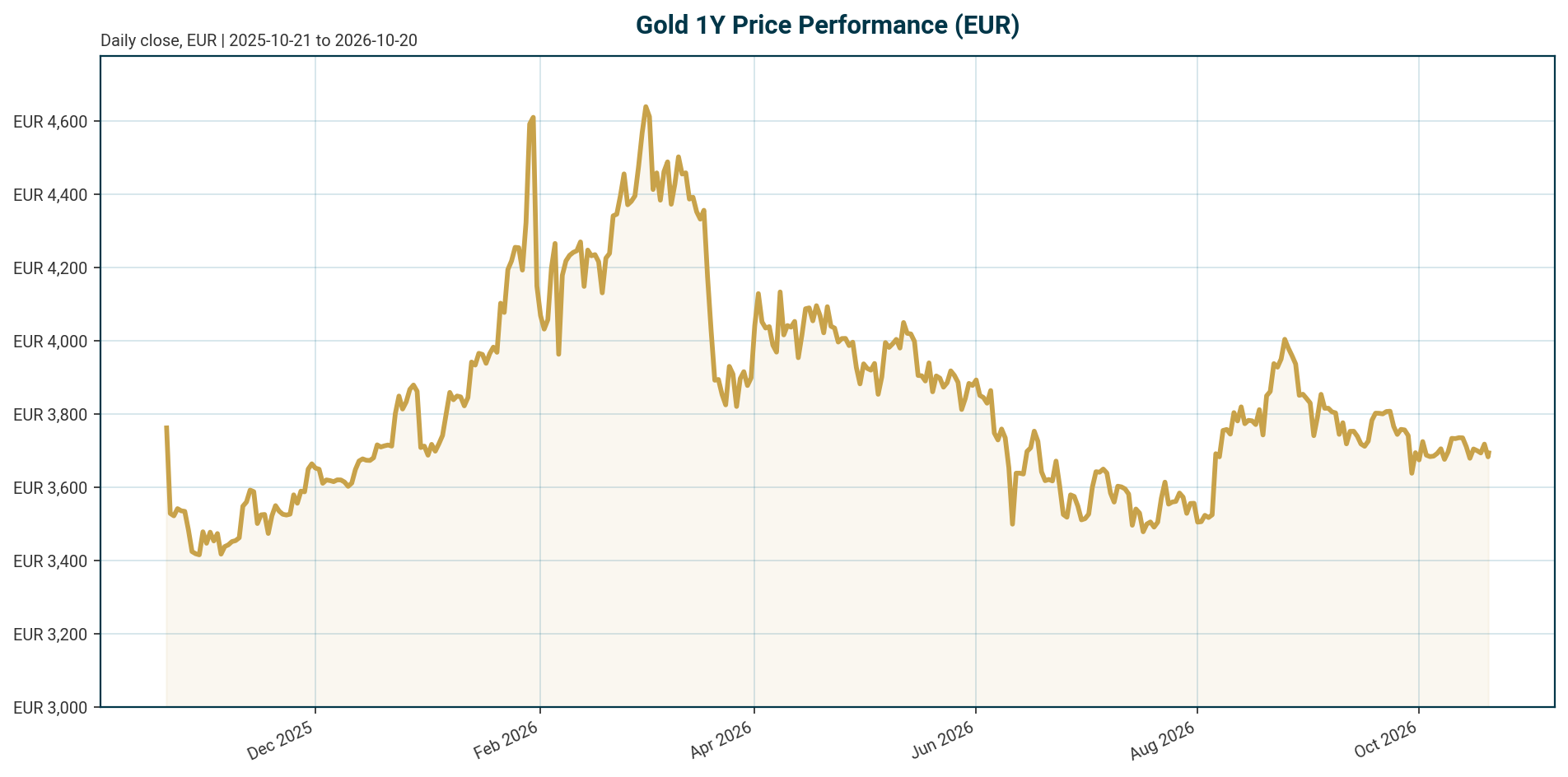
Gold (XAU/EUR) is currently trading at 3,688.98 EUR, representing a 21.32% drawdown from its January 28, 2026 all-time high (ATH) of 4,688.32 EUR. Despite this pullback, the 200-day performance remains negative at -11.17%, while the 1-year return stands at -2.68%. In the broader digital asset ecosystem, gold holds a market capitalization of approximately 1.63 billion EUR, significantly smaller than the total crypto market cap of 2.46 trillion USD. Bitcoin dominance currently sits at 59.59%, highlighting the continued dominance of the leading cryptocurrency.
| Asset | Price (EUR) | 24h Change | 200d Change | ATH Change |
|---|---|---|---|---|
| Gold (XAU) | 3,688.98 | -0.66% | -11.17% | -21.32% |
Macro Backdrop
Risk sentiment is neutral to negative with equity momentum weak, specifically the Nikkei 225 falling 5.16% over five days, while the DAX has outperformed with a 0.24% gain. The rates backdrop is mixed with the Federal Reserve having cut 75 basis points to a 3.75% upper bound, contrasting with the European Central Bank raising rates by 25 basis points in June and September. The FX backdrop is mixed, with EUR/USD at 1.1236, and key observations highlight DACH outperformance relative to global peers. Inflation remains a persistent tail risk, with the Consumer Price Index running at 332.4 on the FRED index, placing it in the 91st percentile of its 12-month range.
Investment Thesis
The investment thesis centers on a structural shift in demand, specifically the acceleration of central bank accumulation to an average of 1,000 tonnes annually over the last four years. This shift is driven by a desire to hedge against geopolitical instability and de-dollarization, with 89% of central bankers expecting further reserve growth. Consequently, gold’s pricing logic is re-anchoring away from the traditional negative correlation with bond yields, supported by persistent inflation and fiscal uncertainty. The macro backdrop helps, with real yields on the 10-year TIPS sitting around 2%, a level high by recent standards but still well inside the band where gold has historically compounded.
Bullish Drivers
- Structural Reserve Diversification: Central banks are aggressively accumulating gold, with 45% of respondents expecting their own reserves to increase over the next year. This is driven by a need to reduce exposure to the dollar and mitigate sanctions risks, as seen in the Dutch Central Bank moving 86 tonnes of gold from the US and Canada to London.
- Geopolitical Instability: An unprecedented 90% of central bank respondents cited gold’s historical performance during crises as highly relevant. Emerging markets, where 95% view geopolitical instability as a key allocation driver, are prioritizing gold as a safe haven.
- Inflation Persistence: Rising oil prices, which have surged from roughly $70 to above $100 following the US-Iran conflict, along with low energy inventories and supply chain disruptions, ensure that inflation expectations remain elevated. This supports the “debasement trade” thesis.
Relative Positioning vs Bitcoin and Ethereum
Gold remains a foundational store of value, currently trading at a significant discount to its ATH, while Bitcoin dominance is high at 59.59%. Gold’s reaction to macro news shows resilience compared to equities, but it trails the volatility of crypto assets. The “Hot Money” is just waking up to gold, potentially leading to a re-rating of the asset class relative to its traditional correlation with bonds. While silver reacted more aggressively to recent soft jobs reports, gold demonstrated stability, indicating a maturation of the asset’s role in diversified portfolios.
Scenario Framework
- Base Case: The Federal Reserve maintains policy rates at 3.75% while the ECB remains hawkish. Real yields stabilize around 2%, and central bank buying offsets any potential retail ETF outflows. Under this scenario, gold consolidates above 3,600 EUR.
- Bull Case: The Federal Reserve accelerates rate cuts, causing real yields to collapse below 1%, or geopolitical tensions flare up significantly. In this environment, gold reclaims ATH levels, potentially testing 4,500 EUR.
- Bear Case: Real yields spike above 3% due to a “higher-for-longer” Fed policy, or the US dollar strengthens significantly. If physical demand collapses, gold could test support levels near 3,500 EUR.
Valuation Discussion
The current valuation offers a margin of safety despite high real yields, as the asset is trading approximately 21% below its January 2026 peak. Valuation is supported by the historical band where gold has compounded, suggesting the current drawdown is a pricing correction rather than a fundamental breakdown. The breakdown in the traditional inverse correlation with yields implies that current valuations may be supported by structural demand from central banks rather than yield arbitrage.
Risks
- Real Yield Shock: If real yields rise significantly above 3%, the opportunity cost of holding gold could pressure prices despite central bank buying.
- ETF Outflows: If private investor sentiment turns negative, the lack of yield generation could lead to significant outflows, particularly if the correlation with yields re-establishes itself.
- Fiscal Dominance: If global debt burdens force central banks to monetize debt aggressively, the currency debasement thesis could reverse if the US dollar strengthens unexpectedly.
Appendix
Sources
- Central Banks Are Snapping Up Gold, ETF Investors Are Just Waking Up: The Best Gold ETFs to Own Before It Hits $5,000 – 24/7 Wall St. [T1]
- Gold Holds Above $4,000 Even as US Treasury Yields Top 5% — Institutions Say Gold’s Pricing Logic Is “Re-Anchoring” — BigGo Finance [T2]
- Central Bank Gold Purchases Hit 1,000t Average: WGC Survey [T3]
- Is it a golden era for gold? | J.P. Morgan Private Bank U.S. [T4]
- Gold vs Silver: Macro Backdrop and Central Bank Buying [T5]
- Gold’s slowdown doesn’t signal a reversal | Lombard Odier [T6]
- Central Bank Gold Reserves Survey 2026 | World Gold Council [T7]
- Central banks to increase gold reserves over next 12 months: WGC survey – The Hindu [T8]
This report is AI-generated for informational purposes only and does not constitute investment advice. Please consult a qualified financial advisor before making investment decisions.
Important Note / Wichtiger Hinweis:
EN: This report may have been generated using AI. It processes data from publicly available sources. The content is provided for informational purposes only.DE: Dieser Bericht kann mithilfe von KI erstellt worden sein. Dabei werden Daten aus öffentlich zugänglichen Quellen verarbeitet. Die Inhalte dienen ausschließlich Informationszwecken.
* DE: Die ergänzenden Inhalte können KI-generiert sein. EN: The additional content may be AI-generated.