
Listen to the summary
Key Data Snapshot
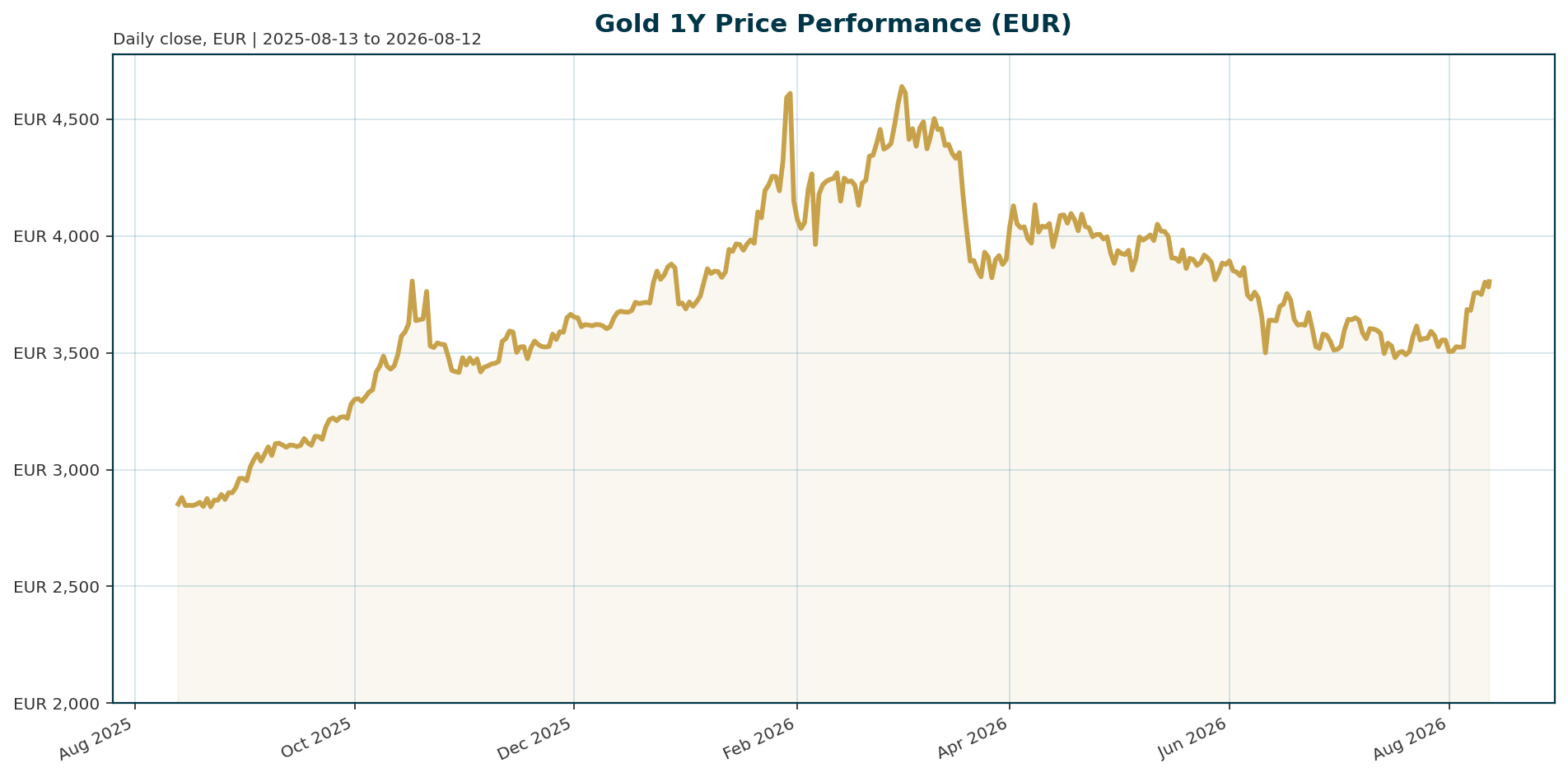
| Metric | Value | Context |
|---|---|---|
| XAU Price (EUR) | 3,807.74 | Trading below 2026 ATH of 4,688.32 EUR |
| Year to Date | +31.2% | Significant rally, but -18.8% from all-time high |
| 200-Day Return | -12.1% | Recent consolidation phase following peak volatility |
| Euro Area 10Y Yield | 3.20% | Up 5.3bp over 5 days, acting as a headwind |
| BTC Dominance | 56.30% | High dominance suggests competitive landscape for safe-haven flows |
Macro Backdrop
The broader market environment displays neutral to positive risk sentiment with Euro area equities like the DAX leading gains at 5.28% over one month. Rates are mixed as Euro area AAA 10Y yields rise to 3.20%, while the EUR/USD pair remains stable at 1.1557. Key observations include the strong performance of the Nikkei 225 and the weakness in the Hang Seng, indicating divergent regional momentum. Gold sits at the center of this debate because of its strong relationship with real interest rates, which remain the primary transmission mechanism for price action [T1][T2].Investment Thesis
Gold is navigating a transition from a speculative risk-on trade to a defensive structural asset. Despite a challenging monetary policy backdrop that resulted in the worst quarter for gold since 2013, institutional consensus remains constructive over the next 12 months. The core thesis rests on the “new regime” characterized by elevated sovereign debt, volatile inflation, and tested central bank independence. Investors are increasingly viewing gold not merely as a hedge against inflation but as a critical diversifier against currency debasement and geopolitical risk, supported by record levels of central bank accumulation [T6][T7][T8].Bullish Drivers
The primary bullish catalyst for gold is the potential for real interest rates to decline or remain negative. Wells Fargo analysis indicates that four out of five modeled macro scenarios point toward conditions structurally supportive of gold appreciation. A stagflationary backdrop—slower economic growth coupled with persistent inflation—remains a key tailwind, as it erodes the real value of fiat currency while maintaining gold’s utility as a store of value. Furthermore, central bank demand is acting as a structural backstop, absorbing supply and reducing sensitivity to short-term interest rate fluctuations [T2][T3][T8].Relative Positioning vs Bitcoin and Ethereum
Gold continues to hold its status as the premier safe haven, though it faces stiff competition from digital assets. With Bitcoin dominance standing at 56.30%, capital allocation is heavily skewed toward crypto, which has outperformed traditional safe havens in risk-on environments. However, gold’s year-to-date performance of +31.2% demonstrates resilience against this competition. As market participants rotate into defensive positions, gold is likely to reclaim alpha from Bitcoin and Ethereum, which may experience volatility during periods of macro uncertainty [market_data].Scenario Framework
- Scenario 1 (Bearish): Real yields spike due to persistent inflation, forcing the Federal Reserve to delay rate cuts. This increases the opportunity cost of holding gold, potentially testing support levels near 3,700 EUR.
- Scenario 2 (Base): Markets consolidate as real yields remain sticky. Gold trades in a range between 3,700 and 3,900 EUR, supported by steady central bank buying which absorbs selling pressure.
- Scenario 3 (Bullish): A soft landing or stagflationary environment emerges, causing real yields to collapse. Gold rallies, potentially reclaiming its all-time high and approaching the Wells Fargo fair value estimate of ~4,500 EUR.
Valuation Discussion
Gold currently trades at a discount to its historical highs and institutional fair value estimates. The metal is down 18.8% from its January 2026 ATH of 4,688.32 EUR, yet it remains significantly above its 2019 lows. With Euro area yields rising, the opportunity cost of holding gold has increased, yet the current price of 3,807.74 EUR appears attractive relative to the structural demand backdrop. Wells Fargo estimates fair value around 4,500 EUR, suggesting room for upside if real yields continue to decline or if central bank diversification accelerates [T7][T8].Risks
The most significant risk to the gold thesis is a sharp reversal in monetary policy that drives real yields significantly higher. If inflation proves stickier than anticipated, the Federal Reserve may maintain a hawkish stance, pressuring the metal. Additionally, profit-taking risk remains elevated following a 16% drawdown in the second quarter of 2026. Finally, a sudden de-escalation in geopolitical tensions could remove the risk premium currently supporting the price, leading to a short-term correction [T1][T5][T6].Appendix
Sources
- [T1] Gold approaches macro inflection as PCE data tests Fed outlook
- [T2] Geopolitics alone isn’t enough to lift gold | ING THINK
- [T3] Gold’s Dual Drivers: Central Bank Flows and Real Yields, According to Societe Generale
- [T4] Gold Price Edges Higher As Crucial US-Iran Deal Hopes Pressure US Dollar, but Analysts Warn of Li…
- [T5] Both Gold and Silver Lose Key Support Levels! Has Last Year’s Get-Rich-Quick Myth Finally Ended?
- [T6] Gold suffers worst quarter in 13 years amid interest rate hike fears
- [T7] Is it a golden era for gold? | J.P. Morgan Private Bank U.S.
- [T8] Gold Is Starting to Look Interesting: Wells Fargo
This report is AI-generated for informational purposes only and does not constitute investment advice. Always conduct your own due diligence before making financial decisions.
Important Note / Wichtiger Hinweis:
EN: This report may have been generated using AI. It processes data from publicly available sources. The content is provided for informational purposes only.DE: Dieser Bericht kann mithilfe von KI erstellt worden sein. Dabei werden Daten aus öffentlich zugänglichen Quellen verarbeitet. Die Inhalte dienen ausschließlich Informationszwecken.
* DE: Die ergänzenden Inhalte können KI-generiert sein. EN: The additional content may be AI-generated.