
The altii-Gold-Report
Listen to the summary
Key Data Snapshot
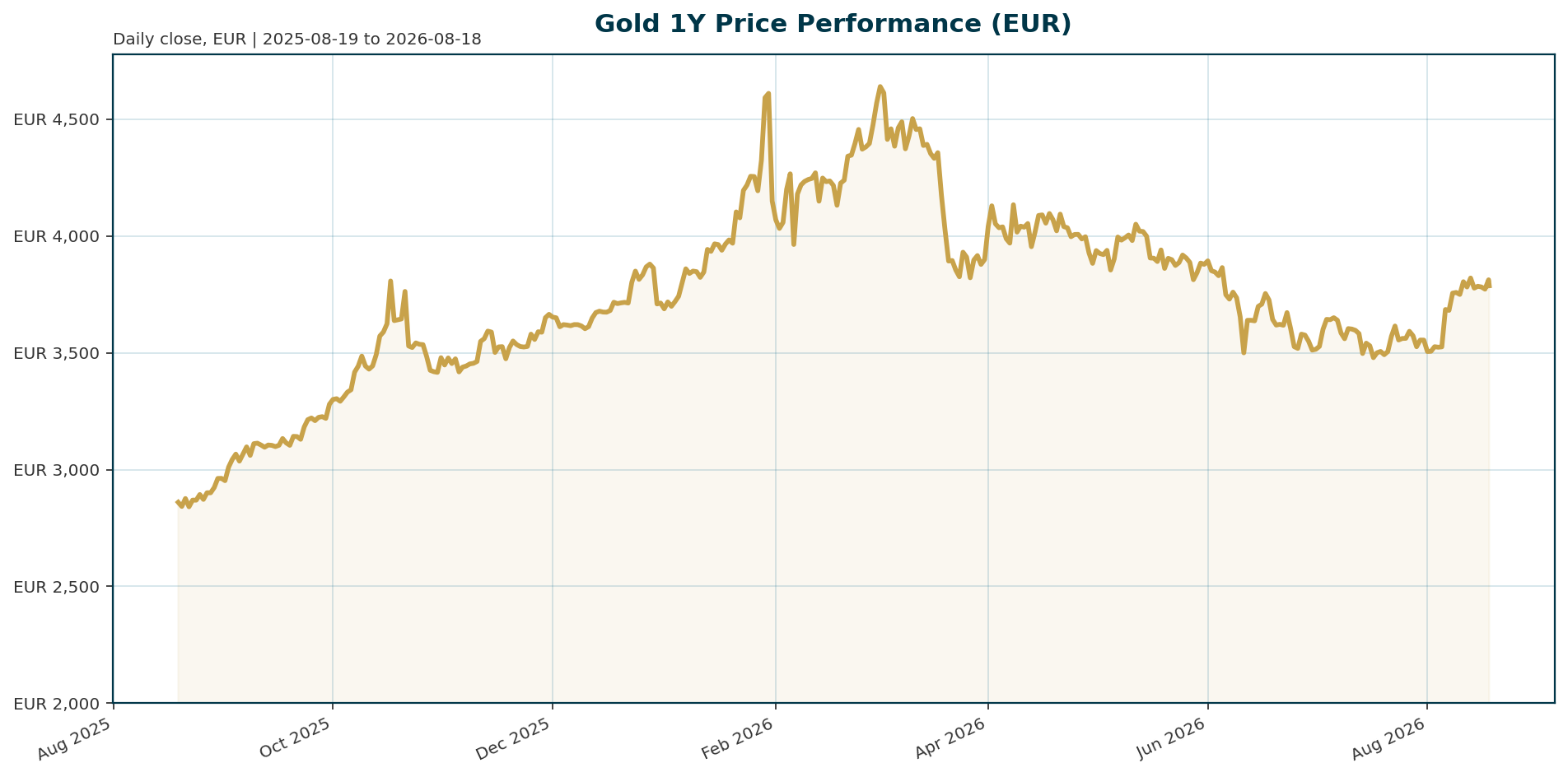
| Metric | Value |
|---|---|
| Current Price (XAU/EUR) | 3,790.32 |
| All-Time High (ATH) | 4,688.32 EUR (Jan 28, 2026) |
| Year-to-Date (YTD) | +31.5% |
| 200-Day Change | -16.3% |
| 24h Volume | 100.69M EUR |
| Market Cap Rank | 42 |
Macro Backdrop
Global risk sentiment is broadly positive, with the Nasdaq Composite leading gains at 0.75% over the past five days [T1]. However, the Euro area AAA 10Y yield is currently 3.21%, moving 1.3 basis points higher over the same period, creating a restrictive backdrop for non-yielding assets. The Euro area 2Y yield sits at 2.73%, maintaining a 48.5 basis point spread over the 10Y curve. While the Euro has strengthened slightly against the USD to 1.1591, the mixed rates environment suggests that gold trading in EUR faces headwinds from rising yields even as equity markets remain resilient.Investment Thesis
The investment thesis for gold remains anchored in its role as a hedge against fiscal uncertainty and the erosion of purchasing power. Despite recent volatility, structural demand remains robust. Societe Generale highlights that central bank gold purchases have become a dominant and structural factor supporting prices, driven by reserve diversification away from the US dollar [T4]. J.P. Morgan notes that 43% of global monetary authorities expect their gold reserves to increase over the next year, citing geopolitical risks and sanctions vulnerability as key drivers [T7]. The metal continues to serve as a critical counterweight to a potential stagflationary environment, offering protection when traditional correlations break down.Bullish Drivers
The primary catalyst for a bullish move in gold is the anticipated path of US monetary policy. ING expects two 25bp rate cuts later in 2026, in September and December, which would lower real yields and reduce the opportunity cost of holding gold [T3]. A shift towards easing would support bullion, particularly if inflation readings show clearer signs of moderation. Additionally, the World Gold Council survey indicates nearly 90% of central banks view gold as a critical tool for hedging inflation and geopolitical risk, suggesting sustained institutional buying [T5]. Geopolitical tensions that push energy prices higher could also reinforce inflation narratives, providing further support for the metal.Relative Positioning vs Bitcoin and Ethereum
Gold currently faces competition from Bitcoin as a store of value, evidenced by Bitcoin dominance sitting at 56.55% [T5]. While gold retains its correlation with real yields and acts as a hedge during rate-hike cycles, Bitcoin tends to correlate with risk-on asset flows. The high dominance suggests a portion of capital is rotating into crypto, but gold remains the primary reserve asset for monetary authorities. The correlation between gold and Bitcoin has weakened, allowing gold to perform independently when real yields rise, which is currently the dominant macro narrative.Scenario Framework
- Bullish Scenario: If inflation moderates and the Fed delivers rate cuts as expected, real yields will decline. This would lower the opportunity cost of holding gold, potentially driving prices back toward the January 2026 ATH of 4,688.32 EUR.
- Bearish Scenario: Persistent inflation and a “higher-for-longer” Fed stance would keep real yields elevated. This would pressure gold prices, potentially testing support levels near 3,500 EUR.
- Base Case: Current consolidation around 3,790.32 EUR is likely to persist. Structural central bank buying provides a floor, while mixed macro data keeps speculative flows in check.
Valuation Discussion
Gold is currently trading approximately 19% below its January 2026 all-time high of 4,688.32 EUR. Despite the Q2 2026 correction, which was the worst in 13 years, the year-to-date return remains positive at 31.5% [T6]. This suggests the market has priced in significant inflation protection, but the recent pullback indicates that valuations are sensitive to real yield movements. A 10 basis point rise in real yields could significantly impact the opportunity cost of holding the metal, making the current price level a function of the current restrictive monetary stance rather than a fundamental discount.Risks
The primary risk is a rapid reversal in monetary policy. If inflation proves stickier than anticipated, the Fed may delay cuts, causing real yields to spike and putting pressure on gold prices [T1]. Additionally, a sustained strengthening of the US Dollar would negatively impact XAU/EUR pricing. Finally, a deterioration in physical demand, such as for jewellery, could offset the support provided by central bank accumulation [T8]. Lombard Odier warns that a prolonged decline in ETF demand or lower physical demand could present headwinds even if central bank buying remains strong.Appendix
Sources
- Gold approaches macro inflection as PCE data tests Fed outlook [T1]
- Gold looks beyond war as inflation, monetary policy steer prices: Report [T2]
- Geopolitics alone isn’t enough to lift gold [T3]
- Gold’s Dual Drivers: Central Bank Flows and Real Yields, According to Societe Generale [T4]
- Both Gold and Silver Lose Key Support Levels! Has Last Year’s Get-Rich-Quick Myth Finally Ended? [T5]
- Gold suffers worst quarter in 13 years amid interest rate hike fears [T6]
- Is it a golden era for gold? [T7]
- Gold’s slowdown doesn’t signal a reversal [T8]
This report is AI-generated for informational purposes only and does not constitute investment advice. The analysis is based on data available as of August 18, 2026.
Important Note / Wichtiger Hinweis:
EN: This report may have been generated using AI. It processes data from publicly available sources. The content is provided for informational purposes only.DE: Dieser Bericht kann mithilfe von KI erstellt worden sein. Dabei werden Daten aus öffentlich zugänglichen Quellen verarbeitet. Die Inhalte dienen ausschließlich Informationszwecken.
* DE: Die ergänzenden Inhalte können KI-generiert sein. EN: The additional content may be AI-generated.