
Watch the video
This player shows only the Gold chapter of the daily altii market briefing. Watch the full video on tube.altii.de.
Key Data Snapshot
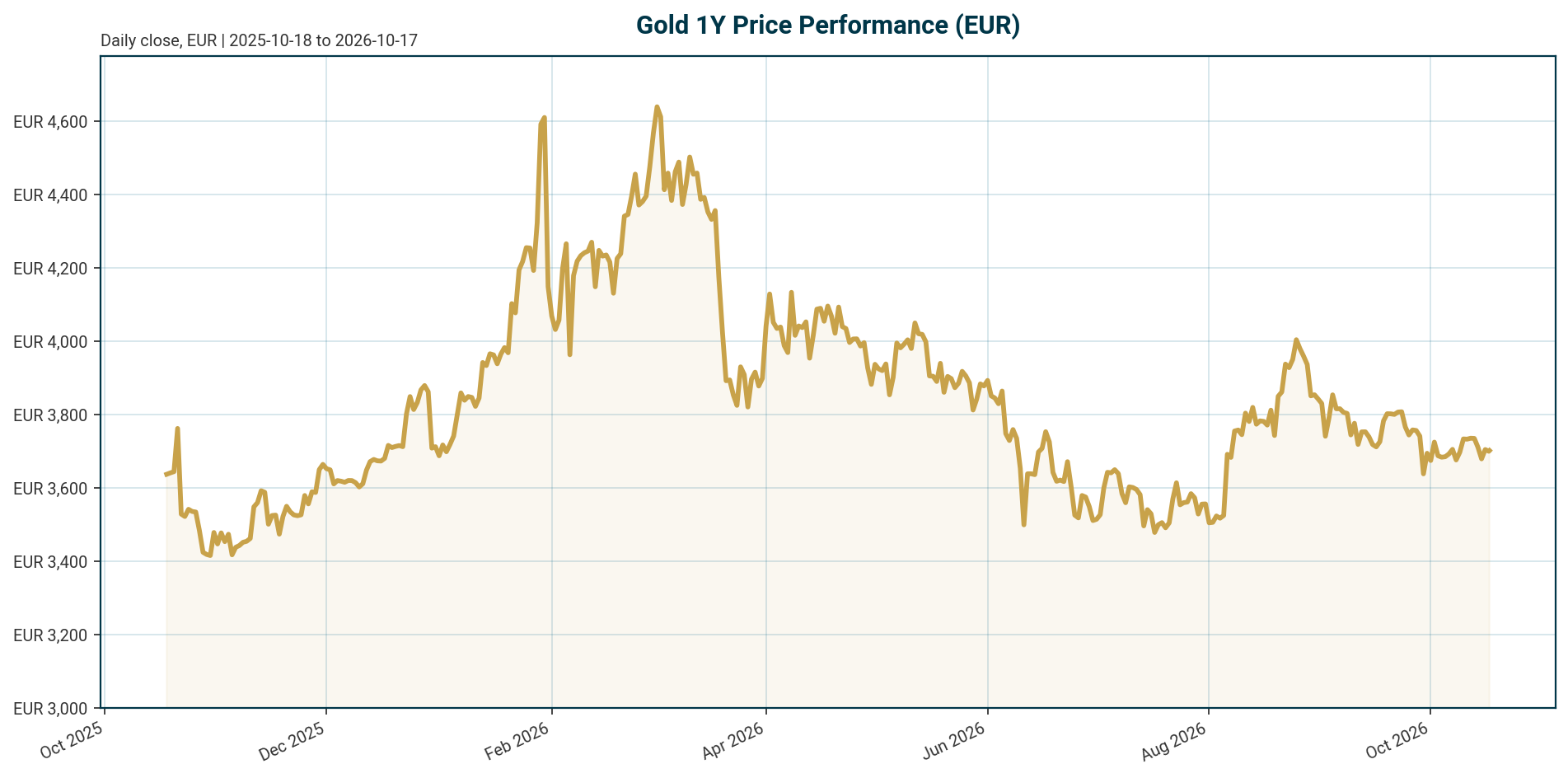
| Metric | Value |
|---|---|
| Current Price (XAU/EUR) | 3,702.30 |
| 24h Change | -0.42% |
| 7d Change | -0.46% |
| 1Y Change | -4.98% |
| ATH (Jan 2026) | 4,688.32 |
| ATH Change | -21.03% [Calculation: (3702.30 – 4688.32) / 4688.32] |
| BTC Dominance | 59.30% |
| Euro Area AAA 10Y Yield | 3.39% |
| EUR/USD | 1.1227 |
Macro Backdrop
The macro environment is characterized by neutral-to-negative risk sentiment and a mixed rates backdrop. The Euro area 10Y yield sits at 3.39% with a flattening curve, while the DAX has outperformed global peers at 1.36% over 5 days, contrasting with the Nikkei 225’s -5.37% decline. Persistent inflation risks, highlighted by oil prices exceeding $100, remain a key concern for central banks.
Investment Thesis
Gold is transitioning to a distinct investment regime where structural demand factors, particularly central bank accumulation and dedollarisation, are decoupling the metal from its traditional negative correlation with real interest rates. Societe Generale views gold as “strategically bullish,” arguing that a post-2022 regime shift has emerged where structural factors like sovereign debt concerns and geopolitical instability provide a higher price floor, limiting the downside impact of elevated real yields [T1]. J.P. Morgan echoes this resilience, noting that despite real yields rising to levels not seen since 2008, gold has remained very stable, supported by robust central bank reserve diversification [T6]. While Lombard Odier acknowledges that real yield sensitivity remains a key driver, they characterize recent headwinds as temporary, favoring a “hold” stance given the macro context of fiscal uncertainty and purchasing power erosion [T8]. Consequently, the thesis centers on gold as a hedge against policy uncertainty rather than a pure rate play, with institutional outlooks remaining strategically constructive.
Bullish Drivers
Structural Reserve Demand: The primary bullish catalyst is the acceleration in official gold accumulation. The World Gold Council reports central banks have averaged 1,000t of gold purchases over the past four years, a significant increase from the 500t average of the preceding decade [T5]. A record 43% of surveyed monetary authorities expect their own reserves to increase over the next year, driven by geopolitical risk and sanctions vulnerability [T6]. The Dutch Central Bank (DNB) exemplifies this trend, moving 86 tonnes of gold to London for faster crisis deployment, reducing its US share from 31.3% to 18.5% [T2].
Debasement and Dedollarisation: Nations are actively reducing dollar exposure to mitigate sanctions risk and diversify reserve mixes. This “debasement trade” is supported by Bundesbank President Joachim Nagel, who noted gold’s share of global reserves has risen from roughly 14% in 2023 to nearly 25% [T2]. The shift in storage hubs to London further facilitates this liquidity.
Inflation and FX Support: Persistent inflation risks, exacerbated by energy shortages and oil prices above $100, underpin gold’s value proposition as a store of purchasing power [T2][T3]. Additionally, EUR weakness at 1.1227 provides implicit support for EUR-denominated gold holdings, while the metal’s decoupling from bond yields suggests it is gaining independence from traditional macro correlations [market_overview][T1].
Relative Positioning vs Bitcoin and Ethereum
Gold maintains its status as the “hard” safe haven anchor within the portfolio spectrum, contrasting with the higher beta and volatility of Bitcoin and Ethereum. While Bitcoin dominance stands at 59.30%, gold’s performance is increasingly driven by structural reserve flows rather than speculative risk sentiment. J.P. Morgan highlights that gold has broken away from historical models that would imply lower prices during periods of rising real yields, a divergence not yet fully reflected in crypto markets [T6]. This structural decoupling positions gold as a distinct asset class that benefits from reserve diversification, offering a stable counterweight to the cyclical nature of digital assets.
Scenario Framework
Bull Case (Reclaim ATH): A decisive pivot in Fed policy, with rate cuts in September and December, combined with a sustained oil shock, would trigger a re-rating. SocGen notes that a materially larger inflation shock is required to generate significant rate repricing, suggesting that a policy easing cycle could rapidly support gold prices back toward the 4,600 EUR level [T1].
Base Case (Consolidation): Sticky inflation keeps the Fed on hold for longer than expected, maintaining pressure on real yields. In this environment, gold consolidates between 3,700 and 3,800 EUR. ING suggests that a stagflationary backdrop—slower growth alongside persistent inflation—remains supportive for gold over the longer term, even as short-term volatility persists [T4].
Bear Case (Breakdown): A hard landing scenario where real yields spike significantly above current levels poses a structural risk. If central bank buying slows or ETF flows turn negative, gold could test the 3,000 EUR support level, reverting to a stronger correlation with bond yields [T8][T3].
Valuation Discussion
Current levels represent a significant discount to the January 2026 All-Time High (ATH), offering entry points for long-term holders. The current price of 3,702.30 EUR is down 21.03% from the ATH, reflecting a market repricing of rate hikes and inflation fears. However, valuation is increasingly driven by structural scarcity and reserve demand rather than traditional yield differentials. SocGen argues that the “debasement trade” implies a higher valuation floor than historical models suggest, as structural factors are providing a higher floor for prices [T1]. The moderation in ETF inflows has been offset by robust central bank accumulation, suggesting that the market is pricing in a lower probability of a sustained breakdown in structural demand.
Risks
Higher-for-Longer Real Yields: The most immediate risk is a sustained spike in real yields. While Lombard Odier views this risk as limited, ING warns that a higher-for-longer rate environment keeps real yields elevated, posing a headwind for the non-yielding metal [T4][T8].
Declining ETF Liquidity: Although inflows have moderated sharply, a prolonged decline in gold-backed ETF demand could exacerbate short-term price weakness, particularly if real yields remain attractive relative to gold [T1].
Geopolitics Without Inflation: ING cautions that geopolitical tensions alone are insufficient to lift gold prices without translating into inflation or policy shifts. If conflicts de-escalate without driving energy prices higher, the macro narrative supporting gold could weaken [T4].
Appendix
Sources
- It’s time to get bullish on gold again, says SocGen | Kitco News [T1]
- Gold Holds Above $4,000 Even as US Treasury Yields Top 5% — Institutions Say Gold’s Pricing Logic Is “Re-Anchoring” — BigGo Finance [T2]
- Gold tumbles below $4,200 on higher oil prices, firmer US Dollar [T3]
- Geopolitics alone isn’t enough to lift gold | articles | ING THINK [T4]
- Central Bank Gold Purchases Hit 1,000t Average: WGC Survey [T5]
- Is it a golden era for gold? | J.P. Morgan Private Bank U.S. [T6]
- Gold edges down as traders monitor oil prices, Fed rate outlook – The Business Times [T7]
- Gold’s slowdown doesn’t signal a reversal | Lombard Odier [T8]
This report is AI-generated for informational purposes only and does not constitute investment advice. Readers should conduct their own due diligence before making investment decisions.
Important Note / Wichtiger Hinweis:
EN: This report may have been generated using AI. It processes data from publicly available sources. The content is provided for informational purposes only.DE: Dieser Bericht kann mithilfe von KI erstellt worden sein. Dabei werden Daten aus öffentlich zugänglichen Quellen verarbeitet. Die Inhalte dienen ausschließlich Informationszwecken.
* DE: Die ergänzenden Inhalte können KI-generiert sein. EN: The additional content may be AI-generated.