
Watch the video
This player shows only the Gold chapter of the daily altii market briefing. Watch the full video on tube.altii.de.
Key Data Snapshot
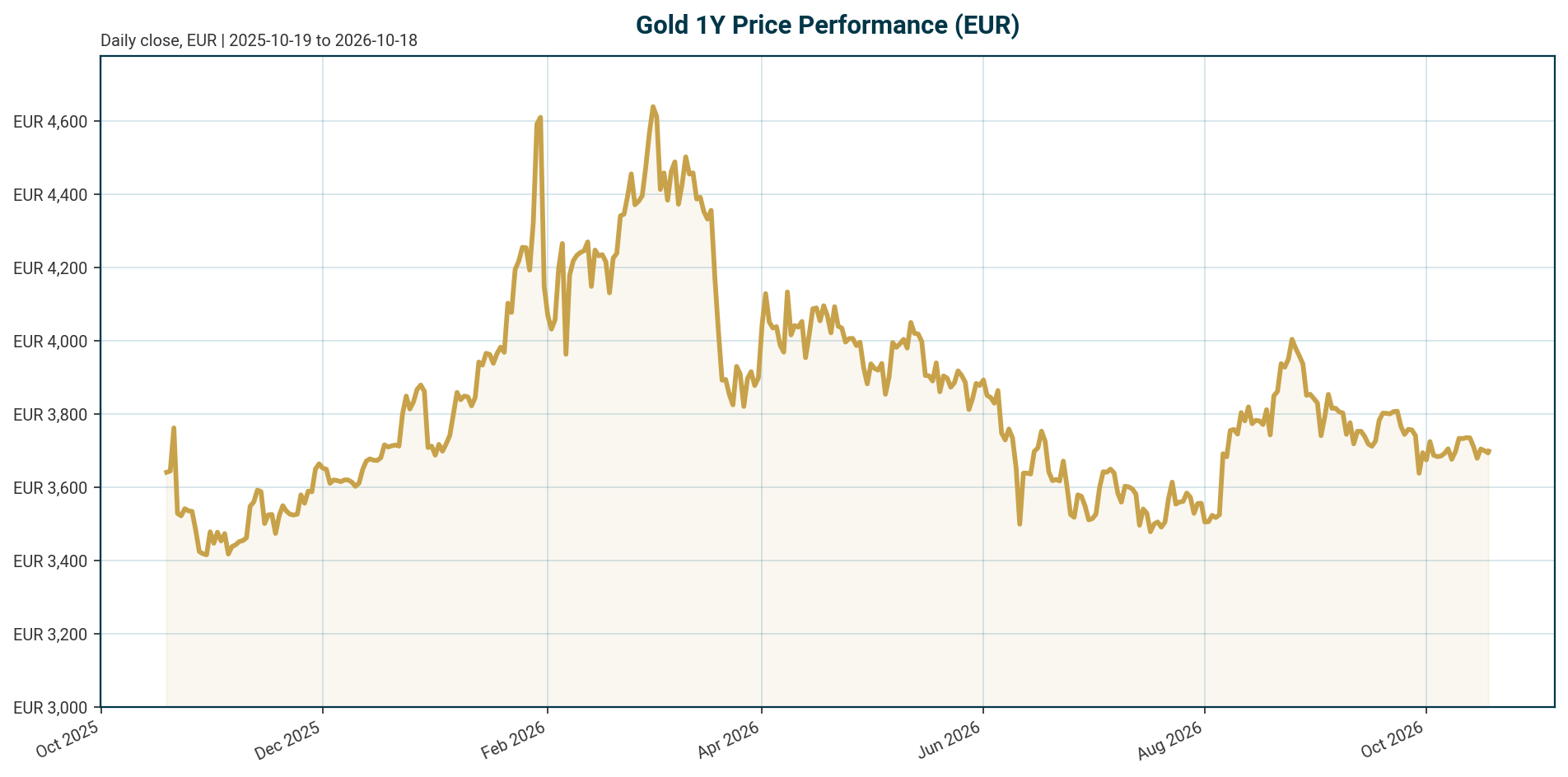
| Metric | Value | Context |
|---|---|---|
| Price (XAU/EUR) | 3,699.09 | Current spot price |
| All-Time High (ATH) | 4,688.32 (Jan 2026) | 21.10% below peak |
| 200-Day Change | -11.11% | Medium-term bearish trend |
| YTD Change | -2.21% | Slight decline year-to-date |
| BTC Dominance | 59.46% | High beta risk environment |
| 24h Volume | 41.3M | Consistent liquidity levels |
Macro Backdrop
Risk sentiment is neutral to negative with DACH equities outperforming global peers. The DAX leads with a 5-day gain of 1.36%, while the Nikkei 225 lags at -5.37% [market_overview]. Euro area yields are flattening, with the 10Y yield at 3.39% and the 2Y yield at 2.99%, while EUR/USD trades at 1.1230 [market_overview]. Persistent inflationary pressures from energy markets, with oil prices rising above $100, are keeping central banks hawkish and maintaining pressure on real yields [T2][T3]. This challenging macro environment supports the case for gold as a safe haven, despite the headwinds from higher real rates.
Investment Thesis
The investment thesis for gold is rooted in a structural regime shift where the metal is decoupling from traditional interest rate correlations. Despite persistently positive real yields, gold has broken away from historical models that would imply significantly lower prices [T1]. The primary structural drivers are the acceleration of central bank accumulation and growing concerns over global debt sustainability. Societe Generale and J.P. Morgan maintain a “strategically bullish” outlook, viewing gold as a cornerstone asset against monetary and policy uncertainty [T1][T8]. The “debasement trade” driven by high public debt-to-GDP ratios in advanced economies favors gold as a store of value [T6].
Bullish Drivers
- Central Bank Accumulation: The World Gold Council survey indicates central banks have accumulated an average of 1,000 tonnes of gold over the past four years, with 43% of authorities planning further increases [T7][T8]. This structural demand provides a significant price floor.
- Geopolitical Fragmentation: Active military activity in the Middle East and tensions in Eastern Europe have increased the relevance of gold as a crisis hedge, particularly among emerging markets [T7][T8].
- Debt Sustainability: Global public debt levels are at post-war highs, increasing the risk of financial repression and currency depreciation, which historically benefits gold [T6].
- Reserve Diversification: Central banks are actively reducing dollar exposure and increasing gold allocations, with the metal now comprising nearly 25% of global reserves [T2][T6].
Relative Positioning vs Bitcoin and Ethereum
Gold maintains its status as the primary safe-haven asset, distinct from the risk-on correlation of Bitcoin. With Bitcoin dominance at 59.46%, the broader crypto market remains highly volatile and beta-driven [market_data]. Gold’s positive year-to-date performance of roughly 6% contrasts with the potential for sharp drawdowns in risk assets, positioning it as a stabilizer in diversified portfolios [T5]. While Ethereum and other crypto assets may offer higher speculative returns, gold provides the necessary insurance against macroeconomic uncertainty and currency debasement.
Scenario Framework
- Base Case: Stagflation persists. Real yields remain elevated but sticky. Gold consolidates around current levels, supported by continued central bank buying and geopolitical tension.
- Bull Case: A pivot in Fed or ECB policy leads to a collapse in real yields. Gold reclaims its ATH levels, driven by a rush into safe havens and a weakening USD.
- Bear Case: A hawkish surprise from central banks or a sharp spike in oil prices triggers a rally in real yields and USD strength. Gold tests support levels near 3,000 EUR, pressured by profit-taking from recent gains.
Valuation Discussion
Current valuations are discounted relative to the January 2026 ATH, offering a potential entry point for structural buyers. The breakdown of the traditional inverse correlation between gold and real yields suggests that valuation models based solely on rate differentials are becoming obsolete [T2]. The “re-anchoring” of gold pricing logic implies that factors such as reserve diversification and debt sustainability are now primary valuation drivers rather than secondary considerations [T2].
Risks
- Real Yield Spike: If central banks tighten further due to sticky inflation, real yields could rise significantly, posing a headwind to gold prices [T3][T5].
- USD Strength: A stronger US Dollar makes EUR-denominated gold less attractive to foreign investors, potentially weighing on the price [T3].
- Profit Taking: Gold is up roughly 6% year-to-date, leaving the market vulnerable to bouts of profit-taking that could trigger short-term volatility [T5].
- Geopolitical Easing: A lack of escalation in geopolitical hotspots could reduce inflationary expectations and diminish the demand for gold as a hedge.
Appendix
Sources
- It’s time to get bullish on gold again, says SocGen | Kitco News [T1]
- Gold Holds Above $4,000 Even as US Treasury Yields Top 5% — Institutions Say Gold’s Pricing Logic Is “Re-Anchoring” — BigGo Finance [T2]
- Gold tumbles below $4,200 on higher oil prices, firmer US Dollar [T3]
- Gold tumbles below $4,200 on higher oil prices, firmer US Dollar [T4]
- Geopolitics alone isn’t enough to lift gold | articles | ING THINK [T5]
- Report: Central Banks Now Hold More Gold Than Treasuries—What That Means for Global Capital and Currencies – CEOWORLD magazine [T6]
- Central Bank Gold Purchases Hit 1,000t Average: WGC Survey [T7]
- Is it a golden era for gold? | J.P. Morgan Private Bank U.S. [T8]
This report is AI-generated for informational purposes only and does not constitute investment advice. The views expressed herein are those of the AI assistant and do not reflect the official positions of any financial institution or organization.
Important Note / Wichtiger Hinweis:
EN: This report may have been generated using AI. It processes data from publicly available sources. The content is provided for informational purposes only.DE: Dieser Bericht kann mithilfe von KI erstellt worden sein. Dabei werden Daten aus öffentlich zugänglichen Quellen verarbeitet. Die Inhalte dienen ausschließlich Informationszwecken.
* DE: Die ergänzenden Inhalte können KI-generiert sein. EN: The additional content may be AI-generated.