
Listen to the summary
Key Data Snapshot
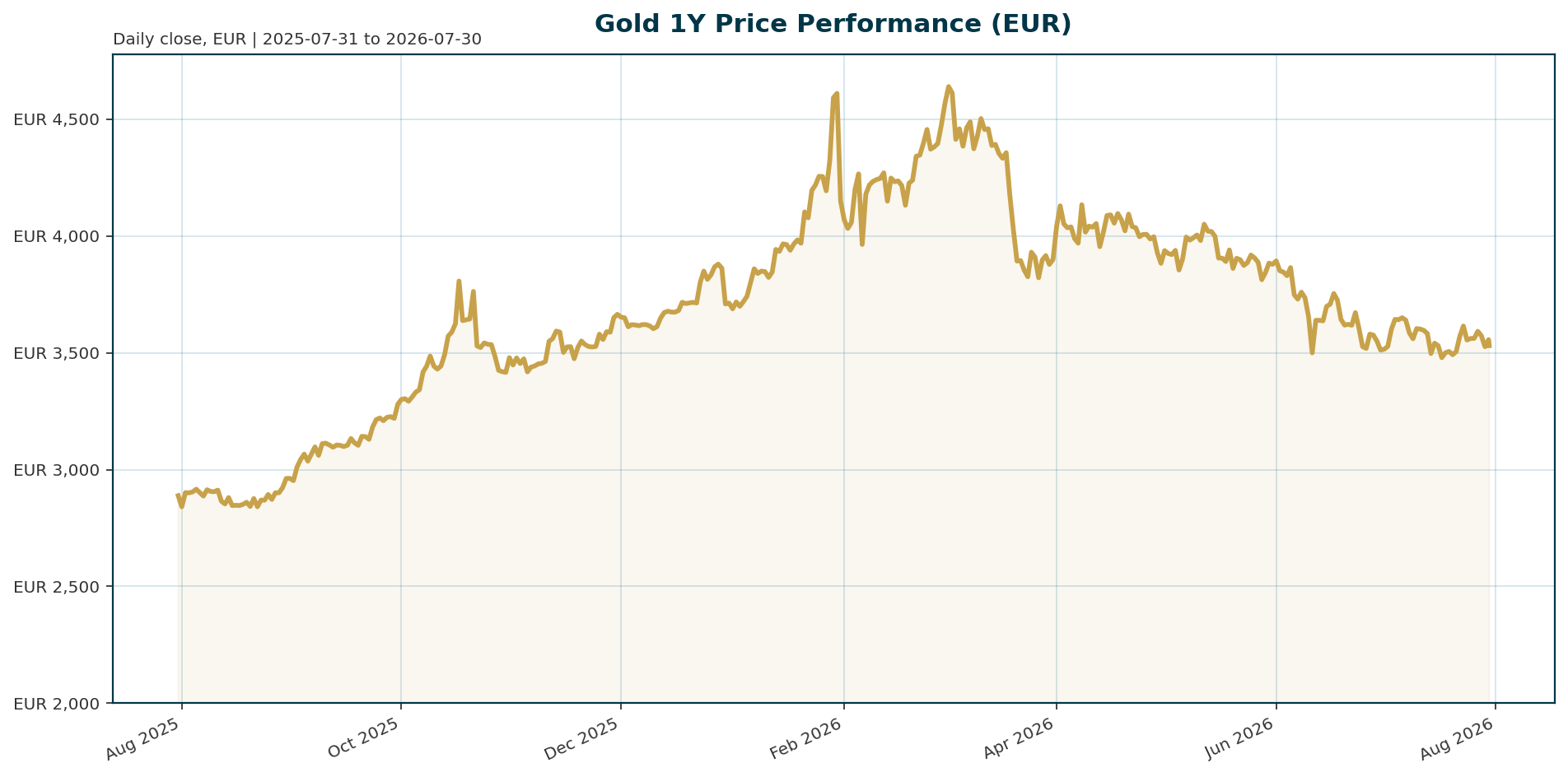
| Metric | Value | Change / Context |
|---|---|---|
| Current Price (XAU/EUR) | 3,533.88 | Current trading level |
| ATH (Jan 2026) | 4,688.32 | Drawdown: -24.62% [Calculated] |
| YTD Performance | +21.5% | Strong rally followed by correction |
| 200-Day Performance | -8.8% | Recent consolidation phase |
| Market Cap | 1.56B EUR | Rank 44 |
Calculation: Drawdown % = (Current Price – ATH) / ATH = (3533.88 – 4688.32) / 4688.32 = -24.62%
Macro Backdrop
Market sentiment is neutral to negative with mixed equity momentum. The DACH region is outperforming global peers, while the Euro area yield curve is steepening (10Y-2Y spread 45bp) and EUR/USD sits at 1.1395, creating a complex backdrop for non-yielding assets [market_overview]. The broader macro environment remains complex for precious metals. Gold sits directly at the centre of the debate between inflation persistence and monetary policy easing. Real yields represent the opportunity cost of holding gold, which generates no income. When real yields rise, as they did in Q2 2026 through a combination of Fed policy ambiguity and energy-price-driven inflation expectations, the relative attractiveness of gold declines [T4]. Recent movements in energy markets have also contributed to the discussion around inflation persistence, with firm oil prices filtering into transportation and production costs [T1].
Investment Thesis
The core thesis for Gold (XAU) in the current regime centers on the divergence between cyclical headwinds and structural demand. While the immediate price action is dictated by real interest rates and Fed policy expectations, the long-term narrative is shifting toward a “new regime” driven by reserve diversification and portfolio insurance. Investors face a world in which the independence of central banks is being tested, inflation is more volatile, and concentration risks are growing [T2]. The best portfolios for this new regime can withstand different scenarios: they need to be diversified across currencies, invested in real assets and gold [T2]. Consequently, Gold is transitioning from a purely cyclical play on rate differentials to a structural defensive asset, supported by high public debt levels that make it politically and economically harder for major economies to run very restrictive monetary policy [T8].
Bullish Drivers
- Structural Central Bank Demand: The outlook of central bank purchase remains strong, with a record of 43% of 73 global monetary authorities believing their own gold reserves will increase over the next year [T7]. This diversification away from the US dollar is a structural support that is less sensitive to short-term price fluctuations [T8].
- Fed Pivot Expectations: Despite recent hawkishness, analysts expect the Federal Reserve to eventually ease policy. ING expects two 25bp rate cuts later in 2026, in September and December, which would tend to stabilise or reduce real yields, a development that historically provides support for bullion [T3].
- “Doom Loop” Scenario: A scenario of slowing global growth in 2026 could see USD and 10-yr yields fall as gold net positioning materially increases. A softer US labour market and weaker consumer activity would prompt the Fed to cut rates beyond current expectations [T6].
- Portfolio Insurance: Repeated growth scares and equity volatility of 2024 and 2025 have reinforced gold’s role as portfolio insurance. Every spike in volatility sends investors back into bullion [T8].
Relative Positioning vs Bitcoin and Ethereum
Gold is currently outperforming risk assets in the current cautious environment, contrasting with the volatility seen in crypto markets. While the Nasdaq Composite is down 5.33% over the last month and the Nikkei 225 is the weakest 5-day performer at -4.07%, Gold remains a preferred safe haven [market_overview]. Unlike Bitcoin and Ethereum, which are highly correlated with risk-on sentiment and liquidity conditions, Gold’s correlation with equities has broken down. This makes Gold a critical diversifier in portfolios facing elevated uncertainty, particularly as central banks and sovereign investors seek to reduce concentration risks in traditional financial assets [T2][T8].
Scenario Framework
- Bullish Scenario (The “Doom Loop”): Global growth slows, prompting the Fed to cut rates by more than 75bps by year-end. Real yields fall, the US dollar weakens, and inflation expectations decline. Gold rallies to reclaim its ATH, supported by aggressive central bank buying.
- Base Case (The “Wait and See”): Inflation moderates gradually, but core CPI remains sticky around 2.8-2.9%. The Fed cuts rates by 25-50bps in late 2026. Real yields stabilize rather than fall, and Gold trades in a range between 3,400 and 3,800 EUR.
- Bearish Scenario (The “Higher for Longer”): Core US CPI trends upward (2.9% in May 2026) and inflation proves persistent. The Fed holds rates steady or hikes further in July. Real yields spike, increasing the opportunity cost of holding gold. Gold corrects further, potentially testing the 200-day moving average support levels.
Valuation Discussion
Gold is currently in a correction phase, trading 24.6% below its January 2026 ATH of 4,688.32 EUR. However, the YTD performance of +21.5% indicates a strong underlying trend that has simply paused. The market is vulnerable to bouts of profit-taking, as Gold is up roughly 6% year-to-date [T3], but deep pullbacks are likely to attract buyers, particularly from central banks and longer-term investors [T3]. The valuation framework suggests that today’s gold price largely reflects macro consensus expectations about economic growth and inflation. With global GDP growth stable at 2.7-2.8% and a core CPI/PCE fall of roughly 40-60bps by year-end expected, the price action is currently rangebound rather than overextended [T6].
Risks
- Inflation Persistence: Core US CPI has trended upward across three consecutive months (2.6% in March, 2.8% in April, 2.9% in May 2026). If this trajectory continues, expectations of a rate hike at the July 28-29 Fed meeting will intensify, posing a significant headwind for gold [T4].
- Real Yield Spikes: A genuine shift to higher real rates combined with convincing fiscal reforms in key economies would be a major risk to the bullish thesis. Real yields represent the opportunity cost of holding gold, and any sustained rise in nominal yields outpacing inflation would pressure prices [T8].
- Geopolitical De-escalation: While geopolitical tensions have pushed energy prices higher, a sudden de-escalation (e.g., a US-Iran deal) could reduce perceived global risk premiums, diminishing the dollar’s traditional safe-haven appeal and potentially pressuring gold prices [T5].
Appendix
Sources
- Gold approaches macro inflection as PCE data tests Fed outlook [T1]
- Gold suffers worst quarter in 13 years amid interest rate hike fears [T2]
- Geopolitics alone isn’t enough to lift gold [T3]
- Central Banks Buying Gold Despite Price Drops in 2026 [T4]
- Gold Price Edges Higher As Crucial US-Iran Deal Hopes Pressure US Dollar [T5]
- ‘Doom loop’ scenario of slowing global growth in 2026 could see USD, 10-yr yields fall as gold net positioning materially increases [T6]
- Is it a golden era for gold? [T7]
- How Geopolitics and Central Banks Are Driving Gold Higher [T8]
Disclaimer: This report is AI-generated for informational purposes only and does not constitute investment advice. The views expressed herein are those of the AI model and do not reflect the opinions of Venice.ai or any individual. Readers should conduct their own research and consult with a qualified financial advisor before making investment decisions.
Important Note / Wichtiger Hinweis:
EN: This report may have been generated using AI. It processes data from publicly available sources. The content is provided for informational purposes only.DE: Dieser Bericht kann mithilfe von KI erstellt worden sein. Dabei werden Daten aus öffentlich zugänglichen Quellen verarbeitet. Die Inhalte dienen ausschließlich Informationszwecken.
* DE: Die ergänzenden Inhalte können KI-generiert sein. EN: The additional content may be AI-generated.