
Listen to the summary
Key Data Snapshot
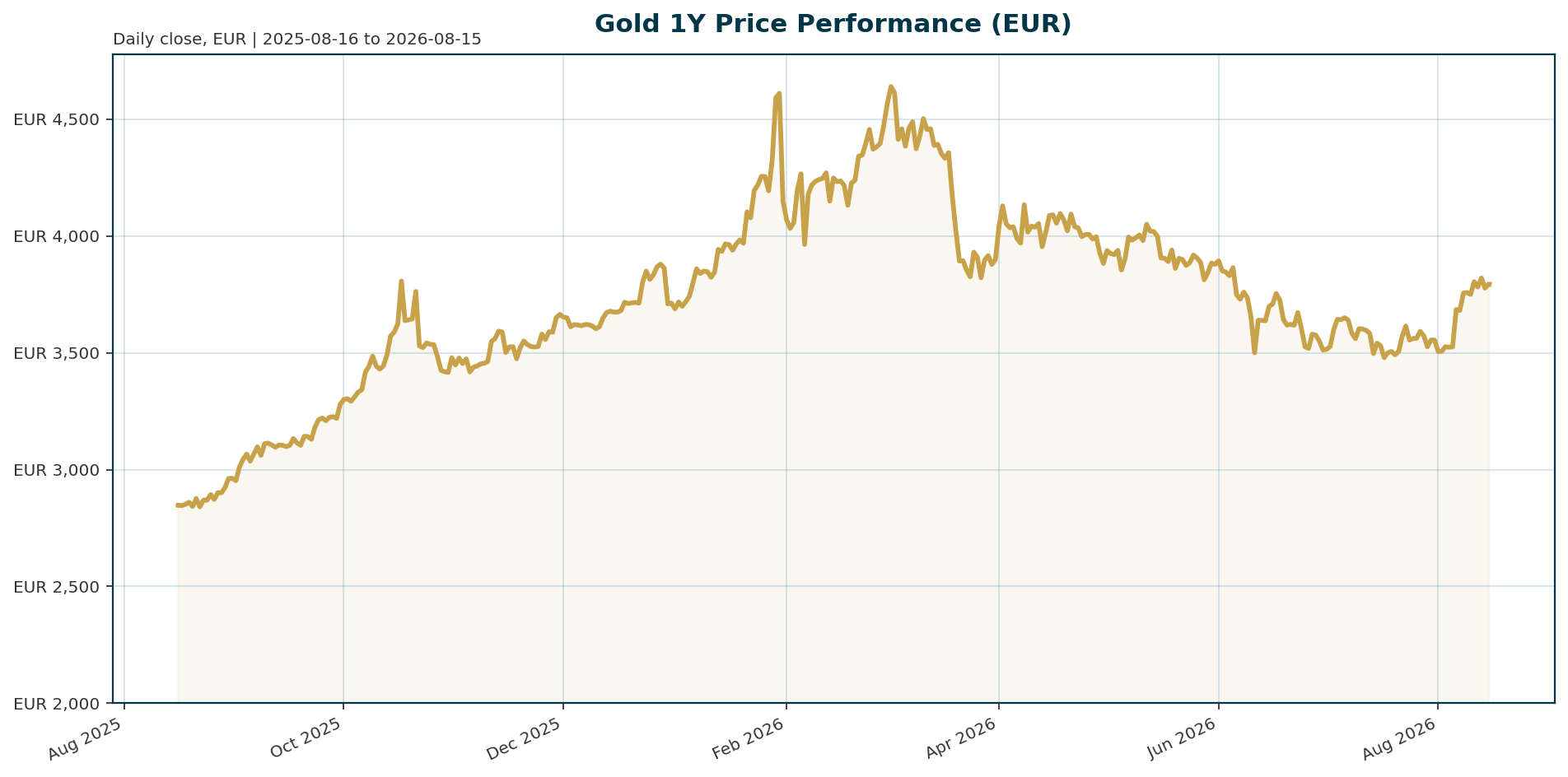
| Metric | Value | Change |
|---|---|---|
| Price (XAU/EUR) | 3,781.74 | +1.4% (24h) |
| All-Time High (ATH) | 4,688.32 | -19.3% (Jan 2026) |
| Year-to-Date (YTD) | 3,781.74 | +31.2% |
| 200-Day Moving Avg | N/A | -13.6% |
| 24h High/Low | 3,793.13 / 3,731.80 | – |
Macro Backdrop
Risk sentiment is neutral to positive, supported by moderately positive equity momentum, with the DAX leading global indices on a one-month basis at +5.76% [T3]. The Euro Area AAA 10Y yield sits at 3.16%, providing a mixed backdrop for gold as high nominal yields act as a headwind while the EUR/USD at 1.1551 reflects a weaker dollar, which generally supports non-USD denominated assets. The current environment suggests gold is acting as a diversifier rather than a primary flight-to-safety asset, as traditional correlations break down amidst a challenging monetary policy backdrop [T3].
Investment Thesis
The investment thesis for gold centers on its role as a hedge against the erosion of central bank independence and inflation volatility. As equities like the DAX rise, gold provides portfolio stability, decoupling from high-beta risk sentiment. The primary structural driver remains the diversification of reserves away from the US dollar, supported by geopolitical risks and high public debt trajectories [T3]. While short-term volatility is driven by real yields, the long-term thesis relies on the enduring appeal of gold as a non-yielding asset in a world of monetary uncertainty.
Bullish Drivers
- Central Bank Accumulation: Global monetary authorities have accelerated their pace of accumulation, averaging 1,000t of gold over the past four years, up from 500t in the preceding decade. A record 89% of respondents in the World Gold Council survey expect global reserves to increase over the next 12 months [T4][T6].
- China’s Reserve Diversification: China’s central bank has extended its gold-buying streak to 19 months, adding 320,000 troy ounces last month alone. This demonstrates sustained state-level demand despite recent price weakness and a challenging macroeconomic backdrop [T7].
- Stagflationary Risks: A backdrop of slower growth alongside persistent inflation, driven by rising energy prices and geopolitical tensions, remains supportive for gold over the longer term. This environment favors non-yielding assets that preserve purchasing power [T1][T3].
Relative Positioning vs Bitcoin and Ethereum
Gold is currently decoupling from the risk-on cycles often associated with Bitcoin and Ethereum. While equity markets are moderately positive, gold is consolidating after a sharp Q2 correction, acting as a defensive anchor within a diversified portfolio. Unlike crypto assets, which often correlate with high-beta equity sentiment, gold’s performance is increasingly driven by macro fundamentals and institutional reserve flows rather than speculative momentum [T3][T8].
Scenario Framework
- Base Case: Euro yields hold steady near 3.15%, and the Fed delivers two 25bp cuts in September and December. Gold consolidates between 3,700 and 3,900 EUR, supported by central bank demand.
- Bull Case: Real yields decline significantly as the Fed pivots to easing. This triggers a reversion to the January 2026 ATH of 4,688.32 EUR, driven by renewed institutional buying and a weaker dollar.
- Bear Case: Inflation proves stickier than expected, leading to a “higher-for-longer” rate environment. Real yields remain elevated, suppressing gold prices below 3,700 EUR as the opportunity cost of holding non-yielding assets rises.
Valuation Discussion
Gold is currently trading at a discount to its January 2026 peak, offering a ~19% reversion opportunity for new buyers. Despite a strong year-to-date performance of +31.2%, the 200-day moving average remains in negative territory (-13.6%), indicating the asset is still in a volatile stabilization phase rather than a fully priced bubble. While the high opportunity cost of real yields currently suppresses the asset’s valuation, the structural support from central bank demand suggests the downside is limited.
Risks
- Real Yield Risk: A sustained increase in Eurozone or US real yields would act as a direct headwind to gold, as the inverse relationship between gold prices and real yields remains a primary driver of short-term price action [T2][T5].
- Profit Taking: Gold is up roughly 6% year-to-date, leaving the market vulnerable to bouts of profit-taking and short-term liquidation as investors rotate into higher-yielding assets [T1].
- USD Strength: A significant strengthening of the US dollar could erode the EUR-denominated price of gold, negating the benefits of its safe-haven status for European investors [T2].
Appendix
- Sources: Geopolitics alone isn’t enough to lift gold | ING THINK [T1]
- Sources: Both Gold and Silver Lose Key Support Levels! | Bitget News [T2]
- Sources: Gold suffers worst quarter in 13 years amid interest rate hike fears | CNBC [T3]
- Sources: Central Bank Gold Purchases Hit 1000t Average | Mexico Business News [T4]
- Sources: Is it a golden era for gold? | J.P. Morgan Private Bank [T5]
- Sources: Central Bank Gold Reserves Survey 2026 | World Gold Council [T6]
- Sources: China’s central bank extends gold-buying streak to 19 months | Yahoo Finance [T7]
- Sources: Gold Market Primer: Market size and structure | World Gold Council [T8]
This report is AI-generated, for informational purposes only, and does not constitute investment advice. Past performance is not indicative of future results.
Important Note / Wichtiger Hinweis:
EN: This report may have been generated using AI. It processes data from publicly available sources. The content is provided for informational purposes only.DE: Dieser Bericht kann mithilfe von KI erstellt worden sein. Dabei werden Daten aus öffentlich zugänglichen Quellen verarbeitet. Die Inhalte dienen ausschließlich Informationszwecken.
* DE: Die ergänzenden Inhalte können KI-generiert sein. EN: The additional content may be AI-generated.