
Watch the video
This player shows only the Gold chapter of the daily altii market briefing. Watch the full video on tube.altii.de.
Key Data Snapshot
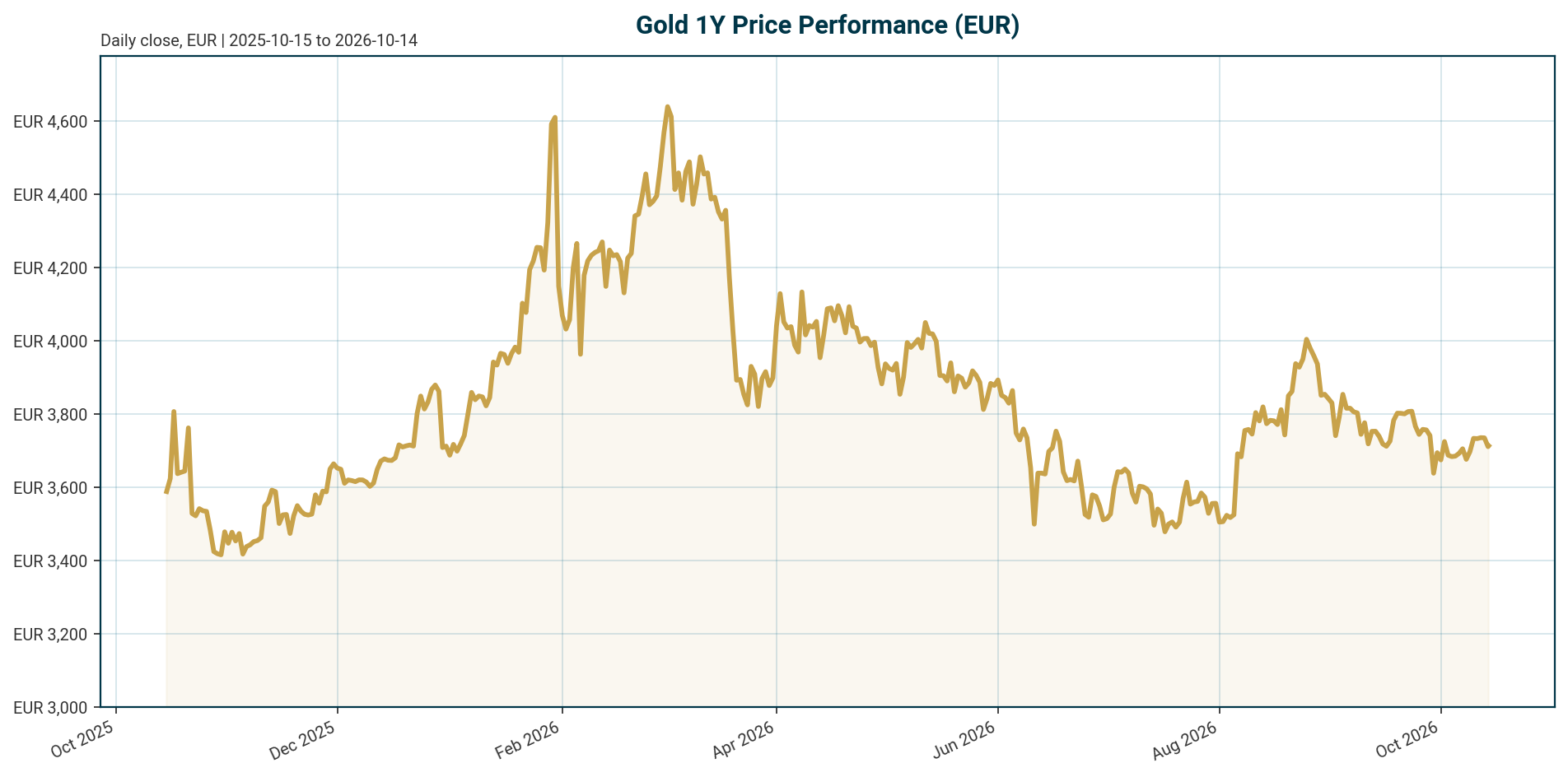
Gold consolidates below its January 2026 all-time high, trading at EUR 3,709.48 after a 24-hour decline of 1.09%. The asset remains in a medium-term downtrend, down 7.26% over 200 days, but shows short-term resilience. The market capitalization stands at approximately EUR 1.63 billion, with a 24-hour volume of EUR 100 million. Central bank demand remains a structural pillar, with gold’s share of global reserves rising to 25% from roughly 14% in 2023 [T1]. Bitcoin dominance is currently at 59.27%, indicating a continued rotation between digital and traditional hard assets.
| Metric | Value |
|---|---|
| XAU/EUR Price | 3,709.48 |
| 24h Change | -1.09% |
| 30d Change | -3.97% |
| 200d Change | -7.26% |
| ATH (Jan 2026) | 4,688.32 |
| ATH Change | -20.88% |
| Market Cap (EUR) | 1.63 B |
| Circulating Supply | 439,423 |
| BTC Dominance | 59.27% |
Macro Backdrop
Risk sentiment is neutral. Euro area yields are mixed, with the 10-year yield holding steady at 3.50%, while the 2-year yield is 3.07%. The FX backdrop is mixed, characterized by EUR weakness against the USD. Key observations include the Hang Seng leading equity gains with a 5-day move of 2.35%, while the Nikkei 225 underperforms with a 5-day decline of -2.50%. The DAX and Euro Stoxx 50 show modest resilience, averaging positive 5-day changes, suggesting a fragmented global equity landscape.
Investment Thesis
The investment thesis for gold centers on structural reserve diversification and inflation protection amid fiscal uncertainty. Central banks are aggressively accumulating gold, with a record 43% of global monetary authorities expecting reserve increases over the next year [T4]. This shift reflects a deliberate de-risking away from the US dollar to mitigate sanctions vulnerability and protect against volatile inflation [T1][T6]. While nominal yields have pressured prices, the scarcity of gold supply and its role as a non-sovereign liability asset provide a fundamental floor for demand in a fragmented geopolitical environment [T8].
Bullish Drivers
The primary bullish catalysts are the continued rotation into hard assets and the potential for real yield compression. Central bank buying remains resilient, driven by geopolitical fragmentation and the desire to reduce dollar exposure [T4][T8]. A weakening EUR (currently at 1.1199) provides a direct tailwind for XAU/EUR price action. Furthermore, the Federal Reserve is expected to keep policy rates on hold for much of 2026, limiting the rise in real yields and reducing the opportunity cost of holding gold [T5]. If inflation proves sticky while nominal rates plateau, real yields could decline, triggering a re-evaluation of gold’s valuation.
Relative Positioning vs Bitcoin and Ethereum
Gold maintains its status as the dominant traditional hard asset, yet it faces increasing competition from the digital asset sector. With Bitcoin dominance at 59.27%, the crypto market is capturing significant risk-on capital. However, gold’s market capitalization of approximately EUR 1.63 billion contrasts sharply with the total crypto market cap of roughly EUR 2.53 trillion, highlighting the scale of the digital asset rally. Relative to Ethereum, gold remains the primary store of value for institutional balance sheets, acting as the benchmark for “digital gold” narratives rather than a direct substitute.
Scenario Framework
- Base Case: Gold consolidates below the EUR 4,688.32 ATH. Risk sentiment remains neutral, and real yields stay elevated, capping upside. Gold trades in a range between EUR 3,700 and 3,800.
- Bull Case: Real yields decline, fiscal credibility weakens, and geopolitical fragmentation persists. Central banks continue diversifying. XAU/EUR retests the prior high. The required upside is approximately 26.35% (EUR 4,688.32 / EUR 3,709.48 – 1).
- Bear Case: Higher-for-longer real yields and a stronger USD trigger a deeper correction. Gold tests support near EUR 3,500.
Valuation Discussion
Gold is currently trading at a valuation compressed by elevated real yields. The inverse relationship between gold prices and real yields has reasserted itself, as high real yields increase the opportunity cost of holding a non-yielding asset [T5][T7]. While nominal yields have risen, the persistence of inflation suggests real yields may not be sustainable at current levels, potentially creating an attractive entry point for long-term holders. The current price action reflects a repricing of these yield dynamics, with the market digesting the shift from a “gold rush” environment to a more balanced valuation based on carry costs.
Risks
The primary risk to the thesis is a sustained rise in real yields, which would further compress gold’s valuation. A prolonged decline in ETF demand or physical demand, such as for jewelry, could exacerbate price weakness despite central bank accumulation [T5]. Additionally, a sharp reversal in EUR/USD strength would directly hurt XAU/EUR performance. Finally, a sudden stabilization of global risk sentiment could trigger a rotation out of defensive assets, including gold, into growth equities.
Appendix
Sources:
- Gold Holds Above $4000 Even as US Treasury Yields Top 5% [T1]
- Gold vs Silver: Macro Backdrop and Central Bank Buying [T2]
- The altii-Gold-Report 2026-10-13 [T3]
- Is it a golden era for gold? | J.P. Morgan Private Bank U.S. [T4]
- Gold’s slowdown doesn’t signal a reversal | Lombard Odier [T5]
- How Inflation and Interest Rates Affect Gold Prices in 2026 [T6]
- What Affects Gold Prices? 6 Key Factors Explained | XTB [T7]
- Gold: Between inflation fears and diversification of reserves [T8]
This report is AI-generated for informational purposes only and does not constitute investment advice. Readers should conduct their own due diligence before making investment decisions.
Important Note / Wichtiger Hinweis:
EN: This report may have been generated using AI. It processes data from publicly available sources. The content is provided for informational purposes only.DE: Dieser Bericht kann mithilfe von KI erstellt worden sein. Dabei werden Daten aus öffentlich zugänglichen Quellen verarbeitet. Die Inhalte dienen ausschließlich Informationszwecken.
* DE: Die ergänzenden Inhalte können KI-generiert sein. EN: The additional content may be AI-generated.