
Listen to the summary
Key Data Snapshot
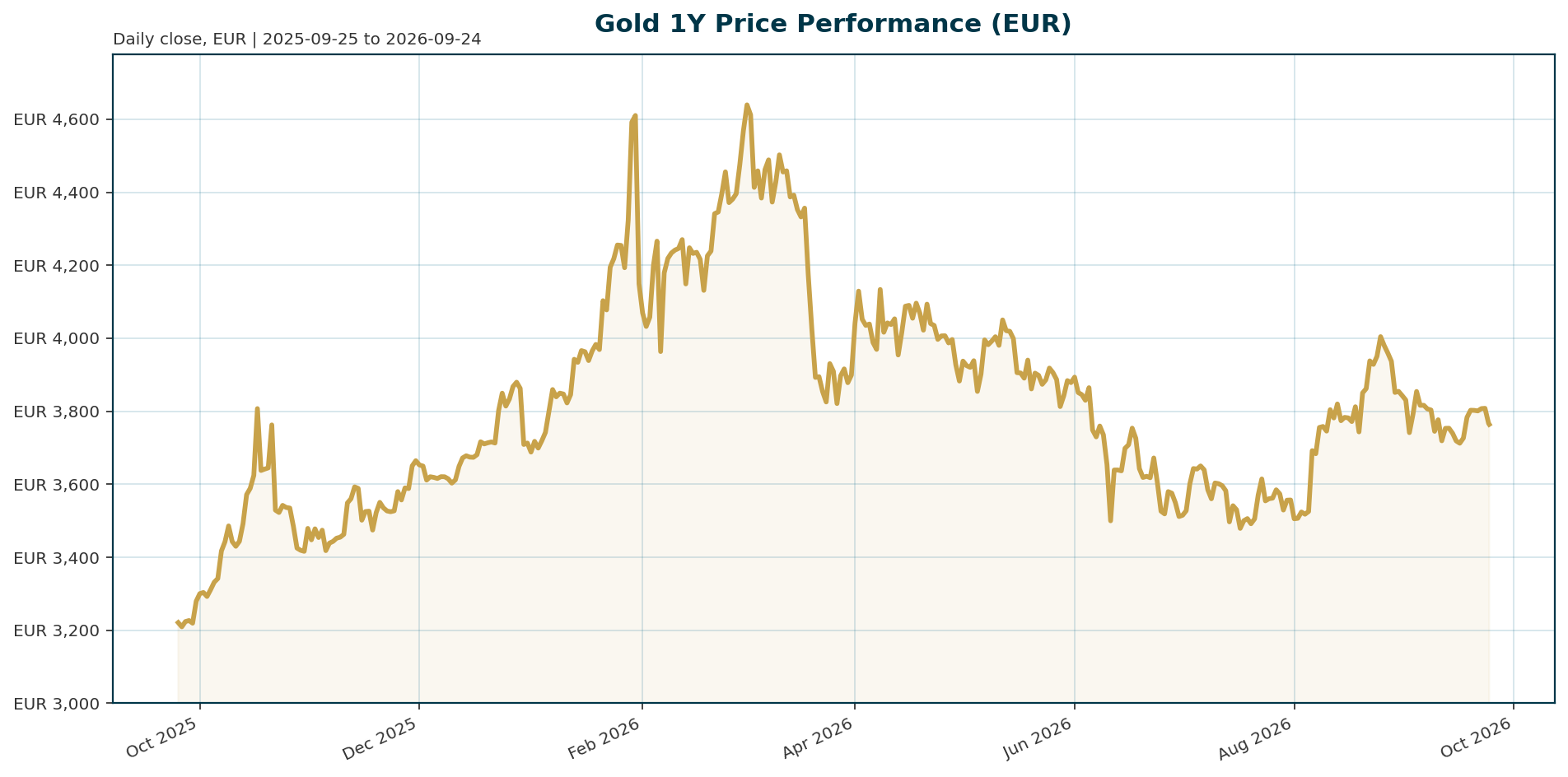
| Metric | Value |
|---|---|
| Price (XAU, EUR) | 3,764.03 (24h range: 3,754.82 – 3,815.83) |
| 1h / 24h change | -0.17% / -0.96% |
| 7d / 14d change | +0.08% / -3.09% |
| 30d / 200d change | -7.33% / -17.28% |
| 1y change | +13.76% |
| All-time high | 4,688.32 EUR (2026-01-28), spot is -19.71% below |
| All-time low | 1,265.28 EUR (2019-11-17), spot is +197.48% above |
| Market cap / rank | 1.64bn EUR / 52 (tokenized PAXG proxy, physical backing only) |
| 24h volume / turnover | 187.1m EUR / ~11.4% of token market cap |
| Backing supply | 434,903.62 oz tokenized |
| Euro AAA 10Y yield | 3.45% (-8.1bp 5d, +50.5bp YTD) |
| 10Y-2Y spread | 31.7bp, curve flattening |
| EUR/USD | 1.1444 (-0.40% 5d, -2.62% YTD) |
Drawdown arithmetic: (3,764.03 − 4,688.32) / 4,688.32 = -19.71%. Reclaiming the ATH requires +24.6% from spot. Momentum divergence: 1y (+13.76%) minus 200d (-17.28%) equals a 31.0pp spread, locating the bulk of the drawdown in H2 2026 rather than a full-cycle reversal.
Macro Backdrop
Market overview: Risk sentiment is neutral and equity momentum is mixed, with DACH lagging global peers. The rates backdrop shows euro yields mixed with curve flattening, and FX is mixed. Key observations: the Nikkei 225 has the strongest 5-day move at 3.59% while the DAX is weakest at -0.50%, the euro AAA 10Y yield stands at 3.45% (down 8.1bp over 5 days) with a 31.7bp 10Y-2Y spread, and EUR/USD sits at 1.1444, down 0.40% over 5 days. This backdrop is context, not the driver, for gold.
The driver for gold is the policy regime. The Federal Reserve held rates unchanged this week, with Powell requiring clearer inflation progress before easing, although ING’s US economist still expects two 25bp cuts later in 2026 [T2]. Energy prices elevated by geopolitical tension complicate the inflation path and keep real yields elevated, a headwind for gold [T2]. Crux Investor describes the current transmission channel as dominant in the tightening direction: conflict raises oil, oil sustains inflation, inflation forces tighter policy, and tighter policy raises the opportunity cost of holding non-yielding assets [T7]. Against this, Société Générale identifies a post-2022 regime shift: gold trades near record highs despite positive real yields, decoupled from historical models, supported by central bank purchases, dedollarisation, geopolitical uncertainty and sovereign debt concerns [T1]. Euro-area yields have drifted lower over five days (10Y -8.1bp), which offers marginal relief for EUR-quoted holders, but the 2Y is up 102.7bp YTD, confirming the front-end repricing of a higher-for-longer path.
Investment Thesis
The core thesis follows Société Générale’s dual-driver framework: central bank flows set the structural floor, real yields set the cyclical amplitude [T1, T3]. Official-sector buying, particularly from emerging-market reserve managers diversifying away from the dollar, absorbs supply and reduces gold’s sensitivity to rate expectations [T3]. Record survey evidence supports persistence: 43% of 73 global monetary authorities expect their own gold reserves to increase over the next year [T5]. Reports suggest central banks now collectively hold more gold than US Treasuries, with public debt-to-GDP in advanced economies at post-war highs, a configuration historically resolved through financial repression, inflation and currency depreciation, all favoring gold [T4].
The cyclical overlay is negative right now. Gold is up roughly 6% year-to-date in USD terms, leaving the market vulnerable to profit-taking, although ING notes deeper pullbacks tend to attract central bank and long-term buyers [T2]. Lombard Odier sees demand as resilient, the macro context favoring real assets, and recent headwinds (higher yields, stronger dollar) as temporary rather than structural [T6].
Balance of argument: the strategic case favors buying the current -19.71% drawdown as a re-entry into a structurally re-priced market. The tactical case warns that the tightening signal still dominates the macro tug-of-war, and exposure added now may face further downside until real yields peak [T7]. Both can be true; position horizon determines which applies.
Bullish Drivers
Ranked by structural weight:
1. Central bank reserve accumulation. Emerging-market central banks are diversifying reserves away from the dollar, a trend showing no signs of abating and providing a consistent floor that absorbs supply [T3]. A record 43% of surveyed monetary authorities plan to increase holdings [T5].
2. Fiscal and monetary credibility erosion. High-debt economies face pressure toward financial repression; sustained negative real rates would be a powerful structural tailwind for gold [T4]. If sovereigns are seen hedging against their own policies, confidence in fiat regimes erodes faster in downturns [T4].
3. Policy-uncertainty hedging. SocGen remains strategically bullish, viewing gold as a hedge against monetary and policy uncertainty, with markets pricing only modest Fed tightening that still falls short of the Atlanta Fed’s Taylor Rule prescription, suggesting inflation risks are underpriced [T1].
4. Stagflation tailwind. Slower growth combined with persistent inflation remains supportive for gold over the longer term, even if near-term real yields cap the move [T2].
5. Demand breadth. ETF inflows have moderated but remain positive, and lower volatility improves gold’s appeal to longer-term reserve managers rather than momentum traders [T1].
Relative Positioning vs Bitcoin and Ethereum
The quoted gold instrument here is a tokenized proxy (PAXG-style), with a 1.64bn EUR market cap ranking 52 in the crypto universe. That figure reflects only the tokenized wrapper, not the total gold market. For scale: the total crypto market cap is 2.52tn EUR with 106.3bn EUR in 24h volume, and Bitcoin dominance sits at 58.70%.
Gold’s character in this comparison is fundamentally different. Its demand base is non-speculative: central banks and reserve managers price it through fundamental reserve-management shifts, not speculative flows [T3]. Bitcoin and Ethereum carry high-beta risk sensitivity; in a neutral risk environment with DACH equities lagging global peers (DAX -0.50% 5d vs Nasdaq +1.96% 5d), the diversification case favors gold. Conversely, strong equity momentum (Nasdaq +15.89% YTD, Nikkei +30.64% YTD) keeps speculative capital in crypto and mutes gold’s tactical upside. Gold’s 1y +13.76% return with a -17.28% 200d drawdown reflects lower volatility than either crypto asset would typically show through a comparable drawdown. Note: specific 1y or YTD return figures for Bitcoin and Ethereum are not available in this bundle, so a direct return comparison cannot be computed.
Scenario Framework
All scenario levels are analytical constructs derived from provided data, not forecasts.
Bear case (tightening dominant). Oil-driven inflation persists, the Fed, ECB, BoE and BoJ maintain or extend tightening, real yields rise, and the tightening signal stays dominant as futures positioning implies [T7]. A tail risk within this scenario is sovereign reserve liquidation: as of December 2025, the US, Germany and Italy hold approximately 8,133t, 3,350t and 2,451t of official gold reserves; forced sales to stabilize public finances would weaken the structural floor [T7]. Directional implication: retest of the 3,500–3,600 EUR zone, consistent with 30d momentum (-7.33%) extended. FX caveat: a USD rebound would mechanically depress EUR-quoted gold even if USD-gold held.
Base case (range with floor). The Fed holds through 2026 with two late-year cuts as ING expects [T2], euro yields flatten, and gold consolidates roughly 3,700–3,900 EUR, supported by continued central bank accumulation while real yields stay positive [T3]. The recent stabilization (7d +0.08% after 30d -7.33%) is consistent with a near-term floor near 3,750 EUR.
Bull case (pivot or repression). Triggers are any of: a dovish pivot before inflation is fully controlled, inflation moderating without aggressive rate increases, or real yields falling as economic weakness outpaces policy response [T7]. A structural variant is financial repression delivering sustained negative real rates in high-debt economies [T4]. Directional implication: gold reclaims the 4,688 EUR ATH (+24.6% from spot), with repression dynamics extending targets beyond prior highs.
Valuation Discussion
Gold’s valuation cannot be assessed against a functioning real-yield model. Historically, gold traded inversely to real yields as the opportunity cost of holding a non-yielding asset. That relationship broke post-2022: real yields rose to the highest levels since the 2008 GFC, yet gold was little changed in 2022 and posted +13% in 2023, ending at a then-record $2,068/oz in USD terms [T5]. SocGen states explicitly that gold trades near record highs while breaking away from historical models that would imply significantly lower prices [T1].
This creates a measurable construct, the regime-shift premium: the gap between spot and model-implied prices under pre-2022 real-yield relationships. Under model reversion, fair value would sit significantly below spot, implying substantial downside risk to the historical-model believer. Under regime persistence, the current -19.71% discount to ATH represents mean-reversion toward structural fair value. The bundle provides no direct breakeven inflation or US TIPS real-yield data, so any implied real yield requires an assumption and cannot be computed from provided data alone.
The 2026 nuance supports regime persistence: if nominal rates rise alongside elevated inflation, real rates can stay low or negative, keeping gold competitive against cash and bonds on a real-wealth basis [T8]. Lombard Odier counters that the real-yield link has re-asserted itself in recent months, making higher-for-longer real yields the primary valuation headwind, though it views this risk as limited given the Fed is likely on hold for most of 2026 [T6].
EUR-quoted overlay: EUR/USD at 1.1444 is down 2.62% YTD, meaning EUR strength since year-start has partially masked USD-gold performance for euro investors. The apparent discrepancy between ING’s +6% YTD (USD terms) and the bundle’s EUR-quoted series reflects this translation effect plus differing measurement windows; both are internally consistent.
Risks
1. Higher-for-longer real yields. The primary headwind. A sharp monetary policy reversal driving real yields rapidly higher would pressure gold directly [T3, T6].
2. The oil-inflation-tightening channel. Conflict elevates energy prices, energy sustains inflation, inflation forces tightening, tightening raises gold’s opportunity cost. This channel currently dominates the tug-of-war [T7].
3. Sovereign reserve liquidation. A forced sale by any major holder (US ~8,133t, Germany ~3,350t, Italy ~2,451t as of Dec 2025) would trigger a supply shock beneath the central bank floor [T7]. Figures are nine months stale; latest available.
4. Demand-side erosion. Prolonged ETF outflows or weaker physical/jewellery demand, even partly offset by official buying, would remove marginal price support [T6].
5. Profit-taking after a strong run. With gold up roughly 6% YTD in USD terms, positioning remains vulnerable to bouts of selling [T2].
6. FX translation risk for EUR holders. A stronger euro mechanically depresses EUR-quoted gold even if USD-gold is flat. EUR/USD -2.62% YTD already illustrates the sensitivity.
Mitigant: ING notes deeper pullbacks tend to attract central bank and long-term investor buying, absorbing supply and containing drawdowns [T2].
Appendix
Methodology and data provenance. Data as of 2026-09-24 (bundle generated 04:27 UTC). Gold price data is sourced via PAXG (tokenized physical gold, fully backed by 434,903.62 oz) as an EUR-quoted proxy; the 1.64bn EUR market cap reflects the token wrapper, not the aggregate gold market. Euro-area yields are ECB AAA-curve figures, not sovereign benchmark Bund yields; comparisons with OAT/Bund spreads should be avoided. News items lack verified publication timestamps; SocGen [T1] and Crux [T7] items may reflect earlier market states. Analyst views genuinely disagree: Crux sees tightening as the priced base case [T7], ING expects two 2026 cuts [T2], and Lombard Odier sees limited higher-for-longer risk [T6]. No consensus is implied. The J.P. Morgan $2,068 figure refers to 2023 in USD terms and should not be conflated with the 2026 EUR ATH of 4,688.32.
Market overview data points (as of 2026-09-23/24).
| Indicator | Latest | 5d | YTD |
|---|---|---|---|
| DAX | 25,410.63 | -0.50% | +3.76% |
| ATX | 6,908.28 | +0.63% | +29.96% |
| Euro Stoxx 50 | 6,277.00 | +0.50% | +8.29% |
| S&P 500 | 7,706.03 | +0.89% | +12.57% |
| Nasdaq Composite | 26,936.04 | +1.96% | +15.89% |
| Nikkei 225 | 65,763.11 | +3.59% | +30.64% |
| Hang Seng | 24,645.00 | -0.43% | -3.85% |
| Euro AAA 2Y | 3.14% | -3.0bp | +102.7bp |
| Euro AAA 5Y | 3.22% | -5.9bp | +77.6bp |
| Euro AAA 10Y | 3.45% | -8.1bp | +50.5bp |
| Euro AAA 30Y | 3.72% | -6.8bp | +23.9bp |
| EUR/USD | 1.1444 | -0.40% | -2.62% |
| EUR/CHF | 0.9404 | -0.71% | +1.06% |
| EUR/JPY | 180.42 | +0.01% | -1.88% |
| EUR/GBP | 0.8585 | -0.01% | -1.52% |
Glossary. Real yields: inflation-adjusted interest rates, the opportunity cost of holding gold. Taylor Rule: a monetary policy benchmark relating rates to inflation and output; deviations suggest under- or over-tightening. Financial repression: policy that holds real rates below inflation to erode debt burdens. Dedollarisation: reserve diversification away from US-dollar assets. Curve flattening: narrowing of long-short yield spreads, here the 31.7bp 10Y-2Y euro AAA spread.
Sources.
- [T1] It’s time to get bullish on gold again, says SocGen | Kitco News – https://www.kitco.com/news/article/2026-09-03/its-time-get-bullish-gold-again-says-socgen
- [T2] Geopolitics alone isn’t enough to lift gold | ING THINK – https://www.ing.com/articles/geopolitics-alone-isnt-enough-to-lift-gold
- [T3] Gold’s Dual Drivers: Central Bank Flows and Real Yields, According to Societe Generale | CryptoRank.io – https://cryptorank.io/news/feed/e43c1-gold-central-bank-flows-real-yields-societe-generale
- [T4] Report: Central Banks Now Hold More Gold Than Treasuries | CEOWORLD magazine – https://ceoworld.biz/2026/06/15/report-central-banks-now-hold-more-gold-than-treasuries-what-that-means-for-global-capital-and-currencies
- [T5] Is it a golden era for gold? | J.P. Morgan Private Bank – https://privatebank.jpmorgan.com/nam/en/insights/markets-and-investing/is-it-a-golden-era-for-gold
- [T6] Gold’s slowdown doesn’t signal a reversal | Lombard Odier – https://www.lombardodier.com/insights/2026/may/gold-s-slowdown.html
- [T7] Gold Declined 10% Over Two Weeks on Rising Oil Prices and Interest Rate Pressure | Crux Investor – https://www.cruxinvestor.com/posts/gold-declined-10-over-two-weeks-on-rising-oil-prices-and-interest-rate-pressure-is-the-safe-haven-case-still-valid
- [T8] How Inflation and Interest Rates Affect Gold Prices in 2026 | US Gold Bureau – https://www.usgoldbureau.com/news/post/how-inflation-and-interest-rates-affect-gold-prices-in-2026
Disclaimer. This report is AI-generated and for informational purposes only. It does not constitute investment advice, an offer, or a solicitation to buy or sell any security or asset. Data may be incomplete or delayed; readers should conduct their own due diligence and consult a licensed advisor before making investment decisions.
Important Note / Wichtiger Hinweis:
EN: This report may have been generated using AI. It processes data from publicly available sources. The content is provided for informational purposes only.DE: Dieser Bericht kann mithilfe von KI erstellt worden sein. Dabei werden Daten aus öffentlich zugänglichen Quellen verarbeitet. Die Inhalte dienen ausschließlich Informationszwecken.
* DE: Die ergänzenden Inhalte können KI-generiert sein. EN: The additional content may be AI-generated.